




AELB: No sites suggested in Lynas waste facility proposal
The Lynas Advanced Materials Plant (Lamp) permanent disposal facility (PDF) proposal submitted to the government does not suggest the locations of the intended waste facility.
The Lynas Advanced Materials Plant (Lamp) permanent disposal facility (PDF) proposal submitted to the government does not suggest the locations of the intended waste facility.
Atomic Energy Licensing Board (AELB) director-general Raja Abdul Aziz Raja Adnan said that the document submitted by Lynas to the board is merely a “conceptual proposal” to explain the criteria of the sites should there be a need for the facility to be built.
The criteria, he said, included less-populated areas and non-gazetted forest reserve areas.
Speaking at a media briefing today, he said that the PDF has not been required up to today as the board is satisfied with the research done by the Australian company to recycle the toxic waste all of which must exported out of the country under the temporary operating license (TOL).
 “We want Lynas to be aware that should they require a PDF, the criteria and what sort of sites that they are looking at.
“We had never wanted to know where the sites are, but certainly we want to know whether they have an idea on how they will look for those places.
“It’s just a plan, not an application to build a repository, so the question of where the place is does not arise,” he said.
For example, he said that should Lynas want to close down Lamp 40 years later and required a PDF, only then must the company apply for a decommissioning licence from AELB and submit the detailed environmental impact assessment report to the Department of Environment.
“It would be irresponsible to name, let’s say Putrajaya (as the PDF location right now). Who gave you permission to name Putrajaya?” he said.
He added that should Lynas be able to decontaminate the plant to bring down the radioactivity level until it is below the AELB’s regulations, than they can be sold as scrap metal.
“If they say they do not need a PDF, than (there is) no need,” he added.
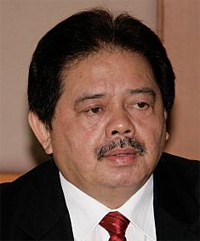 Science, Technology and Innovation Minister Ewon Ebin (
left
) told Parliament early last month that Lynas had submitted its PDF plan to the government, albeit on the last day of its deadline after receiving the temporary operating licence (TOL) 10 months ago.
Science, Technology and Innovation Minister Ewon Ebin (
left
) told Parliament early last month that Lynas had submitted its PDF plan to the government, albeit on the last day of its deadline after receiving the temporary operating licence (TOL) 10 months ago.
However, he did not disclose the location of the intended waste facility, merely saying that the ministry was still poring over the plan.
Based on the seven TOL conditions stated to Lamp, two of them are “total disclosure of the PDF” and “the plans and location of the PDF must be submitted regardless of what the waste will be eventually used for”.
‘Lynas did not breach the TOL conditions’
Nevertheless, Raja Abdul Aziz denied that Lynas had breached the TOL’s conditions for not disclosing the PDF plan, stressing that the company had informed AELB about its strategies for waste management at the Lamp.
When asked whether Lynas should make the PDF plan public, he said that has “not yet” become the condition for Lynas to apply for an operating licence during the next stage.
According to him, AELB will have a meeting on Sept 30 to discuss this matter.
He said that AELB is satisfied with the research done by Lynas to recycle the rare-earth toxic waste, but the plant is required to recycle the waste consistently for every batch of rare earth material.
“So we are still insisting that they collect more data to observe the batch-to-batch analysis to make sure that they can produce this (the same result),” he said.
Raja Abdul Aziz said that Lamp had produced 4,000 tonnes of water leach purification residue (WLP), but the waste currently still remain in the country before being exported.
“We are still looking and studying... We are a very responsible enforcement agency, therefore we have to know when it is been transported out of Malaysia, it would fulfil all the requirements of international standards and good practice,” he added.


Are you sure you want to delete this comment?
This action cannot be undone.