




Futile to suppress 'Sang Saka Malaya' history
COMMENT These days, the only people who appear unaware that there can be alternative versions of similar events are the police force.
They appear not to know that revisionist history has been around as long as history itself, simply from the possibility that if there are two witnesses to an event, there can be two dissimilar versions of the same.
For instance, although there weren't bystanders to the shooting incident in which five criminal suspects were shot dead by the police in Penang two weeks ago, there are already versions of the incident different to that of the police.
COMMENT These days, the only people who appear unaware that there can be alternative versions of similar events are the police force.
They appear not to know that revisionist history has been around as long as history itself, simply from the possibility that if there are two witnesses to an event, there can be two dissimilar versions of the same.
For instance, although there weren't bystanders to the shooting incident in which five criminal suspects were shot dead by the police in Penang two weeks ago, there are already versions of the incident different to that of the police.
 From the location of bullet wounds in a couple of the dead and from the fact that only three guns were found among the five deceased suspects, hypotheses contrary to the police version held that the dead more likely owed their fate to being bushwhacked than from having invited fatal counter-fire.
Just because deputy minister P Waythamoorthy, one of several contra theorists about the shooting incident in Penang, has been admonished into silence by the prime minister, it doesn't mean the truth-content of his hypothesis that the incident was more execution than shootout is void.
Similarly, the claim by the inspector-general of police (IGP) yesterday that national literary laureate Samad Said was in hiding from cops who wanted to question him in connection with the flying of a flag considered contraband was promptly contested by the man himself when he said that he wasn't incommunicado but was at home - presumably in the throes of poetic composition.
That the police these days don't seem to know where to find their quarry, even when they are as innocuous as poet laureates, cannot seem implausible, given the quality of their investigative labours (recently, a cop on the lam for a custodial death surrendered rather than was apprehended, and two others were freed by the appellate court for Altantuya Shaariibuu’s murder which now, six years after its occurrence, remains unsolved) and their consequent demand for preventive detention ordinances to ease their straitened lot.
Much ado about nothing
Conflicting versions of same phenomena are par for the course – to all save the authoritarian-minded.
The problem is that the latter want their version to be the version which is why hoary old laws like the Sedition Act continue to be in the statute books when their inutility, or their susceptibility to selective application, has long been manifestly demonstrated.
That the flying of the 'Sang Saka Malaya' flag which was the flag of national identity recommended by leftwing political groups who were the strongest claimants for Malayan independence from British colonial rule in the immediate post-World War II period is now occasion for police investigation of activists who flaunt the emblem is another instance of why there will always be this thing called revisionist history and why its futile to lose sleep over it.
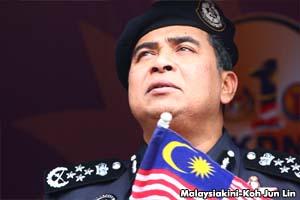 The detention for questioning of social activists Hishamuddin Rais and Adam Adli earlier this week and IGP Khalid Abu Bakar's (
left
) demand yesterday that Samad Said give himself up for similar interrogation on grounds that the trio were complicit in parading the 'Sang Saka Malaya' flag during their version of a commemoration of Merdeka Day last Saturday is much ado about nothing.
The detention for questioning of social activists Hishamuddin Rais and Adam Adli earlier this week and IGP Khalid Abu Bakar's (
left
) demand yesterday that Samad Said give himself up for similar interrogation on grounds that the trio were complicit in parading the 'Sang Saka Malaya' flag during their version of a commemoration of Merdeka Day last Saturday is much ado about nothing.
The trio has not been on record as wanting the 'Sang Saka Malaya' flag to replace the Jalur Gemilang as the flag of Malaysian national identity.
They are just flagging their point that there is another version of the history of the fight for the independence of the country to the one the powers that be have been putting out: that Umno were the pivotal players in the struggle for Malayan independence from British rule.
The latter view is being contested by groups who contend that the British virtually granted independence on a silver platter to right wing forces in Malaya, principally represented by Umno and its allies, MCA and MIC.
The Sedition Act and the Internal Security Act were repressive laws that the British formulated to cripple left wing groups in the immediate postwar period when communist insurrection complicated the left wingers' fight for independence.
Umno, and its allies in the Alliance which was the precursor to the current BN, gained ascendancy in Malayan and later Malaysian politics after the left-wing groups were laid low by the repressive actions of the British colonials who felt that their economic interests in mining and plantation agriculture would be imperiled if the left winger took power.
This version of Malayan history between the end of the World War II and 1960 is fighting to gain credence in the historiographies of the period which have tended to submerge this alternative story.
With the emergence of the opposition Pakatan Rakyat in the last 15 years of our history, this officially sanctioned elision of the part played by leftwing groups in the struggle for independence is being contested.
The use of the Sedition Act to suppress this contestation is futile because revisionist history is here to stay.
TERENCE NETTO has been a journalist for close on four decades. He likes the occupation because it puts him in contact with the eminent without being under the necessity to admire them. It is the ideal occupation for a temperament that finds power fascinating and its exercise abhorrent.


