




M'sia snubs UN on crime statistics, reports NYT
Amid concerns over rising crime in the country, Malaysia has stopped providing statistics to the United Nations, according to yesterday's New York Times.
Amid concerns over rising crime in the country, Malaysia has stopped providing statistics to the United Nations, according to yesterday's New York Times.
This, according to the report, was confirmed by Enrico Bisogno, who is in charge of gathering crime statistics at the United Nations Office on Drugs and Crime.
Even locally, the report notes, there are concerns over such statistics being manipulated.
"Critics note that after years of providing the public with data on murders, rapes, thefts and other crimes, the government has changed the way it presents crime statistics, focusing on what it calls 'index crimes' rather than giving a detailed accounting," it said.
However, the New York Times said it managed to obtain detailed crime statistics from the police.
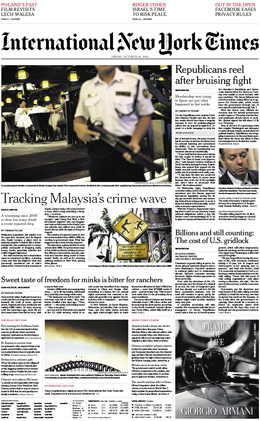 According to the figures provided, it said that homicides in the last 12 years have remained relatively unchanged at around 600 a year.
"The data also show wide swings in some categories of crime, including a reduction in robberies using firearms to 17 cases in 2012 from 722 cases nationwide in 2000.
"In another category, gang robbery, fell to 110 cases in 2012, from a high of 1,809 in 2010," it said.
‘Steep rise in rapes'
However, the report said the statistic showed that rape cases have seen a steep rise with the number reported doubling to 2,964 cases in 2012 from 2000.
The report quoted criminologist Teh Yik Koon of the Universiti Pertahanan Nasional Malaysia (UPNM) as saying that crime rates were widely accepted to be higher than reported due to lack of confidence in the police force.
"There are a lot of people not reporting crimes because they feel there's nothing the police can do," she is reported as saying said.
Ahmad Ghazali Abu Hassan, a professor at UPNM, is also reported as saying that inequality was to be blamed for the disproportionately high number of ethnic Indians involved in crime despite making up only seven percent of the population.
"I still believe that poverty is the root cause of this," he is quoted as saying, adding that such a shortcoming had to be addressed by the country without identifying race.


Report this comment
Are you sure you want to delete this comment?
This action cannot be undone.