




Misplaced corporate flavour to Selangor's pay rises
COMMENT Whether it was due to a lack of consultation or some other reason, the Selangor Pakatan Rakyat government is caught in a bind over the increased salaries for the state's elected representatives.
There is broad agreement that salaries should be raised from their present manifestly inadequate levels; the only question was by how much...
COMMENT Whether it was due to a lack of consultation or some other reason, the Selangor Pakatan Rakyat government is caught in a bind over the increased salaries for the state's elected representatives.
There is broad agreement that salaries should be raised from their present manifestly inadequate levels; the only question was by how much.
The state assembly has passed a bill allowing for increases, in some instances of up to 200 percent.
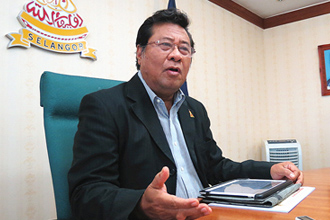 Needless to say, increases of such heft do not sit well with Pakatan's image as a people-oriented government.
It is not often that a government that is seen to be demonstrably prudent and popular comes under attack simultaneously from opponents as well as in-house detractors as the present Selangor administration is over its decision to boost salaries.
Umno vice-president Hishammuddin Hussein criticised the increase as indicative of the Selangor government's placing its self-interest above that of the people.
Criticism from Pakatan's opponents was to be expected, but when the salary increases quickly drew fire from within a coalition component, it was impossible not to sit up and notice.
PKR adviser Anwar Ibrahim felt the increases were "quite high" and that it behooved Menteri Besar Khalid Ibrahim to explain the reasons for the raises.
Even Selangor senator Dr Syed Husin Ali, not inclined to find fault with Khalid as some PKR barons are apt to, frowned on the scale of the increases.
Verbal tiff
PKR deputy president Azmin Ali, Khalid's niggling rival for the post of MB, rapped the increases as "too high" and called for them to be shelved, claiming that there was no prior consultation and that a review would be a "smart move".
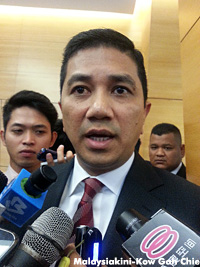 This line
drew Khalid's ire
. He said he did not know that Azmin (
right
) was opposed to the increases.
This line
drew Khalid's ire
. He said he did not know that Azmin (
right
) was opposed to the increases.
"It was a consensus agreement in the state assembly hall from everyone from BN and Pakatan," stated Khalid. Azmin is a member of the state assembly.
Significantly, no criticism of the increases has been heard thus far from the DAP and PAS sides of the state coalition. Also, no BN leader from within the state assembly has joined the chorus of critics.
A fortnight back the subject of the salary increase came up at a meeting of the PKR political bureau.
A consensus emerged that the increase should be ample but not astronomical - the RM6,000-plus pay of an assemblyperson ought to be raised to, say, RM9,000-plus. Something on the order of a 50 percent raise was thought to be adequate and defensible.
It's not clear whether the consensus arrived at the political bureau meeting was conveyed to Khalid by the two Selangor executive councilors who were said to be present at the meeting.
Khalid, who is also a member of the politburo, was not present at the meeting - the business of being the MB affords him little time for party matters and deliberations.
It does not help that he, being hyper-busy, has aides who are not quite amenable to conveying the opinions of the PKR leadership cohort to him. One of the problems Selangor PKR has with their MB is a seeming difficulty in getting their views across to him.
But Khalid is not impermeable to reasoned argument.
In the Selangor budget for 2014, the MB has allocated RM430 million from the state's huge reserves of RM2.7 billion for development projects on which the party had long urged him to expend the surplus.
A typically corporatist argument
That Khalid - befitting his training in the grooves of the mercantile world from which he made the transition to politics - renders a corporatist hue to his administration can be deduced from the explanation he gave for the salary increases.
He said he based Selangor's salary increases on the pay scale enjoyed by state assemblypersons in Sarawak which is RM15,000 a month.
A week or more before this week's Selangor state assembly sitting that passed the increases, Khalid had said the contemplated pay rise would not be more than 70 percent of the Sarawak rates. In the main, the actual increases hovered at that mark
Yesterday, he said in justification of the Selangor increases that his state contributes 25 percent to the national GDP whereas Sarawak furnishes only 10 percent and that the salaries in the latter assembly were still, even after Selangor's raises, the highest in the country.
It was a typically corporatist argument: remuneration should be commensurate with contribution.
But the logic that drives political governance is different to that which lubricates corporate administration. Politics has more to do with public perception, a volatile factor, whereas corporations are largely focused on profits and losses, a variable more pliable to rational inputs.
Salary increases for politicians cannot be based on corporatist criteria. The two careers are immiscible. There's the intrinsic satisfaction implicit in the political career that's incommensurable.
That is why salaries in the political career must not be compared to those in the corporate arena.
TERENCE NETTO has been a journalist for four decades now. He likes the profession because it keeps him in touch with the eminent without being under the necessity to admire them.


Are you sure you want to delete this comment?
This action cannot be undone.