




Teng explains 'unpopular' business license fee revision
Despite facing objections from Pakatan Rakyat counterparts, Selangor senior exco member Teng Chang Khim has explained the unpopular business license fee revision, saying that the actual hike of the fee on certain businesses is not drastic.
Despite facing objections from Pakatan Rakyat counterparts, Selangor senior exco member Teng Chang Khim has explained the unpopular business license fee revision, saying that the actual hike of the fee on certain businesses is not drastic.
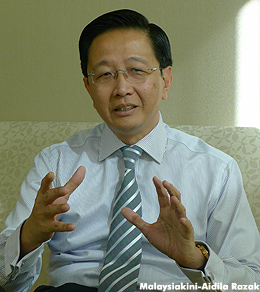 Teng (
right
), who is also the state local government, study and research committee chairperson, urged businesspersons in the state not to view the rise of the fee in terms of percentage.
Teng (
right
), who is also the state local government, study and research committee chairperson, urged businesspersons in the state not to view the rise of the fee in terms of percentage.
Citing the business license fee charged on factories as an example, he said that although the fee will be hiked from RM200 to RM1,000, it only will cost particular factories RM3 per day, or less than RM100 per month, which he said is very low.
“Compare to its rental, the ratio is small although the percentage is drastic,” said Teng at a press conference today.
Nevertheless, he stressed that some of the license fees charged on certain businesses, such as grocery shops and mini markets, are less or remain unchanged under this new policy.
The introduction of the new business license fee rate, which will be enforced starting Jan 1 next year, has sparked dissatisfaction among some Pakatan leaders.
 Former Selangor exco member Ronnie Liu claimed that the fee has been tripled and he is worried that people might question the relationship of this and the recent controversial
salary hike
of the state government and assemblypersons.
Former Selangor exco member Ronnie Liu claimed that the fee has been tripled and he is worried that people might question the relationship of this and the recent controversial
salary hike
of the state government and assemblypersons.
While Selangor state assembly deputy speaker Nik Nazmi Nik Ahmad ( left ) has urged the state government to revise this decision and also claimed that the fees in certain areas have shot up by as much as 400 percent.
The Trade, Business and Industry License By-Laws 2007, gazetted by the former BN Selangor government on July 17, 2007, calls for the revision of the business license fee rate of all 12 municipal councils of the state.
However, the By-Laws, which is supposed to be implemented on Jan 1, 2008, had been postponed twice until today due to strong protests.
'Nothing to do with salary hike'
Teng said that the state government decided to review the fee rate in order to consolidate the financial status of all the municipal councils.
According to him, the development expenditure of all the local councils from 2010 to 2014 is about 4 percent to 10 percent, whereas the operating expenditures consume 90 percent to 96 percent of the total annual budget.
“If there are no actions to consolidate the finances of the municipal councils, in years to come, some of the councils might not have allocations for development, which means they cannot undertake the construction of new basic facilities.
“We may be doing something unpopular now but it is good for the state and municipal councils and we believe the people will understand,” he said.
However, he stressed that all the additional revenue gained through the revision of the fees will strictly be used for development expenditure, and not a single cent on operating expenditure.
Teng was unable to estimate how much extra revenue the municipal councils have gained after the revision exercise, given that not all of them have the relevant data.
He cited Petaling Jaya City Council (MBPJ) and Shah Alam City Council (MBSA) as examples, saying that the revenue gained by them increased 23.18 percent (RM4.80 million) and 24.5 percent (RM1.92 million) after they started collecting on the new rates at the end of last year.
“(I want) to explain that the revenue of the municipal councils, such as assessment tax and license fee, is being kept in the municipal councils’ account and not the state government’s account.
"Thus this has nothing to do with the salary increase at the state level,” he stressed.
Appeal board to be formed
Teng added that the Selangor Economic Action Council yesterday decided to direct all the municipal councils to form a License Fee Appeal Committee to hear and assist businesspersons who are facing problems in paying the fee.
“Businesspersons who want to appeal can pay the license fee according to the old rate beforehand, while waiting for the result of the License Fee Appeal Committee.
"But the license will only be issued after the decision is made.
“However, businesspersons who have already paid the (new) license fee are also (allowed to) make appeal,” he added.


Report this comment
Are you sure you want to delete this comment?
This action cannot be undone.