




The fault is more within than without, Ku Li tells Perkasa
What has a Malay liberal got to say to a group of assertive Malay right-wingers known for flexing their muscles on issues of race and religion?
What has a Malay liberal got to say to a group of assertive Malay right-wingers known for flexing their muscles on issues of race and religion?
Specifically, what can Tengku Razaleigh Hamzah, exponent of the principle of Malays as first-among-equals in Malaysia, say to Perkasa, shrill combatants for Malay rights with race-supremacist leanings?
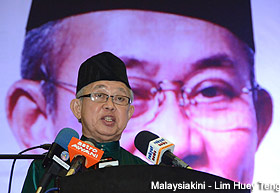 Quite some - and not of the pandering kind - judging from what the MP for Gua Musang told the 4th annual general meeting of the Malay rights group at Pusat Islam in Kuala Lumpur today.
In a speech at the opening of the Perkasa assembly, Tengku Razaleigh said the Malay presence in the corporate and economic spheres was slumping, but that their dwindling numbers did not have anything to do with the denial of Malay rights.
“It has more to do with the problem of Malays not having the mettle to withstand competition and of coping with the difficulties posed by a complex business environment,” said Razaleigh to an audience not used to hearing that the fault for a lack of economic progress by the Malays lay within than without.
He said it was vital to make the Malays more disciplined, and he urged the setting-up of schemes to equip them with the knowledge and approach to withstand and overcome competition from any quarter.
He added that with sustained help, Malays and other bumiputras cannot blame other races if they do not then succeed.
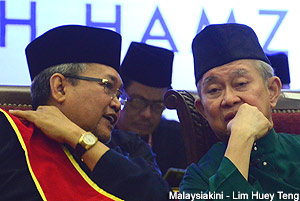 He said the environment to sustain schemes to aid the Malays was not something that could long endure because competition in the global age took little heed of geographical boundaries and the bonds of sentiment.
“There is a lot that can be done to raise and make more mature the economic status of the Malays who is still languishing in the nether regions.
“Win-win situations can be achieved by comprehensive and coordinated endeavour through heightened productivity targeted at achieving higher levels of income whether in farming, fisheries, or plantation agriculture,” said Razaleigh.
Dilating on the theme of the assembly - ‘Upholding the Constitution and Bumiputra Economic Agenda: Happiness for All’ - Razaleigh gave an historical overview of the evolution of the country’s constitution that espoused the point that the polity was Malay and that Islam was a vital touchstone, but that the rights and beliefs of the non-Malays were not to be denied.
Tour of constitutional history
He traced the evolution from a starting point in 1905 when the first consultative councils were established that included Malay nobles and representatives of other races, before noting that the pace of constitutional development quickened in the immediate aftermath of the Second World War through the Federation of Malay Agreement in 1948, the Reid Commission’s proposals of 1956, the Merdeka Constitution of 1957 and the Malaysia Agreement of 1963.
Significantly, Razaleigh said nothing about the People’s Constitutional Proposals of 1947 that was a consensus achieved by the left-wing movement that dominated the trade unions and whose strength was gauged from the success of the hartal they called that paralysed the country in October that year.
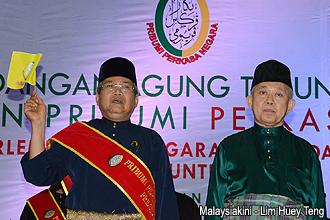 Razaleigh’s brief tour of our constitutional history enabled him to sanitise the goals of Perkasa whose argument is broadly that Malay economic success is synonymous with national tranquility.
He concurred with this amendment - that equal opportunities for the various communities to attain economic well-being were the keys to national amity.
Under the patina of a unity of overall purpose predicated on Malay economic success with its concomitant of national happiness, Razaleigh urged Perkasa to rid itself of conduct that would incur the hatred of others.
“Think that the unity and harmony we experience and cherish have been inherited from our forebears, so we cannot do as we please.
“Further, this inheritance is our common responsibility which we must refresh, revitalise and pass on to those who come after us,” urged Razaleigh, whose initial acceptance to address Perkasa had caused a stir given his and the body’s contrasting reputations.
In the end, his speech smacked more of sobering counsel than the jingoisms of race and religion that have come to be associated with the NGO and its radical leader, Ibrahim Ali.


Are you sure you want to delete this comment?
This action cannot be undone.