




Trade union names M'sian firms doing business with Burma
The Brussels-based International Confederation of Free Trade Unions (ICFTU) has published a new list of 439 companies that are doing business with the military junta in Burma, including 25 Malaysian firms.
The Brussels-based International Confederation of Free Trade Unions (ICFTU) has published a new list of 439 companies that are doing business with the military junta in Burma, including 25 Malaysian firms.
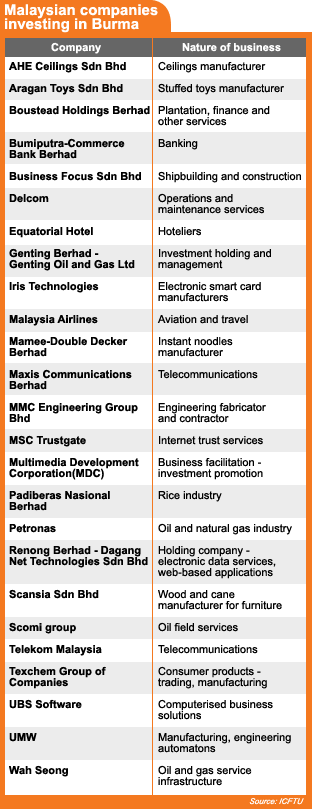 They include Iris Technologies, Maxis Communications Bhd, Petronas, Telekom Malaysia,
Scomi Group
, Bumiputra-Commerce Bank Bhd, Malaysia Airlines and Multimedia Development Corporation.
They include Iris Technologies, Maxis Communications Bhd, Petronas, Telekom Malaysia,
Scomi Group
, Bumiputra-Commerce Bank Bhd, Malaysia Airlines and Multimedia Development Corporation.
Iris, headed by UN Special Envoy to Burma Razali Ismail , is an electronic smart card manufacturer which has also produced MyKad, the official identity card for Malaysians.
Its website carries a message from Prime Minister Abdullah Ahmad Badawi who said he is "proud" of its export of the smart card, a technology which the Burmese military regime has shown a lot of interest in.
Razali has been ticked off by human rights groups for seeking to broker a peace plan between the military junta and the opposition led by democracy icon Aung San Suu Kyi while his company is doing business with Rangoon.
ICFTU's 28-page document concentrates on investment in and trade with Burma and shows how foreign business relationships with Burma - by large and small multinational companies - generate vast profits for the country's military dictators.
In a press statement, it said Burma - synonymous with corruption, repression and forced labour since military rule began in 1962 - is the only country where it recommends 'disinvestment'.
The international union also said the report - a research overview based on details compiled from over 40 different sources - demonstrates "conclusively that investing in Burma is not possible without the agreement of the junta".
"Over the last 15 years, the military dictatorship in Burma has moved itself into a position of virtual control over all aspects of the business sector," it said.
Expenditure data
However ICFTU acknowledged that figures indicate an overall investment reduction in Burma, especially non-Asean countries, over the last few years.
"More and more people, companies and countries are recognising that investing in or trading with Burma makes no sense - either in moral nor in business terms.
"Regrettably, a small number of neighbouring countries, in part because of regional power-plays, refuse to follow that trend. Business interests from China, India, Thailand and some of the other neighbouring Asean countries are stepping in where others are moving out."
Two Malaysian-based companies, Equatorial Hotel and Scansia Sdn Bhd , have replied to ICFTU regarding its investments in Burma. The latter denied any links to the Burmese junta, saying it upholds workers' rights and believes in human rights.
The report provides numerous examples of the Burmese junta's expenditure, alleging that over 40 percent of its national budget goes to military expenditure while only 0.3 percent of GDP is allocated for health services.
In this respect, it "recalls the army's responsibility for a host of human rights abuses, including the widespread and continuing use of forced labour".
Burma has to date allegedly killed or imprisoned thousands of its citizens including pro-democracy activists and politicians.
Malaysia, under former prime minister Dr Mahathir Mohamad, was instrumental in securing Burma its place in Asean in 1997. It will chair the regional bloc in 2006.


Are you sure you want to delete this comment?
This action cannot be undone.