




Set up Interfaith Commission soon, conference urges govt
A two-day national conference on the formation of an interfaith commission ended today with participants calling on the government to establish the proposed commission as soon as possible as there was an 'urgent need' for it.
A two-day national conference on the formation of an interfaith commission ended today with participants calling on the government to establish the proposed commission as soon as possible as there was an 'urgent need' for it.
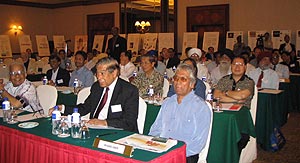 In a plenary statement to be submitted to Prime Minister Abdullah Ahmad Badawi and the relevant government bodies, the conference also endorsed a proposed draft bill on the formation of the commission and urged the government to table it in the Dewan Rakyat without delay.
The three-page plenary statement said the conference reaffirmed fundamental individual rights to freedom of thought, conscience, religion and belief towards ensuring religious harmony in the country '... and the vital role such a body (the commission) would have in assisting the government in ensuring and strengthening national unity'.
The conference also recognised the '... urgent need for a statutory interfaith body of an advisory, consultative and conciliatory nature for the protection and promotion of peace and harmony,' read the statement further.
The premier, the government and civil society were asked to support the conclusions reached by more than 200 conference participants, observers and members of the steering committee who prepared the draft bill and organised the conference.
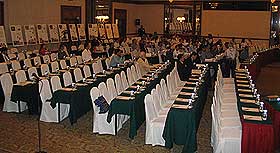
About 150 participants attended today, excluding mainly the diplomatic corp who came for yesterday's opening by Culture, Arts and Heritage Minister Dr Rais Yatim.
 However, mainstream Muslim individuals and groups have
boycotted
the conference in anticipation of anti-Islamic deliberations and with the belief that the proposal was an attempt to usurp the existing religious framework.
However, mainstream Muslim individuals and groups have
boycotted
the conference in anticipation of anti-Islamic deliberations and with the belief that the proposal was an attempt to usurp the existing religious framework.
This was firmly denied by the steering committee chairperson Malik Imtiaz Sarwar, who repeatedly urged all relevant parties to participate in the controversial conference.
The plenary statement also included the six-point agreement from a May 17, 2003 workshop on the formation of an interreligious council.
'It's their loss'
Met after the conference, Malik Imtiaz said the immediate task ahead was the implementation of the plenary statement.
"We will now fine-tune the draft bill as agreed upon at the conference, disseminate the conference objectives and engage interested parties," he said.
"The participants have also requested for the plenary statement to be handed over personally to Prime Minister Abdullah Ahmad Badawi the earlier possible with an explanation of the rationale behind the proposal."
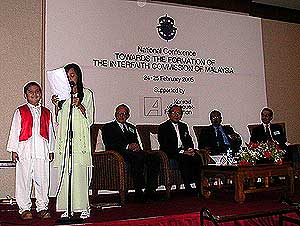 On whether the absence of key Muslim groups had undermined the outcome of the conference, Malik Imtiaz maintained that the conference was still representative of Malaysians of different faiths.
"Too bad that they boycotted (the conference) because they have lost a lot in terms of listening to divergent views as well as expressing their own," he said.
Asked whether English, as the medium of instruction in deliberations, may have had a negative impact on the understanding of the whole initiative particularly on the boycotting groups, he said it may have to some extent.
"The steering committee will see that the document (final draft bill) is translated to Bahasa Malaysia in order to build trust and confidence, and to move forward in our interfaith initiative."
The conference also agreed for a task force to be appointed by the steering committee which is led by the Bar Council human rights sub-committee.
Task force formed
The task force is mandated to follow the draft proposal's passage from the Prime Minister's Office to the Attorney-General's Chambers and until it is tabled in the Dewan Rakyat and is also take all necessary steps to forward the final conclusions to members of Parliament, ministries, and government departments and agencies for further action.
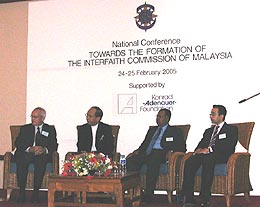 The team is also tasked with engaging the government and civil society in explaining the significance of the initiative and '... to promote the draft bill, the underlying rationale and the aim' of the national conference.
The boycotting Muslim groups and individuals have refused to entertain repeated calls to attend the conference and voiced out their objections as part of the participatory process.
Since last week, Malay-language dailies have been publishing statements by opponents to the interfaith initiative, including Muslim-based opposition party PAS and the Allied Coordinating Committee of Islamic NGOs (Accin), a loose coalition of 13 groups.
Both PAS and Accin boycotted the conference.


