




DAP: Restore local polls to curb litany of Malaccas excesses
The historical city of Malacca contains ample proof of the "deprivation and excesses of dictatorship" visible through several public infrastructure costing almost RM5.2 million, a DAP leader revealed.
The historical city of Malacca contains ample proof of the "deprivation and excesses of dictatorship" visible through several public infrastructure costing almost RM5.2 million, a DAP leader revealed.
 Party secretary-general Lim Guan Eng, in exposing the excesses of the Melaka Historical City Council at a recent
public forum
in Kuala Lumpur, said huge amounts of money was wasted on junkets and costly public facilities.
Party secretary-general Lim Guan Eng, in exposing the excesses of the Melaka Historical City Council at a recent
public forum
in Kuala Lumpur, said huge amounts of money was wasted on junkets and costly public facilities.
He said the denial of local government elections since 1965 resulted in a history of serial failures in providing basic public services.
 "The fundamental flaw in denying local democracy has also led to a disreputable and corrupt management as well as an ineffective and inefficient administration," he said at the forum on the restoration of the third vote.
On March 1, the DAP launched a national campaign to restore local government elections, embarking on a series of public awareness activities including postcard petitions to the prime minister and talks.
Failed projects
Lim went on to cite as examples a number of structures the Malacca council had paid for from public coffers in the last three years.
-
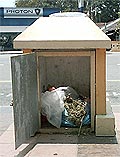
 six kiosks for RM488,000 with each costing RM81,000
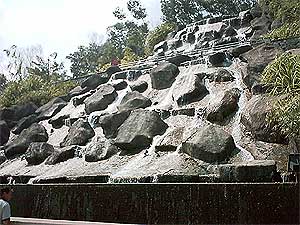
"A total of RM1.7 million was also spent on a man-made waterfall while a RM2.7 million arch greets visitors entering the state through Ayer Keroh," he said, referring to a slide presentation at the forum.
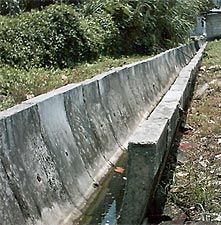 "Such poor governance has resulted in a waste of public resources by spending money on failed projects such as the one where the drain is higher than the land, as if water could (move) upwards." (
photo, left
)
"Such poor governance has resulted in a waste of public resources by spending money on failed projects such as the one where the drain is higher than the land, as if water could (move) upwards." (
photo, left
)
Criticising local councillors for abusing the perks of office by going on unnecessary overseas junkets , Lim questioned the rationale behind the Alor Gajah Municipal Council's RM100,000 trip to Australia in December 2003.
"Why go on an overseas junket when none of the councillors could even speak English? Or for example, the appointment of a bankrupt as the Jasin district council secretary in November 2003?"
Sack PKNS' top guns
Referring to the recent controversy involving Selangor Menteri Besar Dr Mohd Khir Toyo over the massive irreversible destruction of the areas surrounding the Bukit Cahaya Agriculture Park, he said concrete action must be taken.
Khir Toyo, he said, must not only sack the top management of PKNS (Selangor economic development corporation) and the Shah Alam City Hall.
 "He must also explain how he can be ignorant or innocent of the wrongdoings when he himself is the PKNS chairperson.
"Worse still, his office overlooks the whole of the Bukit Cahaya area. How could he have missed the land clearing and gradual degradation of the area given that he has a panoramic view of that part of Shah Alam."
Lim said despite being a government subsidiary, the PKNS showed its contempt and complete disregard for the law by developing land without approval from City Hall, which he said is also liable for gross negligence in discharging its duties.
He also described Mohd Khir's statement that action will only be taken against the PKNS after a probe is conducted as "most shocking".
"What more evidence and what type of probe is still required when the PKNS has already admitted that it is wrong in court?"
Not logical
In making a strong case for the restoration of local government elections, particularly following repeated mismanagement of public funds, he said there was no excuse for Malaysia to reject it.
"Even a communist country such as China and an Islamic country such as Saudi Arabia allow direct democratic elections of village heads and municipal councils.
"Neither is it logical that we can elect our prime minister and menteri besar but not our local councillors," added Lim.
"Democracy, pro-poor growth policies and equitable expansion of social and economic opportunities can improve our lives, ensure good local governance and take back the community that belongs to us."
Rrestoration of the third vote, he said, would lead to a solid foundation for democracy, good governance, rule of law, financial accountability and transparency in decision-making.


