




Groups want commission to review all civil, Islamic laws
More than 50 organisations and 220 individuals have called for the setting up of an independent commission to review and reform the country's civil and Islamic laws, especially those that infringe upon citizens' fundamental rights and liberties.
More than 50 organisations and 220 individuals have called for the setting up of an independent commission to review and reform the country's civil and Islamic laws, especially those that infringe upon citizens' fundamental rights and liberties.
As Islamic affairs in the Federal Constitution come under the respective sultans, those efforts will include approaching the nine state rulers so that Syariah enactments that run contrary to "the spirit of a democratic and pluralistic society" can also come under scrutiny.
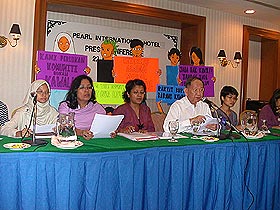
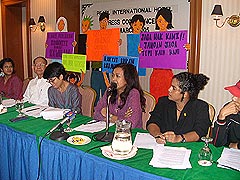
The call for this 'two-pronged strategy' emerged almost unanimously during a press conference today jointly organised by Sisters in Islam and several other non-governmental organisations (NGO) protesting the alleged increase in 'morality policing' by religious authorities.
 Outcry over the wide powers enjoyed by Islamic religious authorities in policing public morality had reached new heights last month after a January 20 raid on a
nightclub
in Kuala Lumpur by officers from the Federal Territory Religious Department (Jawi).
Outcry over the wide powers enjoyed by Islamic religious authorities in policing public morality had reached new heights last month after a January 20 raid on a
nightclub
in Kuala Lumpur by officers from the Federal Territory Religious Department (Jawi).
According to a joint press statement from the group, all laws are fair game for scrutiny by a committee composed of Muslims and non-Muslims and subject to possible repeal, especially "religious and municipal laws that deny citizens their fundamental right to privacy, freedom of speech and expression, and those that overlap with the federal Penal Code."
"(We call for) the appointment of a committee to monitor the process of repealing these laws, including representation from women's groups, human rights groups, civil society organisations, progressive religious scholars and constitutional experts," the statement said further.
'Admit our mistakes'
Human rights lawyer Haris Mohd Ibrahim cited Section 12 (Opinions Contrary to Fatwa) of the Federal Territory Syariah Offences Act to illustrate the need for a review of religious laws, including those promulgated by religious figures that stifled dissension and liberties.
"Any person who gives or disseminates any opinion concerning Islamic teachings, Islamic law or Islamic issue contrary to any fatwa for the time being in force in the Federal Territories shall be held guilty of an offence and shall be liable to a fine not exceeding RM3,000 or to imprisonment not exceeding two years or to both," said Haris.
"Now you analyse this, it means Muslims cannot think. That's frightening. Who authorised them? The answer is that we sat back as these laws were promulgated. We sat back as bit by bit our freedoms were taken away from us," he added.
 "It is incumbent now upon every Muslim, whether you're from Umno Puteri or Umno Youth or the head party to sit up, to take stock and admit our mistakes in having not stopped the slippery slide down. We must reclaim our stake in this country."
National Council for Women's Organisations human rights commissioner RF Bhupalan spoke in support of Haris' call to approach the rulers on the issue of reviewing the Syariah enactments.
"(However) I would emphasis on the need for presenting things in the right way and according to tata-tertib (protocol)," she said.
Commenting on the suggestion that non-Muslims have no say in the affairs of the Islamic religion, Bhunapalan said her family ties to Muslims bestowed on her the right as a concerned family member.
"I am a Christian. But I also have a right as a grandmother of Muslim grandchildren, (as a mother) of a Muslim son, of Muslim nephews and cousins, and Muslim sisters-in law, etc. So I'm not afraid to speak about Syariah law and fatwa," she said.
'Ridiculousness of moral policing'
Ismail Ibrahim was among the other participants at the press conference this morning who cited a history of alleged abuses by Islamic authorities.
He also expressed fears of future persecution if Islamic laws, including a fatwa (religious decree) against smoking, were enforced.
"I didn't realise that I can be caught in Selangor for smoking a cigarette and fined RM2,000. As it is, the fatwa has been passed. Once the fatwa is passed, it is filed and becomes Syariah law in the state," he said.
"Three years down the road, I could be smoking my Camel and they could come and fine me RM2,000. This is the ridiculousness of moral policing," added Ismail.
"I give you (another) example of the mufti of Perak (Harussani Zakaria) who says there is no such thing as a husband raping the wife in Islam. What religion is he representing? Definitely not Islam," said Ismail.
Harussani was among several religious figures who had earlier expressed objections to proposals by the Human Rights Commision (Suhakam) to classify a husband's rape of his wife as a crime punishable by law.
Despite the apparent agreement of the majority of panelists and participants, dissent came from unexpected quarters in the shape of Puteri Umno representative Hazreena Begum Abdul Hamid, who said the wing was not willing to support the repeal of all religious and municipal laws.
"We cannot fully endorse all the statements that have been given although we endorse b and c (pertaining to the appointment of a committee and the call for pluralism through community dialogue). We cannot agree with the repeal of all provisions," she said.
The groups pledged to meet the higher authorities, including the Selangor Sultan Sharafuddin Idris Shah and Perak regent Nazrin Shah Muhibuddin Azlan Shah, as well as parliamentarians and other politicians, to urge for the setting up of the committee.


Are you sure you want to delete this comment?
This action cannot be undone.