




Reconsider support for Japan, govt told
The Selangor Chinese Assembly Hall (SCAH) has called on the government to 'reconsider' its support for Japan to become a permanent member of the United Nations Security Council (UNSC).
The Selangor Chinese Assembly Hall (SCAH) has called on the government to 'reconsider' its support for Japan to become a permanent member of the United Nations Security Council (UNSC).
"Needless to say, our supporters are not happy with the government's decision to support Japan's bid and we will not give up (protesting)," said its chief executive officer Tang Ah Chai.
On Sunday, SCAH organised a protest , which saw 328 civil groups endorsing its position of opposing Japan's bid while another 110 in Ipoh and Seremban also publicly supporting the call
Exceptional case
"Theoretically, with another Asian country joining the UNSC is not a bad idea but Japan's case is exceptional because it has not effectively apologised for its war crimes and crimes against humanity in Asia in the past.
"Since the UNSC is an international organisation that is supposed to promote world peace and engage in conflict resolutions as well as peace-keeping, it requires a high degree of moral legitimacy and credibility from its permanent members, and Japan has not yet gained that degree of moral legitimacy and credibility," said Tang.
He added that although Germany also committed widespread war crimes and crimes against humanity during World War Two, people throughout the world now trust and respect Germany for its honest and self-critical attitude to atone for its Nazi past.
According to Tang, Japan needs to take, at least, three steps to regain the trust and respect from its Asian neighbours, namely no more official visits to the Yasukuni Shrine, withdrawal of approval for 'revisionist' history textbook and compensation to its war victims, especially 'comfort women'.
 At an international conference in Jakarta last week, Japanese premier Junichiro Koizumi expressed his nation's 'deep remorse' and regret for the atrocities committed during the war. But this failed to satisfy the critics, who were quick to denounce it as an 'insincere' apology.
'Dignity and honour'
 Meanwhile, prominent businessman Tan Kai Hee said while the government's decision to support Japan's bid is obviously and understandably economical and financial, it should also factor in 'moral' elements such as the 'dignity and honour' of Malaysians who suffered under the 44-month of Japanese invasion and occupation of Peninsular Malaysia, Singapore, Sabah and Sarawak.
According to the former secretary-general of the once powerful opposition coalition Socialist Front in the 1960s and early 1970s, the government needed Japan's support for its 'Look East Policy' including training of human resources and technology transfer.
"However, time and circumstances have changed, our government should therefore factor in the dignity and honour of our people as well as the strong feelings of other Asian countries like China, South Korea and North Korea as recently expressed.
"As a person who saw what the Japanese troops did to the Malaysians during the three years and eight months of Japanese occupation, I want our government to know the grassroots feeling is serious, widespread and strong," he said.
"We're not against the Japanese people as the majority of them are as human as us but we have to make it very clear to the rightwing elements in Japanese politics and academia that there are these things called 'human conscience' and 'social morality' in life which money cannot buy," he added.
Tan also criticised the United States for supporting Japan's 'aggressive' re-armament and its bid for the permanent membership of the UNSC.
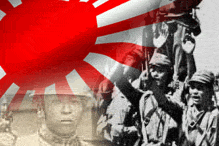 In a
memorial service
held in 2003 in Kuala Lumpur to honour the memory of 18 top communist leaders and MPAJA commanders and soldiers killed by Japanese troops in Batu Caves, it was recalled that during the Occupation, about 70,000 people of all ethnic communities were killed and another 80,000 perished due to torture and imprisonment.
In a
memorial service
held in 2003 in Kuala Lumpur to honour the memory of 18 top communist leaders and MPAJA commanders and soldiers killed by Japanese troops in Batu Caves, it was recalled that during the Occupation, about 70,000 people of all ethnic communities were killed and another 80,000 perished due to torture and imprisonment.
It was also recalled that an additional 300,000 died because of malnutrition and physical exhaustion due to force hard labour.
Singapore's Civilian War Memorial records that some 50,000 unarmed Chinese in the city were rounded up and massacred in one operation that began on Feb 18, 1942, three days after the capitulation of British troops.
Sabah and Sarawak were also invaded and occupied by Japanese troops during the Pacific War.
During the Occupation of Peninsular Malaysia and Singapore, the armed resistance was organised and operated by the underground Communist Party of Malaya (CPM) and its guerrilla forces - the10,000-strong MPAJA.


