




No more hype, we want action, say womens groups
Women's organisations are keen to see results from Prime Minister Abdullah Ahmad Badawi's call to review or amend laws and regulations to ensure gender equality.
Women's organisations are keen to see results from Prime Minister Abdullah Ahmad Badawi's call to review or amend laws and regulations to ensure gender equality.
 Women's Development Collective (WDC) executive director Maria Chin Abdullah said non-governmental organisations have been kept waiting long enough for laws and regulations to be reviewed.
"I would like to see it (the laws) in action. We (women's groups) have waited 20 years. Every prime minister says the same thing, but we have yet to see things happening," she said when contacted today.
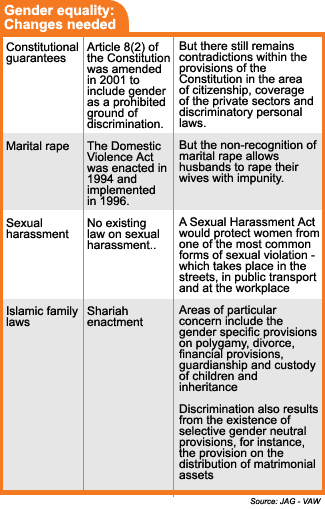 "I hope it is not just a reaction of the Non-Aligned Movement ministerial meeting (on the advancement of women). The government is extremely slow when law reform is concerned."
The premier had said the review of legislation was required for consistency with a constitutional amendment in September 2001 that prohibited discrimination on the basis of 'gender'.
Maria was also speaking on behalf of the Joint Action Group against Violence Against Women (JAG-VAW), which comprises representatives of six women's groups including WDC.
BPFA endorsed
She said JAG-VAW had presented its suggestions a year ago for reform of laws as part of national commitments under the Convention on the Elimination of All Forms of Discrimination Against Women (Cedaw) and Beijing Platform for Action (BPFA).
During the Beijing Conference in 1995, Malaysia endorsed the BPFA, which established the principle of shared power and responsibility between men and women in economic, social, cultural and political arenas. This recommends specific actions by the government and NGOs.
Malaysia also ratified Cedaw in 1995, agreeing to guarantee women's rights and to ensure that no "person, organisation or enterprise violates these rights".
However, the reality has been slow response to the introduction of new laws that protect women's rights. Women's groups have been pushing for a Sexual Harassment Act, for example, but this has not found any takers in government, Maria noted.
Last March, the Women, Family and Community Development Ministry failed to back the formulation of new legislation, proposing instead that relevant provisions be incorporated into laws like Employment Act, Industrial Relations Act and Occupational Safety and Health Act 1984.
'Expedite process'
Women's rights activist Zaitun Kasim said it was "high time" for a review of legislation, including Syariah provisions that discriminate against women.
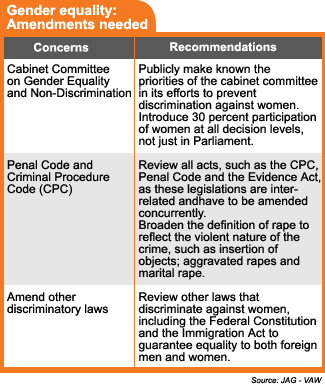 She said the Women, Family and Community Development Ministry should push the Attorney-General's Chambers to expedite the process.
Zaitun also said it is important to extend civil political liberties to women, so that they have the freedom to speak and assemble peacefully.
"The law is important in ensuring men and women have equal access. However if they (law implementors, service providers and officers) are not gender sensitive, even a good piece of law will not be useful," she added.
Asian-Pacific Resource and Research Centre for Women (Arrow) executive director Saira Shameem suggested emphasis on ensuring and enhancing gender sensitivity among law enforcement officers.
She said women are often not given equal access to economic and social support services. They are often chided and dismissed without receiving assistance, while their safety is usually compromised.
Citing the example of abused women and those who become pregnant outside marriage, she said they are often mistreated when they ask for help at police stations or hospitals. She further urged attention to women's reproductive health throughout their life cycles.
Saira added that the authorities should look into bridging the gap in equality for women, through policies as well as the legislative framework and implementation.


