


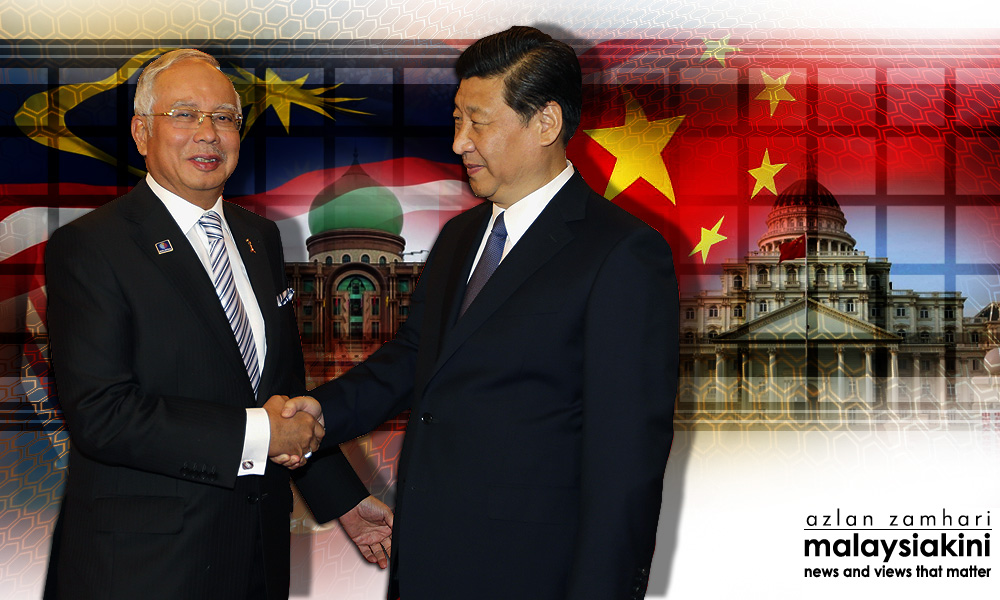

Why M’sians are apprehensive about China-Malaysia ties
COMMENT One has to look beyond what appears to be a “sweet deal” of RM143 billion worth of business “investments” which Prime Minister Najib Abdul Razak has struck over his six-day trip to China.
Credit to whom credit is due, but to give credit to Najib for his “huge success” at face value, is simply too simplistic - in fact, wishful thinking - that the deal is really in the country’s favour. Most Malaysians by now are sceptical enough to dismiss any good report from Najib’s latest trip to China.
It would have been a different story if the deals had been struck by someone whose reputation is clean. The figures of RM143 billion, like the recent budget, could have been blown up for all you know or put in a way to mislead the general population, as Transport Minister Liow Tiong Lai’s argument appears to be saying.
What DAP parliamentarian Tony Pua is hearing and what we are also hearing is that the construction of the East Coast Rail Link (ECRL) at RM55 billion “could be the most expensive rail infrastructure project in the world in its class... it’s a good project but not at this ridiculous price.” (The Edge Financial Weekly).
But Liow is saying that this figure is not the cost of construction, but merely the value of the Financing Framework Agreement (FFA). Liow, as president of MCA, should explain further what the FFA entails. He should also answer this simple question: “Why is the ECRL project parked under the Prime Minister’s Department?”
In this case Najib appears to be playing the roles of all three - prime minister, transport minister and finance minister. Can there be any check-and-balance, just like he plays all three roles as prime minister, finance minister and chairperson of the advisory board in the 1MDB scandal?
I am really curious to find out how the FFA works. Is the figure RM55 billion a loan or an investment in the first place? A loan has to be paid back in full with accumulated interest, whether or not you make money from the ECRL, but for an investment worth that amount, China would have to absorb the losses if ECRL is not profitable.
Since when has public transport in Malaysia been making huge profits to be attractive enough for any investor? If not a loan, does Malaysia currently have such a huge amount of money to pay for the construction of the ECRL? What then is the payback to the lender? This is what every Malaysian should know.
Najib’s ‘tainted’ reputation
The concerns are not about China’s “investments” in Malaysia. We welcome that, if indeed we have become such an attractive destination for such a huge investment.
However, it is Najib’s reputation which has already been tainted by the 1Malaysia Development Berhad (1MDB) scandal that makes many of us asking more questions.
We have heard from Najib’s own explanation that RM2.6 billion which went into his private accounts came from a generous donor from Saudi Arabia. This, however, turned out to be a lie, going by the facts revealed by the US Federal Bureau of Investigation through the US Department of Justice (DOJ).
The DOJ specifically used the word ‘kleptocracy’ and through their civil suit, we now know that the money had originated from 1MDB. Minister in the Prime Minister’s Department Abdul Rahman Dahlan has confirmed that Malaysian Official 1 (MO1) is none other than Najib himself.
The current trial of ex-BSI banker Yeo Jiawei down south also showed that there is consistency in the DOJ’s report. The Monetary Authority of Singapore has in fact closed down two banks involved in the scandal.
According to the Wall Street Journal, Switzerland’s Office of the Attorney-General has opened criminal proceedings against BSI bank, for failing to prevent corruption by third parties but surprisingly, Bank Negara has not taken any drastic action against a local bank which was involved in the same scandal.
Both Ambank staff member Cheah Tek Kuang and Joanna Yu have not been charged in court in the same degree that Yeo has faced the long arm of the law. Despite billions of ringgit being channeled to two companies registered in the British Virgin Islands, neither 1MDB’s Arul Kanda Kandasamy nor Najib has lodged police reports against the people involved in the transfer.
Some of the pieces of the entire jigsaw puzzle are coming together as more foreign investigators reveal their findings. In fact, one only needs to view Pua’s press conference on Jan 26 this year to nail down Najib’s downright lie told to all Malaysians, saying that he did not know some RM42 million from SRC International was in fact part of the “donation” from a “Saudi prince”.
One after another lie has been told, and finally exposed either through our own parliamentarian or foreign investigators, so how would you expect ordinary citizens like me to believe that Najib has indeed managed to attract big investments rather than liabilities for the country?
This is why I beg to differ from people who think that Najib is a cunning leader. I think his time is running out real fast, as more people are now becoming aware of the lies that are being told. There is a Malay saying, “Pandai-pandai tupai melompat, akhirnya jatuh ke tanah juga” (As great a tree climber as the squirrel is, it will eventually fall, too).
God is just. Whatever a man sows that he shall also reap. How the 1MDB scandal will all end will determine how the movie (much to our shame) will be scripted, and no one will be able to rewrite history once the blockbuster hits the silver screen.
COMMENT One has to look beyond what appears to be a “sweet deal” of RM143 billion worth of business “investments” which Prime Minister Najib Abdul Razak has struck over his six-day trip to China.
Credit to whom credit is due, but to give credit to Najib for his “huge success” at face value, is simply too simplistic - in fact, wishful thinking - that the deal is really in the country’s favour. Most Malaysians by now are sceptical enough to dismiss any good report from Najib’s latest trip to China.
It would have been a different story if the deals had been struck by someone whose reputation is clean. The figures of RM143 billion, like the recent budget, could have been blown up for all you know or put in a way to mislead the general population, as Transport Minister Liow Tiong Lai’s argument appears to be saying.
What DAP parliamentarian Tony Pua is hearing and what we are also hearing is that the construction of the East Coast Rail Link (ECRL) at RM55 billion “could be the most expensive rail infrastructure project in the world in its class... it’s a good project but not at this ridiculous price.” (The Edge Financial Weekly).
But Liow is saying that this figure is not the cost of construction, but merely the value of the Financing Framework Agreement (FFA). Liow, as president of MCA, should explain further what the FFA entails. He should also answer this simple question: “Why is the ECRL project parked under the Prime Minister’s Department?”
In this case Najib appears to be playing the roles of all three - prime minister, transport minister and finance minister. Can there be any check-and-balance, just like he plays all three roles as prime minister, finance minister and chairperson of the advisory board in the 1MDB scandal?
I am really curious to find out how the FFA works. Is the figure RM55 billion a loan or an investment in the first place? A loan has to be paid back in full with accumulated interest, whether or not you make money from the ECRL, but for an investment worth that amount, China would have to absorb the losses if ECRL is not profitable.
Since when has public transport in Malaysia been making huge profits to be attractive enough for any investor? If not a loan, does Malaysia currently have such a huge amount of money to pay for the construction of the ECRL? What then is the payback to the lender? This is what every Malaysian should know.
Najib’s ‘tainted’ reputation
The concerns are not about China’s “investments” in Malaysia. We welcome that, if indeed we have become such an attractive destination for such a huge investment.
However, it is Najib’s reputation which has already been tainted by the 1Malaysia Development Berhad (1MDB) scandal that makes many of us asking more questions.
We have heard from Najib’s own explanation that RM2.6 billion which went into his private accounts came from a generous donor from Saudi Arabia. This, however, turned out to be a lie, going by the facts revealed by the US Federal Bureau of Investigation through the US Department of Justice (DOJ).
The DOJ specifically used the word ‘kleptocracy’ and through their civil suit, we now know that the money had originated from 1MDB. Minister in the Prime Minister’s Department Abdul Rahman Dahlan has confirmed that Malaysian Official 1 (MO1) is none other than Najib himself.
The current trial of ex-BSI banker Yeo Jiawei down south also showed that there is consistency in the DOJ’s report. The Monetary Authority of Singapore has in fact closed down two banks involved in the scandal.
According to the Wall Street Journal, Switzerland’s Office of the Attorney-General has opened criminal proceedings against BSI bank, for failing to prevent corruption by third parties but surprisingly, Bank Negara has not taken any drastic action against a local bank which was involved in the same scandal.
Both Ambank staff member Cheah Tek Kuang and Joanna Yu have not been charged in court in the same degree that Yeo has faced the long arm of the law. Despite billions of ringgit being channeled to two companies registered in the British Virgin Islands, neither 1MDB’s Arul Kanda Kandasamy nor Najib has lodged police reports against the people involved in the transfer.
Some of the pieces of the entire jigsaw puzzle are coming together as more foreign investigators reveal their findings. In fact, one only needs to view Pua’s press conference on Jan 26 this year to nail down Najib’s downright lie told to all Malaysians, saying that he did not know some RM42 million from SRC International was in fact part of the “donation” from a “Saudi prince”.
One after another lie has been told, and finally exposed either through our own parliamentarian or foreign investigators, so how would you expect ordinary citizens like me to believe that Najib has indeed managed to attract big investments rather than liabilities for the country?
This is why I beg to differ from people who think that Najib is a cunning leader. I think his time is running out real fast, as more people are now becoming aware of the lies that are being told. There is a Malay saying, “Pandai-pandai tupai melompat, akhirnya jatuh ke tanah juga” (As great a tree climber as the squirrel, it will eventually fall, too).
God is just. Whatever a man sows that he shall also reap. How the 1MDB scandal will all end will determine how the movie (much to our shame) will be scripted, and no one will be able to rewrite history once the blockbuster hits the silver screen.
See how Najib responds
To be fair, we have to see how Najib responds to the questions, “Why RM55 billion to build the 600km ECRL? Is the money a form of investment or loan by China? If it is beneficial for the Malaysian people, certainly the agreement can be viewed by parliamentarians.”
I am sure people like Pua and Rafizi Ramli would have a hundred and one questions, as this is their job as lawmakers in the country. Even Gobind Singh Deo is a rising star in parliament after his father’s legacy. The latest is Ahmad Husni Hanadzlah who was finance minister II, whose speech in Parliament is worth listening to. We hope to see more outspoken parliamentarians who would be raising all the right questions in parliament.
Based on several examples cited by The Edge, there is really no reason for awarding the 600km ECRL to China Communications Construction Company (CCCC) at a bloated cost of RM91.7 million per kilometre when China Rail Construction Corp could do it for the 215km Padma rail line in Bangladesh for RM68.1 million and 120km Mobasa rail link in Kenya for RM61.4 million per kilometer.
There are a number of other agreements signed; therefore, we are looking for some more plausible explanations.
What most of us fear is that because the country is cash-strapped (something that we sensed from the recent budget), Najib is too desperate that he turns to China to help solve the 1MDB issue. In the process, he is inviting more trouble, as China is not going to pump in money into the country without putting its finger into the pudding.
Strictly speaking, business is business. There is no compassion in the way how ruthless businessmen conduct their businesses.
Even Chinese Malaysian businessmen who have invested in China to set up factories or traded with Chinese businessmen in the past know how cunning and crafty the mainland Chinese are in their business dealings.
For that reason, Najib cannot blame the Chinese community in Malaysia for his wrong initiatives. Of course, we would welcome if there are genuine investors who want to invest in long term growth of this nation, after all, who would not? For that reason, I encourage my children to learn Mandarin.
STEPHEN NG is an ordinary citizen with an avid interest in following political developments in the country since 2008.


Are you sure you want to delete this comment?
This action cannot be undone.