




Table 'police watchdog' bill now, say commissioners
The draft bill for an independent watchdog on the police force recommended by the Royal Police Commission has to be tabled in Parliament urgently to pave the way for its implementation, two of its commissioners said.
The draft bill for an independent watchdog on the police force recommended by the Royal Police Commission has to be tabled in Parliament urgently to pave the way for its implementation, two of its commissioners said.
 Tunku Abdul Aziz, president of the International Institute of Public Ethics and a commission member, said the Independent Police Complaints and Misconduct Commission (IPCMC) must be formed soon "as the beneficiary will be the police themselves because the public have lost confidence in them".
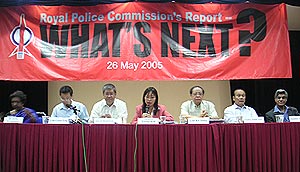 He told the 200 people present at a DAP forum entitled 'Royal Police Commission's Report: What's next?' in Kuala Lumpur last night that if the IPCMC could be set up soon and the other recommendations implemented, then the police force will be perceived by the public as more efficient and law-abiding.
The IPCMC was among the highlights of the 125 recommendations unveiled by the commission in its report to the government. The commission was tasked to look into the police force which has been viewed by many as brutal and riddled with graft.
Political will
 Another commissioner Dr Micheal Yeoh shared similar sentiments, saying the IPCMC should be put in force as soon as possible.
Together with other recommendations, the police force hopefully will be transformed from one with a force-mentality to a service mentality, he added.
Yeoh urged parliamentarians to play a more pro-active role in tabling the draft bill of IPCMC because if they were to wait for the Attorney-General's Chambers, it could possibly take several years.
"But we can't wait that long. Members of Parliament should continue to keep up the pressure," the chief executive officer of the Asian Strategy and Leadership Institute said to loud applause from the floor.
 On the 125 recommendations, Yeoh stressed that since the commission has been dissolved, it will require the government's political will and the voice of the people to ensure the recommendations are implemented.
Yeoh also noted that some of the commissioners were not fully satisfied with the outcome of the commission's report, in which he supported the idea of posting it on the Internet.
"Some of us felt that we could have done more, push for more, but we have to come to a consensus therefore there must be compromise in certain areas.
"In some areas that we have not pushed far enough, perhaps these are the shortcomings in this report," he said without elaborating.
 Former National Human Rights Society president Ramdas Tikamdas who was also one of the panelists nevertheless pointed out two glaring omissions in the report in his speech.
One was that of the many cases of people killed in police shootings as he said the report ought to have considered international standards for the use of fire-arms and provided a specific mechanism to deal with this problem.
"Another serious omission was the role and conduct of the police in responding to the Kampung Medan killings and brutal assaults," the lawyer noted.
Apart from these omissions, he described the report overall as "comprehensive, courageous and up to its task in line with the commission's mission statement".
On IPCMC, he said there is no reason to further delay its implementation as the bill is ready.
Although it has until May 2006 to implement the IPCMC, the first real test of the government's resolve for reforms in the police force is whether the report would be tabled in the next parliamentary sitting next month, Ramdas said.
Motion tabled
 Parliamentary Opposition Leader Lim Kit Siang informed the gathering that he has tabled a motion in the Lower House seeking to debate the commission's recommendations when the session commences in June.
He hoped that his motion will not face a similar fate as his previous motions on the Human Rights Commission of Malaysia's (Suhakam) annual reports which were turned down by the House.
 Labour rights group Tenaganita director Irene Fernandez who also spoke at the forum said she looked forward to see a more gender-sensitive police force.
She recalled that in the mid-80s, police officers were trained to exercise sensitivities when dealing with rape survivors and domestic violence victims but this training is no longer in place.
Federal police chief Mohd Bakri Omar and Deputy Internal Security Minister Noh Omar who were invited to the forum did not turn up. The forum was moderated by the DAP publicity chief Teresa Kok while its secretary-general Lim Guan Eng delivered a keynote address earlier.
The Royal Police Commission's report, compiled by a 16-member team headed by former chief justice Mohamad Dzaiddin Abdullah, was submitted to the King and the Prime Minister Abdullah Ahmad Badawi on April 29.


Are you sure you want to delete this comment?
This action cannot be undone.