




State conspiracy alleged against Ayah Pin
A follower of Ayah Pin is seeking to quash the Besut district land administrator's order to destroy a cluster of unique giant structures on land that she owns in Tenang, near Jerteh.
A follower of Ayah Pin is seeking to quash the Besut district land administrator's order to destroy a cluster of unique giant structures on land that she owns in Tenang, near Jerteh.
 Che Minah Remeli, 60, said she believed there is a state conspiracy against Ayah Pin, 65, who 'preaches' religious universality at the commune located at the site. She is also the first wife of Ayah Pin (
photo
), whose real name is Ariffin Mohammad.
Che Minah Remeli, 60, said she believed there is a state conspiracy against Ayah Pin, 65, who 'preaches' religious universality at the commune located at the site. She is also the first wife of Ayah Pin (
photo
), whose real name is Ariffin Mohammad.
 The construction of the structures is said to have violated land-use regulations, according to the order issued at the end of April. It set a 30-day deadline for their demolition, which Che Minah had ignored.
The commune in Kampung Batu 13 is widely known for the concrete-and-tile structures shaped like a teapot, pitcher and umbrella-like tower, among others.
In her affidavit supporting an application for leave for the judicial review - filed at the Kuala Terengganu High Court on Sunday - Che Minah claimed the order was made in bad faith and that there was abuse of power.
She alleged that the Besut district land administrator - the first respondent - as well as the state religious department and Besut District Council had acted in bad faith or conspired to stop the activities of her husband and the villagers by using all means possible.
 "The authorities seem concerned that my husband's activity will affect the faith of Muslims," she stated, but also pointed out that state and federal authorities had known about Ayah Pin's activities for years.
The Terengganu Land and Minerals Department director and the state government were named as second and third respondents.
All the respondents could not be reached for comment today.
Applications rejected
Che Minah claimed that the Besut District Council had ordered her in 2001 to destroy a Kaabah-shaped building.
In her affidavit, she denied the existence of any such structure on her land and insisted that none of these resembled known holy or religious symbols or buildings.
 She said the Besut district land administrator had, in 1999, ordered her to apply for land conversion from agriculture to building within 14 days or face action under the National Land Code 1965 (NLC).
However, her first application for land conversion in 2001 was rejected although it had been approved in principle by the state government at a meeting in 2000.
Her second application for land conversion was rejected in April last year, therefore exposing "their true intentions" which amount to abuse of power, she said.
To illustrate her allegations of conspiracy, Che Minah argued that no action has ever been taken against owners of neighbouring or surrounding lots which she claimed were also in violation of the NLC.
As example, she cited several agriculture land lots where businesses were being operated including a food stall, an auto and metal workshop, a car and bus workshop and a petrol station.
She claimed that government policy protects Malay owners and occupants of agriculture land from any action under the NLC.
'Work of art'
In her affidavit, she also said that she has allowed the land - which she has owned since 1990 - to be used to shelter about 100 to150 poor, low-income people with little education mainly from around the state.
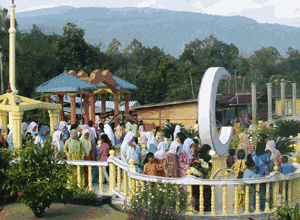 Describing the "decorative buildings" as art, she said they were meant to be used as a recreational area for the villagers and their children, as well as an attraction for local and foreign tourists.
Che Minah said that she and Ayah Pin had collected the funds for the structures over a period of time - the construction was carried out in stages since 1998.
Referring to the demolition order, she said nothing was mentioned about the number of houses on the land although this had formed the basis of previous notices.
Che Minah explained that her husband has long been involved in the rehabilitation of troubled minds and drug addicts regardless of race or religion.
"My husband regularly initiates inter-faith activities at the site in the hope that people of different races and religions will unite and live in peace," she stated, adding he had the support of the villagers.
She said Ayah Pin had previously been charged with insulting Islam and jailed for 11 months. He was then told to set aside a house for religious classes but that he had refused.
This, she added, was one reason why he has since been accused by religious authorities of spreading 'deviant' teachings.


