


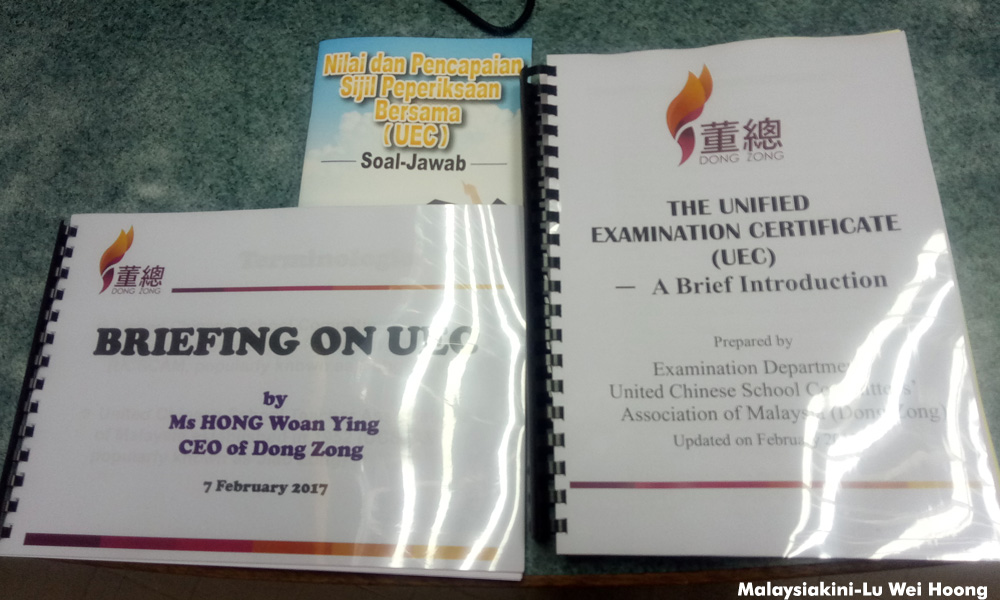

Perkasa wants gov't to say 'final no' to UEC recognition
Malay rights pressure group Perkasa has urged the government to reject recognition of the Unified Examination Certificate (UEC), in light of assurances by top leaders that the matter is being weighed.
Perkasa education bureau chief Abdul Raof Hussin echoed arguments that doing so went against the idea of “national unity”, and cited a number of reasons to back his claim, including what he claimed were divisive elements in the Chinese schools' curriculum.
“We view the matter of UEC recognition was serious.
"We are extremely concerned and feel it is extremely unfortunate there are leaders who make comments supporting the UEC without evaluating all aspects o.f effects on the country's education system [...].
“We urge that the government must give their final reply that the UEC certificate cannot and will not be recognised for all for all eternity,” said Abdul Raof in a statement today, stating five reasons.
Last Saturday, MCA lauded Deputy Prime Minister Ahmad Zahid Hamidi's announcement that the Education Ministry will be instructed to conduct an in-depth study and evaluation into the recognition of the UEC at the national level.
This follows increasing criticisms from various quarters that the Chinese school certificate is recognised abroad, but not in Malaysia.
Among the reasons Abdul Raof cited was the language of instruction being in Chinese went against the federal constitution provision of the national language being Bahasa Malaysia, and therefore disqualified the UEC from recognition.
He added the UEC contravened the national education policy and the Education Acts 1961 and 1996.
'Too China-centric'
Abdul Raof heavily criticised the UEC history curriculum for being China-centric and lacking attention to Malaysia's history.
“The percentage of content on Malaysia is too little,” he said, adding the focus of history was more inclined towards Chinese history and Chinese identity, and in one instance even “touches on the ideology of san-min”, referring to the a political philosophy developed by Sun Yat-sen.
“As a result of too much focus on aspects of China, the philosophy and ideology of Malaysia's nationalism is ignored, especially in the understanding of the Rukun Negara,” he said.
Abdul Raof further complained of inaccuracies in facts about Islam that were “wrong and insulting to Muslims”, citing an example which the texts purportedly said Muslims prayed six times a day, because it took Friday prayers into consideration.
Finally, the Perkasa leader took issue with the history texts related to the May 13, 1969 riots which put the death toll at 163 Chinese, 25 Malays and 13 Indians while adding that the figures could be higher.
Gerakan's Yong refutes Perkasa
In an immediate reaction, Gerakan deputy youth chief Andy Yong refuted Perkasa, saying that vernacular schools are not a hindrance to national unity, arguing that a person who understands or studied in such schools will agree with him.
“This simply shows Abdul Raof has lack of understanding about our history, the Federal Constitution and related laws. Or he is merely a narrow-minded or a man of myopic vision?
“Vernacular schools are actually guaranteed by the supreme law. Malaysian history is taught in such schools.
“I am quite certain if there is a demand, religious studies such as Islamic subject can be taught in vernacular schools,” argued Yong.
The Gerakan leader also said that universities in Singapore and Taiwan recognised the UEC because they know the quality of students that excel in the exam.
“It is indeed about the quality and producing a more capable and knowledgeable young generation. On a pro rata basis, more UEC graduates are successful than those from national schools in their careers,” said Yong.


Report this comment
Are you sure you want to delete this comment?
This action cannot be undone.