




MMC: Decision not racially motivated
The Crimea State Medical University (CSMU) in Ukraine can appeal once it has complied with the conditions set by the Malaysian Medical Council (MMC) for recognition of its degree.
The Crimea State Medical University (CSMU) in Ukraine can appeal once it has complied with the conditions set by the Malaysian Medical Council (MMC) for recognition of its degree.
MMC secretary Dr Wan Mazlan Mohamed Woojdy said the university could appeal against the de-recognition (effective January 2006) and re-apply once it has satisfied the criteria.
"If they can comply with our conditions, there is nothing to stop them from re-applying. They can appeal as soon as they're ready and we're more than willing to re-consider," he said when contacted.
"It's not as if we've totally cut off links with CSMU," he added, reiterating earlier assurances by MMC president Dr Ismail Merican that those who register with the university before Dec 31 will not be affected.
An estimated 1,000 Malaysian students are currently pursuing medicine in CSMU.
Not racially motivated
Reiterating Ismail's statement last week, Wan Mazlan said no racial factors featured in the decision to de-recognise the CSMU degree.
Asked to comment on allegations by MIC president S Samy Vellu that the ruling was biased against Indian Malaysian students, he said it was a "non-issue".
"Malays and Chinese are also affected by this. Ultimately, quality must prevail."
However, he could not furnish figures on the total number of students in CSMU based on ethnic breakdown.
"Our embassy in Ukraine does not have the total figures as not all students who are studying in Ukraine are required to report to them. Only government scholars, as far as I know, must report to our embassies," he said.
He said some 400 more Malaysians were studying in non-recognised universities in Ukraine, which has a total of 19 universities offering medical undergraduate programmes.
There were also unconfirmed reports about Malaysian agents providing misleading or inaccurate information on students' qualification which had led CSMU to allegedly lower its entry requirements.
The CSMU administration could not be reached for confirmation.
Blow-up in Parliament
Over the weekend, Samy blasted the MMC for allegedly attempting to stop Indian Malaysian students from becoming doctors.
He said the only option left to those intent on pursuing medicine was to study abroad, given the limiting quota system for intakes into public universities.
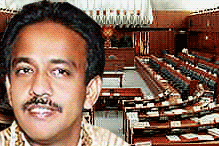 This blew-up in Parliament on Tuesday when MIC secretary-general S Sothinathan, backed by opposition MPs, grilled Deputy Health Minister Dr Abdul Latiff Ahmad over the government's endorsement of students' application in CSMU.
In a drastic move yesterday, Prime Minister Abdullah Ahmad Badawi, who is Barisan Nasional chief, suspended Sothinathan as deputy natural resources and environment minister for three months with immediate effect.
Meanwhile, Wan Mazlan said MMC has a nine-point criteria for recognition that is divided into three main areas - curriculum, staffing and facilities.
"The curriculum at CSMU had not changed, so that is okay. The other two areas are the problematic ones. We were told that the university maintained a staff-student ratio of one to six or seven.
"This is high and violates the recognition criteria, so we had to act or risk poor-quality teaching," he added.
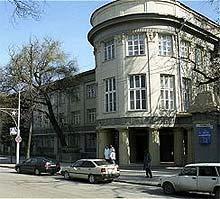 Following the second of two visits by a government technical panel in 2001 and 2003, he said the CSMU's facilities were being stretched to cater to an increasing student population, "leading to overcrowded laboratories and wards".
"We don't want this. Bed-side training is crucial in medicine and this will be hampered if there were too many students in each group," he added.
The Malaysian Medical Association, the Public Services Commission, and the Health and Higher Education Ministries make up the visiting panel for overseas evaluation. The National Accreditation Board will study the report before recommending a degree for recognition.
Aware of concerns
Wan Mazlan said CSMU started taking in more students following a surge in application for seats soon after recognition was granted in 2001, which has since doubled the staff-student ratio.
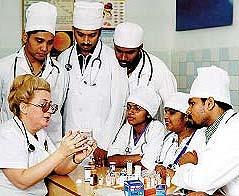 "The average in Malaysian public universities (for medicine) is 1:4 or five but we have information that CSMU now has 1:6 or seven, which we discovered later was a rampant practice," he added.
He said even Universiti Kebangsaan Malaysia's medical faculty had a low staff-student ratio.
"It took us about two years to complete the (revaluation) report before reaching a final decision. We ran the complaints through proper verification procedures including extensive interviews with various parties involved with CSMU," he added.
This included interviews with ex-CSMU graduates about their study experience and those supervising their housemanship.
Wan Mazlan said the MMC was aware of concerns over fees already paid to secure seats in CSMU and worries that this issue may tarnish the image and result in discrimination against those graduates.


