




Corruption index 2004: Malaysia slides further
Malaysia's 39th placing on a list of 146 countries indexed for perceived corruption should rankle the present administration, particularly the prime minister, who has repeatedly vowed to combat graft.
Malaysia's 39th placing on a list of 146 countries indexed for perceived corruption should rankle the present administration, particularly the prime minister, who has repeatedly vowed to combat graft.
While efforts to increase awareness of anti-corruption measures are underway, public expectation for actual action is not being met.
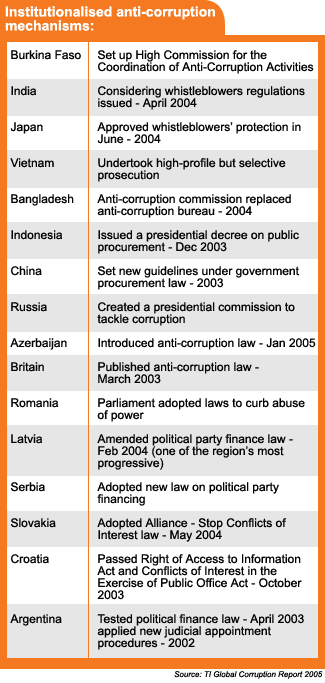 In contrast, a host of other countries have made far greater strides in waging war against corruption by institutionalising anti-corruption mechanisms. (See table)
Transparency International's (TI) 2004 Corruption Perception Index was topped by Finland which scored 9.7 out of the full 10 points, followed by New Zealand (9.6), Denmark (9.5) and Iceland (9.5). Neighbouring Singapore scored 9.3 to occupy the fifth spot.
Malaysia, whose ranking has been on a decline over the last few years, was placed 37th among 133 countries in 2003 and 34 among 102 countries the previous year, recording an average score of 5.
Last March, TI released a 316-page Global Corruption Report 2005 with special focus on corruption in the construction industry.
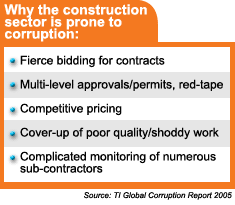
"Nowhere is corruption more ingrained than in the construction sector," read the TI report.
It proposed for both public and private sectors to sign an integrity pact or a 'no-bribes' agreement designed to commit contracting parties to refrain from bribery, which TI claims to be in use in over 20 countries.
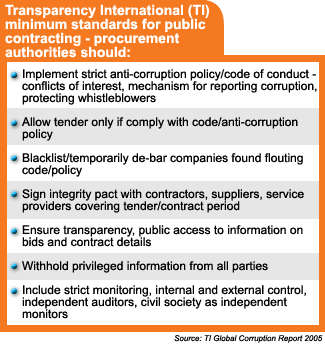
A blueprint for transparent public contracting called Minimum Standards for Public Contracting was also released together with the report.
Open, competitive bidding
Among others, it requires open, competitive bidding, blacklisting of companies caught bribing, full disclosure of the entire tender details and contract process and strict monitoring by independent agencies and civil society bodies.
Although a number of emerging economies in Africa, Eastern and Central Europe, and Southeast Asia were cited as prone to corruption, the report had examples of ongoing efforts to counter them. (See table).
 Malaysia's strategy is found in the National Integrity Plan spearheaded by the Malaysian Institute of Integrity which was formed in 2004 to attain set targets by 2008.
Dr Sulaiman Mahbob in his paper at a recent integrity forum on the construction sector said there was a need to develop an implementation and coordination mechanism.
He said the public sector has management integrity committees at all levels but needs to strengthen the mechanism with the leadership's commitment.
A similar role can be played by chambers of commerce and associations in the private sector.
"Regulatory bodies such as the Companies Commission of Malaysia, the Securities Commission and the central bank must ensure compliance of laws and procedures," he said.
Sulaiman emphasised on the need for public and private leadership to set the tone for anti-corruption measures by formulating concrete policies and implementing them strictly.
Last week, Malay Contractors Association president Roslan Awang Chik confirmed at the same forum the long-standing suspicion that Malaysia's construction industry was corrupt and plagued by red-tape.
Concrete reforms
Josie M Fernandez of TI Malaysia, meanwhile, gave a socio-economic perspective and cited tragedies in recent years such as the Penang jetty tragedy (1988), the Highland Towers (1993), the North Klang Valley Expressway-Meru Link (2005) and the Sultan Ismail Hospital (2004) to illustrate claims of corruption in the construction sector.
In addition to political will, concrete reforms and good governance, she proposed a code of conduct for clients, construction and engineering companies.
"Implement TI's integrity pact for contracts," she added.
 Prof Khairuddin Abdul Rashid in his paper cited tender, payment, variation and claims as the most problematic areas in a pilot study involving 32 Malaysian construction students in August.
"About 94 percent answered yes to a question on whether ethical problems existed in the industry."
He also found that the construction sector lacked integrity due to delays, cost overruns, poor quality and abandoned projects.
Khairuddin proposed that Malaysia consider the World Bank's country procurement assessment reports containing 183 attributes to identify gaps for improvement.
Forum participant Koon Yew Yin further affirmed the public's perception of prevailing corruption at all levels in the local construction sector.


Report this comment
Are you sure you want to delete this comment?
This action cannot be undone.