




Temples: DBKL pledges to listen first
Kuala Lumpur City Hall (DBKL) has undertaken to hear the views of a newly established five-member committee comprising of representatives from Hindu bodies before it proceeds with any future Hindu temple demolition in the city.
Kuala Lumpur City Hall (DBKL) has undertaken to hear the views of a newly established five-member committee comprising of representatives from Hindu bodies before it proceeds with any future Hindu temple demolition in the city.
 Led by Malaysian Hindu Sangam president A Vaithilingam, the committee would investigate on a case-by-case basis Hindu temples ordered to be relocated or demolished by DBKL.
The new committee would liaise with the affected Hindu temples, developers and land owners before forwarding their recommendations to DBKL.
"Before, DBKL would just give such temples notice before demolishing them. But now they have come to an understanding that they would consult us first to solve the problem as amicably as possible," said Vaithilingam when contacted today.
The new committee is also tasked with working out details of the affected temples' relocation and compensation amount, he added.
The decision to establish the committee was finalised this morning during a meeting between MIC president and Works Minister S Samy Vellu and Kuala Lumpur Mayor Ruslin Hassan.
Asked if this model could be implemented in other local governments nationwide, Vaithilingam said the issue was not as critical in other states yet as compared to Kuala Lumpur.
 He said the demolishing and relocating of temples there were state government decisions which could be appealed. Furthermore, he said, MIC state executive members have been tasked with handling the matter and liaising with the affected temples in the various states.
"Kuala Lumpur is a unique case because of the ongoing structural plan and clearing of squatter areas," said Vaithilingam.
Other members of the new committee are Universiti Malaya's retired head of Indian studies Dr K Thilavavathi, Malaysian Hindu Youth Council secretary-general Raja Selvam, Malaysian Indian Youth Council vice-president Kantha Rao and Rudra Devi Samaj deputy president G Gunaraj.
Illegal extensions
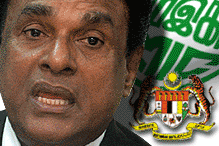
Announcing the new committee at a press conference after his meeting with Ruslin, Samy said the mayor had also proposed the establishment of a special unit within DBKL to handle matters concerning temple relocations and demolitions.
 Bernama
quoted Samy as saying that a proposal was made during the meet for alternative sites and ample time be given before any demolition took place.
Bernama
quoted Samy as saying that a proposal was made during the meet for alternative sites and ample time be given before any demolition took place.
Samy also said that most of the problems relating to temples facing demolition were the result of illegal extensions made without the approval of DBKL.
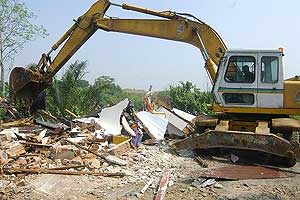
At least three Hindu temples have been demolished by DBKL since February and the issue become a cause of discontent among the Hindu community.
At a parliamentary roundtable conference on June 4, more than 160 representatives of temple committees and groups from Perak, Selangor and Negeri Sembilan had complained that local authority enforcement officers, assisted by police personnel, had employed high-handed tactics to demolish long-standing temple structures in the wee hours of the morning.
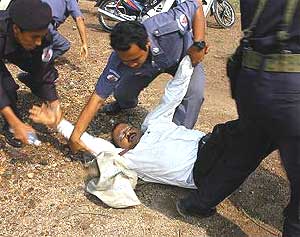 There were allegations that enforcement teams of 10 to 300 personnel had destroyed or set fire to temples in Shah Alam, Klang, Seremban, Damansara, Sungai Petani, Petaling Jaya and Jasin. Some of these had been built a century ago.
On May 11, a group of Malaysian Hindus led by the Hindus Rights Action Force (Hindraf) had petitioned the government through a memorandum to Nazri to stop the demolition of temples.
The first protest over temple demolitions was held on May 25 by about a group of 100 who gathered at the Kuala Lumpur City Hall building but were ignored by officials.


