




Bloody Sunday: Suhakam to hold inquiry
The Human Rights Commission of Malaysia (Suhakam) will hold a public inquiry to investigate allegations of police violence in dispersing a group of demonstrators during an incident on May 28 that has been dubbed 'Bloody Sunday'.
The Human Rights Commission of Malaysia (Suhakam) will hold a public inquiry to investigate allegations of police violence in dispersing a group of demonstrators during an incident on May 28 that has been dubbed 'Bloody Sunday'.
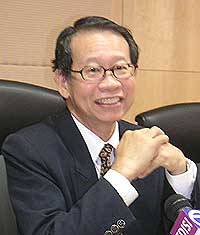
"At the last monthly meeting on July 10, we decided that we would investigate the alleged police violence during the demonstration," commissioner Choo Siew Kioh told a press conference at the Suhakam headquarters in Kuala Lumpur this morning.
The inquiry will be the fifth held by the government-appointed human rights watchdog since its formation in 1999 - unless police activate the process of prosecution in the meantime.
 "Mind you, if the police start taking action, the inquiry panel may not need to be commenced at all," Choo said.
Under its enabling legislation, Suhakam is barred from inquiring into any complaint of alleged human rights infringement should this become a matter pending in court.
Choo said the four-member panel - comprising himself, KC Vohrah, Michael Yeoh and Zaitoon Othman - have yet to meet, set a date for the inquiry or decide the terms of reference. A meeting will be held "soon" to elect the panel head from among themselves.
He said the terms of reference will be similar to those of the ground-breaking Kesas Highway public inquiry in 2000. That inquiry, which kicked off on Nov 29, 2000 and lasted 20 days, involved 46 witnesses including both demonstrators and police officers.
Suhakam's report subsequently lambasted the police for brutally cracking down on some 100,000 reformasi protestors who were travelling on the highway to a rally venue near Klang.
'Failure to act'
In relation to 'Bloody Sunday', the commission had earlier said it would wait for the conclusion of an internal police investigation into the matter before deciding whether or not to hold an inquiry.
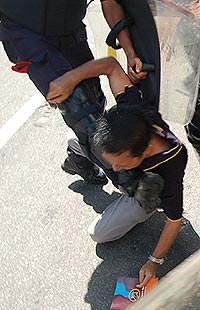 During a demonstration against price hikes for fuel and electricity, police armed with baton and shields were alleged to have bludgeoned and kicked a number of protestors when dispersing the 500-strong group in Kuala Lumpur.
Among the 20 protestors who were arrested, two were seriously injured - one requiring five stitches on his head, while another sustained a broken arm.
Noting today that the police have failed to act, Choo also expressed disappointment that they had not responded to the commission's repeated written enquiries.
"If the police had responded, maybe this exercise would not be necessary. But then the police had also justified its action by saying they had not used excessive force, they were performing their duty and that the gathering was an illegal assembly," he added.
Choo urged eyewitnesses such as journalists to testify at the inquiry, which will be opened to the public. Suhakam is also expected to call several witnesses named previously by complainants and police officers.
Contacted by malaysiakini for an immediate response, activist S Arutchelvan welcomed Suhakam's decision, but hoped that the inquiry would be carried out without any hitches.
 "Suhakam has written to us a few times to ask for the names of witnesses. We told them we would not furnish them with anything until they call for an inquiry," said Arutchelvan, who is a secretariat member of human rights watchdog Suaram.
"However, Suhakam should not be holding an inquiry only because they are frustrated with the lack of response from the police. Suhakam, as an independent body, should have the willpower and confidence to investigate (the incident)," he said.
Previous public inquiries held by Suhakam include the one on the Kesas Highway incident (2001); conditions faced by Internal Security Act detainees (2002); alleged mistreatment of native villagers in Kundasang, Sabah, by the police (2004); and death of S Hendry while in police custody (2006).


Report this comment
Are you sure you want to delete this comment?
This action cannot be undone.