




Suhakam: Illegal immigrants have rights too
The Human Rights Commission of Malaysia (Suhakam) vice-chairperson Simon Sipaun has reminded the people in Sabah that the hundreds of thousands of illegal immigrants in the state also have human rights and it should be respected.
The Human Rights Commission of Malaysia (Suhakam) vice-chairperson Simon Sipaun has reminded the people in Sabah that the hundreds of thousands of illegal immigrants in the state also have human rights and it should be respected.
"Human rights are universal and have no borders," he said, adding that illegal immigrants are not lesser human beings.
 Sipaun, a highly-respected Kadazandun intellectual and former state secretary, said this in his opening remarks at a Suhakam roundtable discussion on 'Human Rights and Citizenship - Its Impact on Economic, Social and Cultural Rights' in Kota Kinabalu yesterday.
However, the Suhakam vice-chairperson also noted that since illegal immigrants are essentially law-breakers the process of law should take its course.
There has been conflicting accounts from official and unofficial sources on the exact number of illegal immigrants in the state. Most, however, agree that the number is around 750,000. The illegal immigrants are predominantly from the Philippines and Indonesia.
The total number of foreigners from various countries, including illegal immigrants, is estimated at 1.75 million, pushing the state's total population to 3.3 million. Most of the working foreigners are employed in the construction and agricultural sectors.
Locals are saying the presence of such large number of foreigners in Sabah is taking a toll on the local population as they now face an increase in crime and so forth.
The foreigners are also said to be competing with the locals for healthcare and educational services in the state and indirectly subsiding such costs for foreigners.
Effective action
Meanwhile, Sipaun told more than 50 participants at the roundtable discussion that the exercise of human rights must be in line with the country's laws.
"Effective action must be taken by the relevant authorities to achieve the desired results," he stressed.
He said despite of the amnesty offer which was repeated in the recent past, illegal immigrants have not responded enthusiastically.
"I have no idea as to what extent the objectives of the amnesty have been achieved. Was there any review or post-mortem conducted following the exercise?" he asked.
The Suhakam vice chairperson said it could not be denied that illegal immigrant workers have contributed to the economic development of Sabah, especially in the construction and plantation sectors.
"Sabah without them would come to a stand-still," he pointed out.
Nevertheless, the problem of the large numbers of illegal immigrants in the state has to be dealt with more firmly.
What is their status?
Sipaun said the government's proposal to set up separate courts to try illegals might help to ease the backlogs of cases provided there are enough magistrates and supporting staff.
He said a separate exercise should also be undertaken to investigate the alleged falsification of documents and the issuance of Mykad and citizenship status to illegal immigrants.
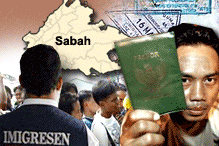
He also queried why although the authorities had stopped issuing IMM13 permits to 'refugees' or displaced persons there were reports claiming that such permits were still being issued up to 2002.
"I understand there were originally between 50,000 and 60,000 'refugees' in the 1970s. And they are still here unlike the Vietnamese refugees who were confined to Pulau Bidong (in Peninsular Malaysia) and either sent back or sent to a third country two years," he said.
"After 36 years, the ones in Sabah are still here. What is the status of their children and grandchildren? What is their future going to be?" he asked.
The Suhakam vice-chairperson said there are now a lot of questions being asked as to whether it is true IMM13 documents are still being issued when it should have stopped a long time ago.
"Is it the fault of the system or the people operating the system or both?" he asked.
Spiaun also said that some illegal immigrants have approached Suhakam Sabah to complain that their children were forced to stop schooling or denied admission.
He said the presence of 'refugees', illegal immigrants, stateless and undocumented persons has great economic, social, cultural and political implications for Sabah.
Possibly this is one of Sabah's biggest problems and probably be next to impossible to resolve, he added.


Report this comment
Are you sure you want to delete this comment?
This action cannot be undone.