




Ikim: Islam is not the handmaiden of politics
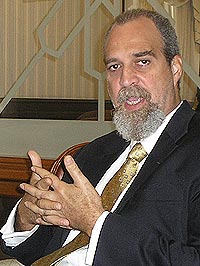
Islam is never a pawn but in Malaysia, it's part of a tale of two Malay-based political rivals pitching their own versions for power, said Institute of Islamic Understanding Malaysia (IKIM) director-general Dr Syed Ali Tawfik Al-Attas.
Islam is never a pawn but in Malaysia, it's part of a tale of two Malay-based political rivals pitching their own versions for power, said Institute of Islamic Understanding Malaysia (IKIM) director-general Dr Syed Ali Tawfik Al-Attas.
The religion, he said, became a pawn in relation to the contentious status of Malaysia as an Islamic state.
"But that's not right at all. Islam is not the handmaiden of politics," he said during a three-hour exclusive interview with malaysiakini.
 He said Islam is one comprehensive system, unlike the western-style worldview where the church and state were separate entities.
"But an Islamic state is not defined purely by the hudud, which again has a historical element to it. There are civil laws in this country that already conform to the Islamic law."
Under civil law, he said, crimes are punished although it may differ from what is prescribed by syariah law.
"We don't have any problem with the syariah law and civil law existing like this but this is precisely the reason Islam is put as the official religion, because it is the most complete and perfect one.
"But that does not mean that other religions are not afforded their rights. Obviously they have their rights which are already contained within Islam."
In an interesting twist, Syed Ali said the Article 11 coalition and some in the Bar Council were themselves turning Islam into a political pawn.
"Islam in the constitution is not politically-connected. It's a matter of the worldview again. Just because Islam is enshrined in the constitution, it's not saying that we are using Islam in our political arena," he explained.
Islamic state or not?
"Rather, the politics is learning from Islam. It is Islam that gave birth to the politics. That's how they should use it, not the other way around. Not they are using Islam as our tool for us to politicise."
He also questioned the necessity for Malaysia to be either an Islamic state or otherwise.
"Is it necessary to be known as an Islamic state or a non-Islamic state? What's the big problem? Why only now this matter is being raised? There was no one asking (about this) at the beginning?"
Noting the heavy reliance of Muslims on religious teachers, Syed Ali said it was the parents' duty to teach their children religion, the Quran.
"I have often said in my musings, the Malays have almost become like the Catholics who have the father-confessor who is the conduit between the profane and the sacred," he said, adding that it was not a reliance on institutions but on individuals.
"Everything we 'rujuk kepada dia orang' (refer to them) and they tell us fait accompli this is fatwa, this is haram, this is halal, and we all accept without even thinking. That is unfortunately what I see happening nowadays."
 Referring to Perak Mufti Harussani Zakaria (
right
), he said it was not the office of the mufti that is found wanting.
Referring to Perak Mufti Harussani Zakaria (
right
), he said it was not the office of the mufti that is found wanting.
"We have great respect for the office of the mufti but that does not mean that just because he is making (certain) statements that the mufti's office is completely shattered. No. We still have confidence in the mufti's office. It may be what he says that we don't have confidence in.
Ulama's duty
Harussani is widely known for making controversial statements, the latest of which was declaring the existence of 100,000 cases of apostasy in the country.
"For instance, how do you come up with 100,000 cases of murtad (apostasy)? Where is the proof? Has the national registry already shown you that 100,000 people have applied in their IC (identity card) to change from Islam to something else? Do you have that document?"
Harussani grabbed headlines more recently when he declared that kongsi raya was haram.
Syed Ali said the mufti's intentions were still unclear but he believed that Muslims were not sharing the worship aspect of the different celebrations.
 "They are sharing in terms of being together, having this togetherness. That is nothing haram at all. In fact why should it even have a label haram halal? It's just like you're going to somebody's party and you're just having fun at the party."
On non-Muslims discussing issues related to Islam, he said only the ulama has business to discuss them and no one else including Muslims without a proper grasp of Islam.
"Only those who bring clarity and resolve, not those who bring confusion and conflict. It's not guaranteed that the mufti and ulama are the ones. If the mufti brings confusion and conflict, then he's not an ulama.
"The ignorant has no right to discuss (Islam). The non-Muslim who has no authority (meaning ilmu) and similarly the Muslim himself has no business to discuss if he has no knowledge because he will misrepresent it."
Ant-hill or elephant
He said that harping on small issues sometimes attaches undue weight to it which then generates more interest.
"This country's too busy trying to dissect an ant-hill they forget the elephant standing in front."
Likening the group of Article 11 activists to confused western apologists, he said a choice in Islam meant an improvement to one's life which translates into responsibility, not a right.
"Don't bring Islam down to your level. Bring yourself up to that level. There's no such thing that we have a right. In Islam, we have a responsibility.
"No other religion except Islam claims to be complete or perfect, so how can you say you already have a right. Who gave this right to you, because you're incomplete? Did you give yourself the right?"
Citing Adam's temptation as an example, Syed Ali said it was Satan's whispering that influenced him and therefore was not for the better because it was not a free choice.
 On tolerance in a plural society, he said it meant forgiveness and not a grin-and-bear attitude.
"If you respect a person, forgive and respect, treat him with eminence and magnanimity and not like a third-class citizen who's beneath you because he's a non-Muslim, surely he will have the feeling that this is a very good religion. No one likes to be tolerated."
As for dialogue, he said it was a science that cannot be conducted by just anybody.
"The PM agreed to have dialogue but it's a science, not anybody can do this. When he said nobody should discuss this anymore because it's creating unrest and discomfort, it's because the people who are doing it are not the ones who know how to dialogue.
"You have to have proper knowledgeable arguments and proper reason," he said, referring to Prime Minister Abdullah Ahmad Badawi's directive to stop all public forums on religious issues following strong protests to Article 11 coalition's roadshow.
An alternative recourse, he said, is for people to approach the respective wakil rakyats to voice their sentiments, and to vote them out if they fail to perform.


Report this comment
Are you sure you want to delete this comment?
This action cannot be undone.