




Ikim DG: Malays are Muslims first
exclusive The Malays in Malaysia are Muslims first, else they won't be Malay by definition, declared Dr Syed Ali Tawfik Al-Attas, the director-general of the Institute of Islamic Understanding Malaysia (Ikim).
exclusive The Malays in Malaysia are Muslims first, else they won't be Malay by definition, declared Dr Syed Ali Tawfik Al-Attas, the director-general of the Institute of Islamic Understanding Malaysia (Ikim).
The Federal Constitution, he said, clearly defines a Malay as, inter alia, "a person who professes the religion of Islam, habitually speaks the Malay language, conforms to Malay custom".
"Without being a Muslim, a Malay is not a Malay. The Malay language, which gives the Malays identity, comes from the Quran," he said in response to whether a Malay has a right to renounce Islam during in a three-hour interview recently.
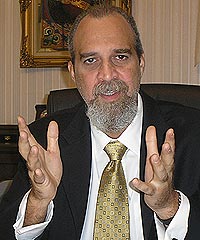 "The Melayu is defined as first being a Muslim and because he's a Muslim, he follows the customs and traditions of the Malays which are derived from Islam, followed by the language of the Malays which (also) derives from Islam."
Syed Ali, 41, who took office last year June, said that changing a language leads to an identity crisis because thoughts and speech are influenced by language and surroundings.
"In the case of the Muslims, when you change the language you invariably change the way they think and similarly, the way they think then will be duly influencing their own language."
He said the definition of Malay being Muslim first, the customary practices and the language was included in the Federal Constitution by Onn Jaafar, the founder and first president of the United Malays National Organisation (Umno).
"It was a correct definition. Just that element of defining the Malay itself is a very important thing for Malays. I would think that Umno would be very interested in this," he said, adding that Umno has not indicated so.
Malay dilemma
He noted that the identity crisis among Malays already existed decades ago.
"But it was not as apparent as (it is) today. In those days, the language was still purer than today. I'm sure there were some simmering undercurrents but in my personal opinion, I don't think that the situation in those days was worse than today."
He said Islam's special place in the constitution was with good reason - to provide an established value system.
"You cannot deny that the ethical moral principles of government come from religion. And because Islam is already complete, it is used as the official religion with which to then derive the system of the constitution.
"Whether or not it is relevant or manifest today is another question altogether but that will be the intention to have a good system, so when you talk about human rights everyone has equal right to water, electricity, schooling. All this is already contained in Islam."
 Presently, Malaysia is saddled with the burden of a rising tension level between Muslims and their fellow non-Muslim Malaysians following social injustices highlighted in the cases of S Shamala (conversion of children) and M Moorthy (religious status).
To a suggestion that prevailing government policies and implementation were part of the problem, accumulated over time, that had led to dissatisfaction among non-Muslims, Syed Ali agreed that it was a recent development.
"A slow decline towards ignorance is causing this. If it is a racial issue, then the responsibility lies with those who have assumed the mantle of authority who are themselves not authorities. They are simply there by virtue of who they know not what they know."
Unwelcome interference
Noting the recent social tensions, he asked why the non-Muslims were interfering with Islamic affairs.
"What I want to know is why are the non-Muslims involving themselves in this," he said, noting attempts by non-Muslims to hype-up certain issues and turn them into test cases.
As far as freedom of worship is concerned, he said, there was no problem because non-Muslim Malaysians could worship wherever and whenever they wanted.
"If they start talking about structures... we want to build a temple here, build a church there, then that's another matter altogether. That's got nothing to do with freedom of worship.
He said Muslims should not be denied the right to discharge their responsibility to guide their wayward brethren back to the fold.
"If we know something to be true and we see one of our brethren is confused, we have every responsibility to try and convince that person that he or she is confused."
On apostasy, a very sensitive subject in Malaysia, he said Muslims with proper understanding of Islam could never accept a situation of a fellow believer leaving the religion.
He asked if persons wishing to leave Islam were actually renouncing it because they no longer believed in the religion or because they were disillusioned with fellow Muslims.
"Which is it?" he posed, decrying non-Muslims interferences at the same time.
He also asked if people who intended to renounce Islam had gone through the syariah court procedures first.
Emergency law
Agreeing to a suggestion that the hudud, which he said was unsuitable for a society like Malaysia, was similar to an emergency declaration provided certain elements are present to warrant it.
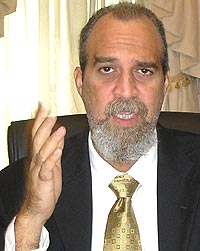 "(This is) because one of the intentions of the hudud law in the beginning was to prevent the Arabs from going back to the mentality of the pagan tribes people.
"If the danger of Muslims becoming pagans existed today, then I would say apply it but this condition does not exist, so why speculate when there is no precedent."
Asked on the exact moment that apostasy occurs, Syed Ali said it was dependent on one's intent and action.
He also disagreed with a suggestion that a bad Muslim was more acceptable to Muslims than an apostate.
"I don't think in either case, private or public, (it) is fine to leave Islam."
He said it depended on the actions of a Muslim, on whether the act affects only that person or involved others for whom he or she would then have to bear responsibility as well.
Pending a landmark decision by the Federal Court is the case of Lina Joy, a Malay-Muslim woman seeking to delete the word 'Islam' from her national identity card after being baptised as a Christian in 1998.
In a general reference to it, Syed Ali said the court case had turned high-profile due to the sensation it has garnered.
"It (has come to this) because the ones who are supposed to be handling (such matters) in an amicable manner have not done their job properly, resulting in confusion and conflict."
A series of public forums on freedom of religion by a grouping of women's and human rights activists (Article 11 coalition) have angered many Muslims and provoked aggressive reaction from Muslim NGOs and opposition political party PAS on grounds that Islam is under threat.
Syed Ali believes that discussions on religious issues were making matters worse.
"This so-called vibrant, dynamic debate going on, I think, is doing more damage than good because the real voice of discernment and reason in these NGOs who are fighting is ignored."
The voices of the knowledgeable people, he said, were drowned out by "the many who are activistic" and with clear vested interest.


Are you sure you want to delete this comment?
This action cannot be undone.