




Salleh's 'quit or be sacked' not strong enough: Nazri
Former Lord President Salleh Abas's personal account that he was told to quit or face a tribunal is not enough to convince de facto law minister Mohd Nazri Abdul Aziz to re-examine the 1988 judicial crisis.
Former Lord President Salleh Abas's personal account that he was told to quit or face a tribunal is not enough to convince de facto law minister Mohd Nazri Abdul Aziz to re-examine the 1988 judicial crisis.
"(That conversation) was privy to him (Salleh) and (then premier) Dr Mahathir Mohamad. I know nothing about it and it is not a strong enough reason (to review the judicial crisis)," Nazri told malaysiakini at his office in the Parliament building today.
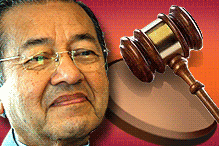 The minister in the Prime Minister's Department said this after being shown a copy of the private notes taken down by Salleh right after his meeting with Mahathir (
left
) on May 27, 1988.
The minister in the Prime Minister's Department said this after being shown a copy of the private notes taken down by Salleh right after his meeting with Mahathir (
left
) on May 27, 1988.
The notes narrating the meeting was reproduced in the latest edition of Aliran magazine.
In Parliament last week, Nazri said in a written reply that the government is prepared to review the 1988 judicial crisis involving the sacking of Salleh and two Supreme Court judges if "new and important" facts emerge.
"If any member of the tribunal (that found the judges of misconduct) comes forward and says they had been pressured into making the decision at the time, we will consider this as a fresh fact," he had said.
In a late-breaking development this afternoon, however, Salleh issued a press statement in which he described four more incidents which he hoped would persuade the authorities to conduct the review.
 During the interview, the minister did not budge from his stand that there should be finality in the episode, in contrast to the legal argument that the finality principle is not applicable in the sacking of the judges since it was not an ordinary court case, which allows for the right to appeal.
"Why say finality is not important? If we have a review today, one year later, maybe there will be another quarter asking for a review of this review. So, shall we have a review then? There will be no finality," he argued.
Asked why he did not let the cabinet decide on the matter, Nazri replied: "It is not important."
He noted that, although the Malaysian Bar - which represents some 12,000 lawyers - has been pushing for the review and has gained support from civil society groups, the number could not be said to represent the majority view of 23 million Malaysians.
Dark days in history
According to the notes, Mahathir summoned Salleh to his office and told him to step down because of a letter which the ex-Lord President had written to the King, regarding the state of relationship between the judiciary and the executive.
Also present at the meeting were then deputy prime minister Ghafar Baba and then chief secretary to the government, Sallehuddin Mohamed.
 Salleh (
left
) said he told Mahathir he would not resign and that the prime minister "could do what he pleased".
Salleh (
left
) said he told Mahathir he would not resign and that the prime minister "could do what he pleased".
Mahathir then set up a special tribunal which tried Salleh on charges of misconduct and for questioning constitutional amendments that seriously eroded the powers of the judiciary. Salleh was subsequently sacked.
Two of five supreme court judges - George Seah and Wan Sulaiman Pawanteh - who had ruled that the tribunal was convened unconstitutionally were sacked along with Salleh after being found guilty of misconduct by another tribunal.
Some have described the dismissal of the top judges from the Supreme Court - then the highest court, now renamed the Federal Court - as Malaysia's darkest hours in its judicial history.
A month ago, Salleh broke his 18-year silence and supported the Bar Council's call to review the 1988 judicial crisis.
Those who have joined in the chorus include opposition leaders and backbenchers like Kota Melaka MP Wong Nai Chee and Kota Baru MP Zaid Ibrahim, who said the country had committed a sin towards Salleh.
Former deputy premier Anwar Ibrahim yesterday said the government's refusal to review the sacking of the top judges is against its pledge for integrity and reform.


