




Plantation mega-merger: More than meets the eye
The mega-merger of three government-linked plantation firms may be a veiled attempt to acquire valuable property development land and will defeat the original purpose of the National Economic Policy (NEP).
The mega-merger of three government-linked plantation firms may be a veiled attempt to acquire valuable property development land and will defeat the original purpose of the National Economic Policy (NEP).
Also, it may trample on the rights of minority shareholders and not deliver the promised efficiency gains.
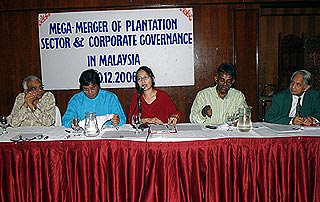 These were among the key concerns raised at the 'Mega Merger of Plantation Sector and Corporate Governance in Malaysia' forum organised by the Strategic Information and Research Development Centre in Kuala Lumpur yesterday.
Last month, Deputy Prime Minister Najib Abdul Razak announced that the government has approved the merger of the country's three largest plantation companies - Sime Darby Bhd, Kumpulan Guthrie Bhd and Golden Hope Bhd - to create the world's largest plantation company.
Led by Synergy Drive, a special purpose vehicle owned by CIMB, whose chief executive officer Nazir Razak is the deputy prime minister's brother, the new entity will have a combined market capitalisation of about RM27 billion.
It will employ about 93,000 people and become the country's fifth-largest company on the stock exchange, and have a combined land-bank size of slightly more than 600,000ha.
Development land acquisition
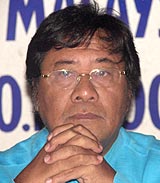 "This is not a plantation merger, it's a development land merger. Old plantations tend to be sold off to property developers or developed at a more lucrative profit.
"As the land value in the country goes up, it makes more business sense to acquire cheaper land, say in Indonesia, to plant oil palms," former chief executive officer of Permodalan Nasional Berhad (PNB) and Guthrie Group Khalid Ibrahim told the forum.
Due to their close proximity to development corridors of the country, schemes like Sungai Buaya (in northern part of Kuala Lumpur) and Bukit Cherakah (in the fringe of Kuala Lumpur) were redeveloped into residential and industrial satellites, resulting in a drastic boom of land prices of these schemes. Many of the earlier settlers and families are now millionaires from the sale of their land.
Sime Darby is the controlling shareholder of Sime UEP, and Sime Engineering, while Guthrie has substantial stakes in Highlands & Lowlands Bhd (Hi&Lo) and Guthrie Ropel Bhd, and Golden Hope own significant stakes in Mentakab Rubber Co (Malaya) Bhd and Negara Properties.
Sime UEP is an established property developer with some 8,000 acres of land. Its ongoing projects include Putra Heights and Bandar Bukit Raja development.
The company also owns commercial buildings and other properties like the Kuala Lumpur Golf & Country Club in Mont Kiara, the Sime Darby Centre in Singapore as well as industrial buildings in Queensland, Australia.
Hi & Lo and Guthrie have a joint venture called Guthrie Property Development Bhd, which is the developer of Bukit Jelutong, near Shah Alam. Guthrie also has some 11,000 acres of plantation land along the 24km Guthrie Corridor Expressway. Negara Properties owns around 1,000 acres.
Sime Darby's plantation land bank is fully planted with oil palm while Guthrie's land, the bulk of which is in Indonesia, is about 80 percent planted, and so is about 85 percent of Golden Hope's land.
National interest at stake
Besides the commercial benefits, the political, social and economic impact on the country needs to be carefully evaluated in the context of the NEP.
In the 1970s, the high level of rural poverty at 58.7 percent (Third Malaysia Plan, 1976-1980), and vast differences in wealth among the races were the key social forces behind the 1969 racial riots incited by opportunistic politicians.
Hence, under the Second Malaysian Plan, the NEP was introduced to foster national unity and wealth redistribution for a more equitable society. Schemes like Felda provided land and capital to the rural poor through massive development of new land, and distributed it to the landless poor.
Government-linked companies such as the three plantation firms also had the broader goals of the NEP when they were bought over from their original British founders to be controlled by bumiputeras.
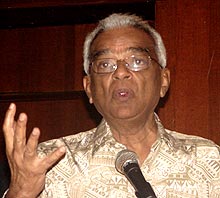 Speaking at the forum, former Gerakan MP and lawyer Dominic Puthucheary said the mega-merger has become an issue of national interest.
"It's not just a private enterprise exercise, our national interest is at stake. (Second premier) Tun Razak's vision in the 1970s was to give the Malays a share of the economic pie.
"Now, this is being robbed by private firms when it should be used to overcome the country's pressing problems like unemployable graduates and income redistribution," he said.
He said profits from the merger or future land sale should be redistributed and not concentrated in the hands of a few large shareholders.
"It's the country's wealth! So it should be used to further the country's interest!
"An example is the Sabah Land Development Board, which is both rich in land and power. But the people of Sabah are poor," he added.
Besides the bigger question of national interest, there are also concerns about the rights of minority shareholders and the potential for efficiency gains.
Fundamental responsibility
Minority Shareholder Watchdog CEO Abdul Wahab Jaafar Sidek reminded the directors of the three firms that their fundamental responsibility is to act in the best interests of the shareholders.
 "We broadly support the merger but are concerned about efficiency gains.
"It looks good on paper, as it will help the merged entity compete globally. But large organisations are about leadership and culture," he said.
"There is a common saying in Malaysia. That we are good at forming task force but when the force is dismantled, the task is still there. So, we must look at the leadership.
"If it's the same people, will the culture change? If the culture of excellence and professionalism is not there to enhance shareholder values, it will be a very expensive exercise indeed," he added
While Sime Darby and Kumpulan Guthrie have both agreed to the merger, PNB is still waiting for a response from the board of one other company, Golden Hope Plantations Bhd.


Are you sure you want to delete this comment?
This action cannot be undone.