




Ministry: A request, not directive
The Internal Security Ministry today denied it had 'ordered' mainstream newspapers not to quote or publish reports found on Internet portals and blogs.
The Internal Security Ministry today denied it had 'ordered' mainstream newspapers not to quote or publish reports found on Internet portals and blogs.
Clarifying this, a ministry official claimed that the authorities had merely 'requested' the newspapers to obtain correct information from the right sources.
The ministry's Publications Control and Al-Quran Texts Unit senior officer Che Din Yusof said the government's concern is that newspapers publish "whatever comes from the Internet" and this in turn destroys the credibility of the newspapers themselves.
 "We don't want the newspapers getting people to believe everything that comes from blogs and the likes," he said when contacted.
Che Din had signed the March 13 letter ( see below ) sent to the country's top editors warning them against publishing or giving "any consideration whatsoever" to online articles found to be anti-government, have no basis at all, or based on mere speculation.
Newspapers were also reminded that condition 11 of their publishing permit required them "to follow and not act against" such directives issued by the ministry.
State intervention
Responding to the thinly-veiled threat, media watchdog Charter2000-Aliran said this is "nothing but a glaring and deplorable state intervention in the daily affairs of the editorial management of the newspapers concerned."
"This worrying development signals a further regression of press freedom in Malaysia under an administration that ironically promises to be transparent and accountable," said its coordinators Dr Mustafa K Anuar and Anil Netto in a statement today.
"This move by the government negates all the inspiring platitudes that have been voiced in defense of democratic values and the declared fight against corruption," they added.
The duo also expressed concern that "with one stroke of the pen" the government sought to tarnish online portals and blogs by giving the impression that they are, by definition, anti-government, reckless, irresponsible, sensational, and without any respect for the truth.
 "Discerning Malaysians would recall that if not for these online portals and blogs, the various scandals that have been exposed would not have seen the light of day," they said.
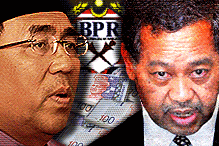
They were referring to the scandals surrounding Anti-Corruption Agency (ACA) chief Zulkipli Mat Noor and Deputy Internal Security Minister Mohd Johari Baharum.
Zulkipli has been accused of amassing properties and wealth beyond his means, while Johari was alleged to have received RM5.5 million in bribes to free certain criminal suspects held under the Emergency Ordinance.
Embarrassing disclosures
"The government's attempt to muzzle and shackle the mainstream media confirmed the suspicion that the recent exposes of these financial scandals by some blogs and portals might have embarrassed and indeed irked the powers that be," said the Charter2000-Aliran coordinators.
"To prevent any further ventilation of other corrupt practices, it seems, the government is tightening the screws and forcing the media to be docile and impotent," they added.
Meanwhile, National Union of Journalists (NUJ) president Norila Mohd Daud said while the threat to newspapers was clear enough, it was still the responsibility of newspapers to expose wrongdoings in high places as long as there is enough grounds to substantiate the claims.
"The government can say whatever it wants, but it's still up to the newspapers to decide. Of course, we have to expose these things," she said when contacted.
However, she stressed on the need for newspapers to ensure that they do their homework thoroughly and not publish baseless allegations.
"Sometimes, newspapers do get excited over things that they see some things as truths," she added.
Meanwhile, press freedom group Centre for Independent Journalism (CIJ) ticked off Deputy Internal Security Minister Fu Ah Kiow who conceded that he sometimes call up editors to "remind the media concerned when sensitive issues are published".
According to Fu, some even considered him the 'super media editor' .
"By restricting editorial independence, the government is increasingly moving away from its goal of openness and transparency. It is now seen to be hiding something and is restricting Malaysians who are without Internet access from getting the information," said CIJ executive director Sonia Randhawa.
"The deputy minister's admission shows the seriousness of government's disregard to media freedom at the expense of the public."


Report this comment
Are you sure you want to delete this comment?
This action cannot be undone.