




Eric Chia acquitted
The former head of the national steel company was acquitted of embezzling RM76.4 million today after a court ruled that the prosecution failed to prove a prima facie case.
The former head of the national steel company was acquitted of embezzling RM76.4 million today after a court ruled that the prosecution failed to prove a prima facie case.
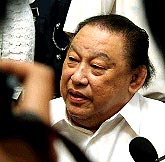 Singapore-born Eric Chia, 74, was the first prominent person charged with corruption after Prime Minister Abdullah Ahmad Badawi replaced Dr Mahathir Mohamad in October 2003, pledging to root out graft in government and business.
Chia's trial opened in August 2004 after a lengthy investigation into the payment of RM76.4 million from Perwaja Steel to Japan's NKK Corporation through a non-existent company in 1994.
But sessions court judge Akhtar Tahir said the material witnesses were not even called in the case.
"As a conclusion I would say ... in this case the court was deprived of making this maximum evaluation as the material witnesses were not even called," Akhtar Tahir, sessions court judge said.
"I have decided that the prosecution has failed in proving a prima facie case against the accused on both the main and the alternative charge. The accused is therefore acquitted and discharged for both the main and alternative charge," he added.
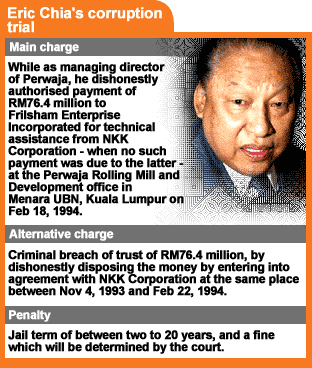 The alternative charge referred to Chia's dishonestly disposing of the funds by entering into an agreement with NKK Corporation and authorising the payment of the RM76.4 million without the approval of the board of directors or tender committee of Perwaja.
"The prosecution's case has been negated by their own evidence and crippled by the non-calling of essential witnesses," said Akhtar.
The prosecution was led by senior deputy public prosecutor Yusof Zainal Abiden while lawyer Muhammad Shafee Abdullah represented Chia.
Handpicked by Mahathir
The wheelchair-bound Chia said: "truth has prevailed but the allegation has broken my family."
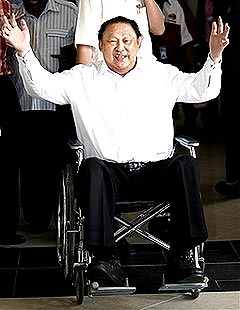 "My son had to go to the United States and my daughter to Hong Kong in search of work because of shame.
"I was a victim of slander. It has ruined my family. I live alone here (in Malaysia). It has broken my family and even my friends have stayed away from me," he said.
Chia said he accepted the job with Perwaja because former prime minister Mahathir Mohamad pressed him to take it in 1988.
"Mahathir told me: 'You came to Malaysia from Singapore with five ringgit. This country has blessed you. Now it is your duty to serve the country,'" he said.
"After 11 long years, I now feel vindicated. Yes, I can move on now with my life. But I have a broken family. My children can't come back. This is my country and I will live and die here," he said.
Opposition leader Lim Kit Siang, who is DAP leader, said Chia's acquittal without being called for defence was a setback to Abdullah's administration.
"It will be seen as a major setback as Abdullah's anti-corruption drive has never really taken off.
"When Chia was charged, it was hailed as a major breakthrough in his anti-corruption drive," he said.
Lim also criticised the prosecutors for failing to establish a case.
"The prosecutors' failure to establish a prima facia case also raises a question of professionalism on the Attorney-General's Chambers especially after a long and expensive trial with evidence taken in Hong Kong and Tokyo," he said.
In May 1996 Chia was blamed in Parliament for the losses suffered by Perwaja.
Chia's counsel Muhammad Shafee said he expected the prosecutors to appeal.
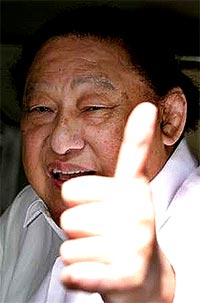 Chia's trial opened in August 2004, and he was the first prominent person to be charged with corruption since Abdullah took power.
Chia was handpicked by Mahathir in 1988 to turn Perwaja around when it ran into financial difficulties six years after it was set up as the cornerstone of Malaysia's industrialisation drive.
He resigned in 1995 and Perwaja was declared insolvent the following year, saddled with debts and losses totaling some RM10 billion.
Chia's arrest capped one of the most drawn-out probes ever conducted by the Anti-Corruption Agency and appeared to reflect Abdullah's pledge to battle corruption, analysts said.
The ACA probe zeroed in on the payment made by Perwaja through non-existent Frilsham Enterprises for "consultancy fees" to NKK for a project in Gurun, in Kedah, that eventually went into overseas bank accounts.


Report this comment
Are you sure you want to delete this comment?
This action cannot be undone.