




History is against Koh to win seat
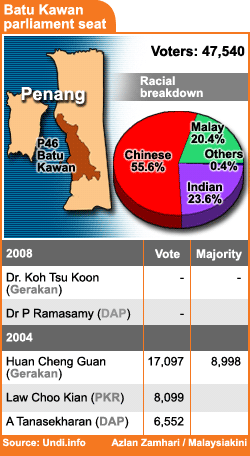
Signs are ominous that outgoing chief minister and Gerakan acting president Dr Koh Tsu Koon would not have an easy win in the Batu Kawan parliamentary constituency as it was predicted earlier.
Signs are ominous that outgoing chief minister and Gerakan acting president Dr Koh Tsu Koon would not have an easy win in the Batu Kawan parliamentary constituency as it was predicted earlier.
There are a few reasons for this - ranging from the voters' dissatisfaction over his performance as the chief minister to the strength of his DAP challenger right up to the historical fact that outgoing chief ministers are never allowed to move up to federal politics or retire without a heartbreaking defeat.
 Based on the voters’ sentiments in the area, the going is getting tough for Koh, former Chinese educationist, as he faces his biggest battle of his political career against DAP newcomer Prof P Ramasamy, a political scientist.
Observers also note that the fact that for Koh, 59, to face a tough fight against a newcomer in a so-called ‘safe’ Gerakan seat of Batu Kawan, does not speak well on his report card as Penang's third chief minister between 1990 and 2008.
They also say that Ramasamy’s, 58, strong challenge against the Gerakan number one in this mixed constituency, which has 47,378 registered voters, is a proof that Koh's 18-year legacy would rather be forgotten by all Penangites than be cherished.
"Therefore Batu Kawan should be the place for Koh to perish," said PKR candidate for Kebun Bunga state constituency, Jason Ong Khan Lee at a rally recently.
Several Chinese voters, who make 56.3 per cent of Batu Kawan constituency, believe that Koh had `fled' from the Penang island to the mainland to save his political career. Indians make up 22.8 per cent while Malays and others make up the rest in this mixed constituency.
Undercurrents alleged that Koh had fled to mainland thinking that he could hoodwink Batu Kawan Chinese voters after practically “mismanaging” Penang.
"He thinks that we in Batu Kawan are unaware with his miserable record as a chief minister without any power.
"He thinks that we are unaware he was an Umno stooge for 18 years," a Batu Kawan voter, Teh Eng Lai, 42, from Chai Leng Park, told Malaysiakini during a DAP rally in Dewan Mariamman, Butterworth recently.
A political embarrassment
The common feeling is that Koh fled from the island after realising that he would face an electoral disaster in any of the three parliamentary constituencies that Gerakan contest on the island, namely Jelutong, Bukit Bendera and Tanjung.
Since Koh took over from the state chief ministership from his predecessor Dr Lim Chong Eu in 1990, Gerakan’s power of influence on Penang mainland had rapidly eroded.
Voters also point out that it was a political embarrassment for Gerakan to be allotted only one Parliament constituency of Batu Kawan and three state seats – Bukit Tengah and Bukit Tambun (both under Batu Kawan), and Machang Bubok (under Bukit Mertajam) on the Penang mainland, which has seven federal and 21 state seats.
Gerakan, under Koh, had previously surrendered its Nibong Tebal federal seat and Sungai Bakap state seat to Umno in 2004.
 The party now plays only a third fiddle on mainland behind Umno, which contest four federal and 11 state seats, and MCA, which contest two Parliament and five state seats.
With these anger seething against him, Koh would be hard pressed to canvass enough voters to win handsomely in Batu Kawan.
Based on the present anger among the Indian community against the ruling coalition, it is almost a foregone conclusion that Koh would not receive their support.
However, party insiders are still hopeful and think it is not all bleak for Koh. They are confident of winning the Chinese sentiments and the votes that come with it.
Furthermore Umno could probably deliver a significant number of Malay votes for him to secure a slim victory.
After all, they said, Umno needs Koh to win Batu Kawan more than the Chinese community since the constituency is expected to be transformed into a major township in near future due to the construction of the second bridge.
History beckons
However, the DAP camp is determined not to allow Umno to chip away the Malay votes in Batu Kawan.
In the past few days, several joint-rallies by DAP and PKR, which has a strong presence in the area, was organised to woo the Malay votes.
 "I am working hard to win a good number of Malay votes and a chunk of Chinese votes," said Ramasamy, who is also contesting the Prai state seat against MIC's L Krishnan.
The elegant political scientist is fast becoming a popular among Batu Kawan electorates, especially in Prai, due to his down-to-earth style and humbleness.
The professor's double quests, however, could be thwarted by the notorious split-voting trend prevalent among certain segment of Chinese voters.
About 10 per cent of Chinese voters are expected to vote for Ramasamy in Prai while supporting Koh at Batu Kawan.
Bookies are taking bets from punters with the odds on 500-majority win for Koh.
The bet, however, could favour Ramasamy to upset all odds and send the Gerakan top man to political oblivion.
The state political history would reveal Penang chief ministers had always bitten the dust in electoral battles after announcing that they would leave office.
Penangites had never allowed them to move up to federal politics or retire without a heartbreaking defeat.


Report this comment
Are you sure you want to delete this comment?
This action cannot be undone.