




Gov't to launch massive ops against illegals in Sabah
The government will launch a series of massive operations against illegal immigrants in Sabah and beef up security along the state border.
The government will launch a series of massive operations against illegal immigrants in Sabah and beef up security along the state border.
 Finally responding to a constant barrage of complaints from ruling legislators and social activists in the state, Deputy Prime Minister Najib Abdul Razak said the operations would “flush out the illegal immigrants from Sabah and deport them to their home country”.
Najib said Malaysian authorities will hold talks with their counterparts in the Philippines and Indonesia to organise the mass deportation.
“We will also increase the number of checkpoints at suitable places and the presence of our security agency too will be increased,” he told a press conference in the Parliament lobby after chairing the high-powered cabinet committee on illegal immigrants in Sabah.
The two-and-a-half-hour meeting was attended by Home Minister Syed Hamid Albar and attorney-general Abdul Gani Patail, among others.
Najib said he would meet with Barisan Nasional component parties to inform them of measures to be taken and to gather feedback.
The cabinet committee was formed after the government came under heavy fire by Sabah BN parliamentarians, who criticised the inaction to date.
Issues related to illegal immigrants were also cited by component party Sabah Progressive Party (Sapp) as one key factor in the loss of public confidence in the leadership of Prime Minister Abdullah Ahmad Badawi.
Responding to questions, Najib said the government has not set a target on the number of illegal immigrants that it intends to remove from Sabah.
“We don’t want to use figures, (the action will be against) whoever is classified as a illegal immigrant. We have sent back 300,000 so far and we are prepared to (deport) even more in the near future,” he said.
Authorities say there are 130,000 illegal migrants in Sabah, but local politicians put the figure as high as 500,000.
Checks in peninsula later
On the government’s plan to deal with illegal immigrants holding false Malaysian identity cards, Najib was non-committal.
He said this is a “complex problem” that should be dealt with step by step.
“There are all kinds of claims but the most important thing is to send back the illegal immigrants. (As for) subsequent problems, we will handle (these later),” he said.
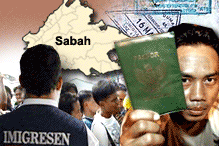 Stressing the government’s commitment to tackle the issue, Najib said a separate exercise would be conducted against illegal immigrants in the peninsula later. The situation, he said, is more critical in Sabah.
On the root cause of the problem, Najib said one reason is that Malaysia’s borders are “porous”.
“Traditionally people don’t recognise the border, they move in and out. Of course, there is also economic opportunities, (while some have) come in legally but overstayed,” he noted.
A top Sabahan politician had claimed that the number of illegal immigrants with Malaysian identity cards - known as Project IC beneficiaries - plus their children has reached 600,000.
The cabinet committee is also expected to look into solutions, particularly for foreigners holding the ‘IMM13' - a document in lieu of passport issued by the immigration department to Filipino refugees. It permits them to reside in Sabah.
Reactions from Sapp and PKR
Sandwiched by the Philippines in the north, and Indonesia's Kalimantan to the south, resource-rich Sabah is a magnet for immigrant workers who for decades have come to labour on construction sites and oil palm plantations.
Sapp MP Eric Majimbun welcomed the deportation drive, but said the government should also probe claims that many foreigners in the state had been given Malaysian citizenship without going through legal channels.
"I would like to say thank you very much for this good initiative. At least our voice was heard," he told AFP .
"But we are still waiting for an investigation into foreigners who have been given Malaysian citizenship," he said.
Jeffrey Kitingan, chief of the opposition PKR in Sabah, said the proposal was "long overdue" but questioned the government's motives.
"It seems to be more of a political gimmick to try and ease the dissatisfaction of Sabahans," he said.


Report this comment
Are you sure you want to delete this comment?
This action cannot be undone.