




Opposition pledges yet to be fulfilled
Even as the Anwar Ibrahim-led opposition Pakatan Rakyat coalition celebrates 100 days in office this week with huge rallies across the country, the public euphoria that brought them into power is beginning to cool off as people tighten their belts in the face of a slowing economy and escalating cost of living.
Demands are rising for the opposition to implement their pledges.
Even as the Anwar Ibrahim-led opposition Pakatan Rakyat coalition celebrates 100 days in office this week with huge rallies across the country, the public euphoria that brought them into power is beginning to cool off as people tighten their belts in the face of a slowing economy and escalating cost of living.
Demands are rising for the opposition to implement their pledges.
It is clear now that it was easy to make election pledges, but next to impossible to fulfil some of them, especially the promise to lower the price of petrol to pre-2004 levels, world price then was about US$20 a barrel. The price of oil is now hitting US$150 a barrel.
In 2004, pump prices in Malaysia were under RM0.92, but today the price is RM2.70 and set to rise to RM3.20 by year-end.
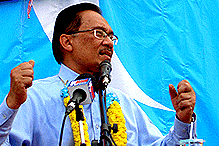 "I cannot understand how Anwar is going to lower pump prices when world price is set to cross US$200 by year end," said a Universiti Malaya economist who declined to be identified, for fear of repercussions.
"I think he has to tell his legions of supporters soon that petrol prices will only rise and not drop because the commodity is limited but usage is increasing," said the economist.
For the opposition - which captured five states and won 82 of the 222 seats - the issue is pressing.
"As the opposition we promised the sky to win but as the government now we have great difficulty to deliver because we don't have the power, our power to effect change is limited," said opposition lawmaker Tian Chua.
"But we are doing our best and the people understand it... they are with us," he said.
Many are still in a state of shock having been transformed overnight from ‘street fighters' battling police to lawmakers. The size of the victory and the suddenness of the transformation took everybody by surprise.
Voters who believed the opposition rhetoric and voted for change to see their lives transformed for the better are increasingly unhappy that change is slow to arrive.
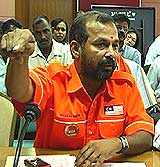 "We want an end to corruption, we want accountability and transparency, we want redistribution of wealth and we want to see equality for all races," said RS Thanenthiran, national co-coordinator of
Makkal Sakthi
or People Power movement that helped to bring the disparate opposition into power.
"We want an end to corruption, we want accountability and transparency, we want redistribution of wealth and we want to see equality for all races," said RS Thanenthiran, national co-coordinator of
Makkal Sakthi
or People Power movement that helped to bring the disparate opposition into power.
"The era of blaming the previous governments for all the ills in the country is over and people want the new leaders to deliver," he said.
"But they are still trapped in the old mentality," he told IPS in an interview.
"They are the government now and they have to deliver."
Massive jump in cost of living
A key opposition challenge is how to satisfy rising expectations which are fuelled by opposition rhetoric and rising cost of living - on June 5 there was a 41 percent hike in petrol and 61 percent hike in diesel prices.
Before the fuel hike, the country's poverty rate - calculated by a household income of RM800 - was 3.7 percent of the population, or 27 million people.
After the fuel hike, and resulting massive jump in cost of living, the government is proposing to a new 'lower income' category who earn RM2,000 and below.
Nearly 25 percent of the population will fall under this new category of 'low-income earners'.
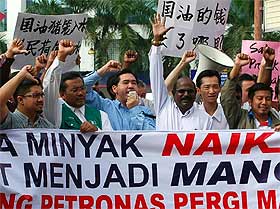 The new definition covers only expenses for food, clothes, rental, utilities, transport, communication, health and education, former banker turned government minister for special functions, Amirsham Aziz told Parliament on June 24.
"Many among the former middle-class are now falling into the lower-income category and they are fearful and looking to the opposition political parties for deliverance," said S Sivananthan, a senior official with the Malaysian Trade Union Congress, an umbrella body for private sector unions.
"Clearly the former boom years are turning into lean years and people are angry at the sudden lost of status," he said.
Pakatan Rakyat is made up of three disparate political parties and has yet to formulate a single, holistic agenda to raise wages and household income and redistribute national wealth, the key demands of the people.
Instead the former opposition is resorting to distributing sugar, rice and cooking oil to the poor and so doing are fuelling higher expectations for more handouts.
"A comprehensive and workable scheme of measure to beat inflation and raise income is not in place yet," said Sivananthan.
"Populist measures like free rice are temporary measures and will raise expectation without solving the root cause which is low wages."
The difference between the three political parties that make up Pakatan is also a contributing factor in the failure to offer a comprehensive common agenda.
While Islamic party PAS, wants a greater role for syariah in the five opposition ruled states, the secular, Chinese-based DAP supports defending the secular constitution and stopping the advance of Islam in a multi-ethnic secular society.
Anwar and his PKR - Malay-led but nominally secular - is left sandwiched between the two feuding foes and drained by the constant need to keep the peace.
‘Buying' political opponents
Increasingly public attitude towards Anwar is unfriendly, seeing him as pre-occupied more with grabbing state power by toppling Prime Minister Abdullah Ahmad Badawi and less on alleviating the real problems the masses face.
In fact, Anwar, who controls 82 seats in Parliament, is preoccupied with secret negotiations to persuade government backbenchers to defect to his side.
If he can get 30 lawmakers to defect he says he can topple Abdullah and form the next government without facing the voters for a fresh mandate.
Many of his own colleagues are openly against 'buying' political opponents to make up the numbers because that may cause national instability, and put Pakatan at the mercy of the defectors whose loyalties will always be questioned.
 "It is also unethical. We should work at representing the people in Parliament, act as an efficient check and balance on the federal government and go for a new mandate," said veteran opposition lawmaker Karpal Singh.
"I am against using defectors to topple the government," he said.
Many lawmakers also feel the future of Pakatan lies in addressing fundamental problems, and on populist measures like distributing food and cooking oil.
Nevertheless the opposition victory has given the people fresh hopes that the new government is for them, and in their interest will be not hijacked by the rich and powerful.
After an initial huge jump in expectations and optimism the mood is now cautious but optimistic for Pakatan, partially because people still have grievances with the former Barisan Nasional government and its arrogant ways.
But, experts warn, these are still the first 100 days and public mood could change dramatically unless the former opposition now in government put aside their differences, abandon populist measures and come together to tackle the real issues, which are poverty, low wages, rising cost of living and lack of social mobility.
- IPS


