




All eyes on PM as he weighs his options
Prime Minister Abdullah Ahmad Badawi has less than a week left to tell the nation whether or not he will defend the presidency of his ruling party Umno - a decision that will have far-reaching implications not only for the Malay community but also for the entire country.
Prime Minister Abdullah Ahmad Badawi has less than a week left to tell the nation whether or not he will defend the presidency of his ruling party Umno - a decision that will have far-reaching implications not only for the Malay community but also for the entire country.
“As he has said, the decision is his,” a party insider told Malaysiakini . “So exactly when he announces it, we have to wait and see. But he will tell everybody on or before Oct 9, that is his promise and he will keep it - no matter what the final decision is.”
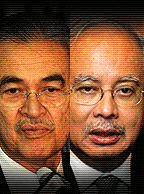 After five decades of snail-paced change, Malaysians have unexpectedly found themselves onboard an unstoppable political roller coaster this year. But after months of dizzying twists and turns, the ride may soon briefly pause for Abdullah to vacate the driver’s seat in favour of his deputy, Najib Abdul Razak.
Once that is done, other Umno leaders are expected to climb in and stake their claim for the top two posts. Party elder, Tengku Razaleigh Hamzah, has already thrown in his hat for the party presidency though he is not expected to beat Najib.
Meanwhile, party vice-president Muhyiddin Yassin and former Youth chief Ahmad Zahid Hamidi are widely expected to offer themselves for the deputy presidency - which carries in tow the deputy premiership of the country.
Ahmad Zahid yesterday confirmed he will be going for the No 2 post. According to him, the party’s rank-and-file want him to contest.
Bows to pressure
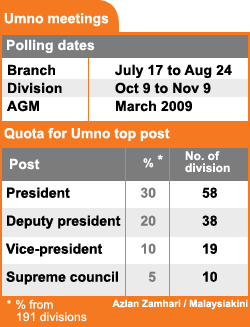
Last week, Abdullah finally bowed to pressure to let the top two posts be contested. He agreed to drop an unpopular plan to hand power to Najib in 2010, accepting in place a new deal that will delay the party’s annual general assembly and election by three months to March 2009.
The prime minister, also known as Pak Lah, is said to have verbally agreed to quit before March, so that new candidates led by Najib can be fielded in the party election.
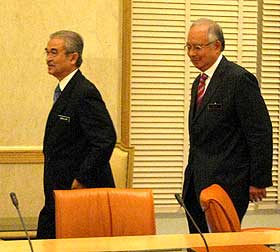 “It was designed to give Pak Lah an honourable exit,” said the party insider. “The grassroots don’t want him to stay because they don’t think he can contain Anwar Ibrahim. But we cannot be seen to be pushing him out. That’s not in our Malay culture, so we have to compromise.”
Claiming he was unfairly blamed for the party’s worst-ever performance during general election earlier this year, Abdullah’s supporters have tried hard to delay his exit. But the aftershock that thundered through both Umno and the Umno-led Barisan Nasional may have been too damaging.
“It is too late for any face-saving job. It is really too late,” said political analyst Khoo Kay Peng. “The damage done to the Barisan administration is irreversible.”
The Barisan coalition had for the first time lost its two-thirds parliamentary majority to the Pakatan Rakyat led by opposition icon Anwar Ibrahim, who won five of the country’s 13 states.
Back to December possible, but unlikely
Still, despite his humble ways, the prime minister has a famous independent streak. Earlier this month, a defiant Abdullah rattled his party with hints he may dig in and fight. However, this time around - although he has yet to confirm it - he is nonetheless expected to stick to the script.
 Party watchers told
Malaysiakini
that Umno grassroots are stepping up demands for a leadership change and may even press the supreme council to switch party polls back to December.
Party watchers told
Malaysiakini
that Umno grassroots are stepping up demands for a leadership change and may even press the supreme council to switch party polls back to December.
But they do not think the council will agree unless Abdullah opted to defend his presidency.
A shift back to December would not only deny him and his camp additional time to shore up their positions, it could also thwart a leadership battle that could shatter Umno and create further friction within the Barisan.
“A leadership transition may give component parties justification to stay with Barisan and work out their differences. But whether the national political alignment can or cannot change depends on whether the new leader of Umno is willing to commit to reforms and liberalisation. If the new leader stands for pretty much the same, then it will only strengthen Anwar,”said Khoo.
Earlier this week, Barisan stalwart Gerakan lost a score of members to Anwar’s PKR party. Acting president Koh Tsu Koon admitted 60 percent of members wanted Gerakan to leave the Barisan and be independent or team up with PKR, which has a similar multi-racial structure.
“Don’t worry. Gerakan won’t divorce us,” said the party insider. “But all the more we need to move fast. Otherwise there’ll be no end to it - everyday, we will be fighting either among ourselves or with Anwar. Who is going to look after the country and economy?”
Anwar still in the power loop
An early handover to Najib will pit Anwar in direct confrontation with his arch rival of nearly two decades. Although his political pedigree may not be as impeccable, Anwar was favoured and chosen over the younger Najib in 1993 when Mahathir picked him to be his deputy premier.
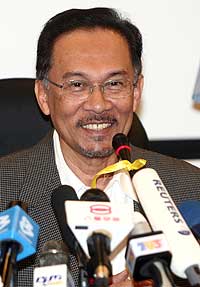 Anwar - then regarded as an ultra-Malay - was well-loved by Umno grassroots, but the 61-year old burned his political bridges after he was sacked from Umno and the government in 1998 by Mahathir, who also jailed him. It was then that Anwar and his supporters formed Keadilan, later renamed PKR, to fight the Umno-led Barisan government.
Analysts said even if Abdullah left quickly - allowing Najib to begin the process of healing Umno sooner rather than later - Anwar would still figure prominently in the nation’s leadership equation. However, he may no longer be able to command the political limelight as before, given that attention may initially swing to the resurgent Najib and his programmes for the nation.
“The impact on Anwar will not be pronounced or prolonged. The forces in the Barisan are conflicting in nature. The coalition can only hold if Umno liberalises and moves away from its Malay supremacy politics and not by deepening it,” said Khoo.
Since his release from prison in 2004, support for Anwar has shot up, boosted by his reform agenda and promises of a ‘Malaysia for Malaysians’ that has won the hearts of voters frustrated with the Barisan’s refusal to discard its divide-and-rule, race-based politics.
Can Najib do it?
Najib, on the other hand, is the eldest son of second prime minister Abdul Razak. A UK-trained economist, he entered politics at age 22 after the death of his father, who was revered in Umno for introducing the controversial New Economic Policy. While the NEP has benefitted and protected Malay rights, abuses in its implementation have also sidelined many non-Malays.
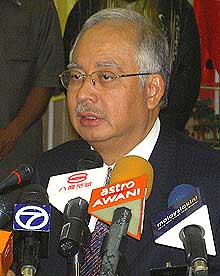 Now aged 55, Najib has been criticised for being too much of a status-quo politician, and even his benefactor Mahathir - who had pushed for his appointment as Abdullah’s deputy in 2003 - recently chided him for being too loyal to the prime minister at the expense of the rest of the party.
Yet, his inner circle believe the best is yet to come.
“Najib is only 55, the rest except for Ahmad Zahid are above 60,” said a Najib stalwart. “His is a courteous character, so it is inbuilt for him to control his words and actions. Not that he doesn’t have strong opinions, he just hasn’t had much chance to prove his stripes yet. We should give him time to come out of his shell and show us what he can really do.”
Muhyiddin, who is likely to go for the deputy president post is 61 years old, while Razaleigh - who is seeking to contest the president post for the third time - is 71. Ahmad Zahid - who was formerly Najib's political secretary - is 55.
While Najib’s early entry into politics has helped him to mature faster than his peers, it has also made him appear to be older than his age. Political watchers believe the key to his success may lie in whether he can distance himself from the stuffy, sycophantic Umno stereotypes that younger Malaysians - including young Malays - these days equate with corruption and racism.
“His immediate asset is that he is young - physically and mentally fit. He has shown he can appeal to the older Malays. Hopefully he can also gel with younger voters - the Generation Y - and transform both Umno and the country,” said his supporter.
Previously tipped to endorse Muhyiddin as his number two, Najib is expected to keep his options diplomatically open now that there is the possibility of Ahmad Zahid joining in the fray.


Are you sure you want to delete this comment?
This action cannot be undone.