




MCA a 'penumpang' in BN
opinion For some time, I was wondering why the intensity of the outbursts of the Umno ultras led by Penang-based Ahmad Ismail and why were they so indignant on the ‘penumpang’ non-Malays in the country.
From their persistent refusal to apologise; there must be some valid reasons for such strong sentiments. When I reviewed again the political landscape of the country over the weekend, I found the answers.
opinion For some time, I was wondering why the intensity of the outbursts of the Umno ultras led by Penang-based Ahmad Ismail and why were they so indignant on the ‘penumpang’ non-Malays in the country.
From their persistent refusal to apologise; there must be some valid reasons for such strong sentiments. When I reviewed again the political landscape of the country over the weekend, I found the answers.
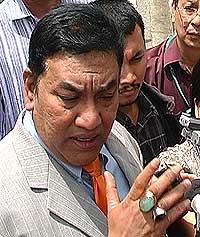 Ahmad and those who shared his view, as I see it, were not targeting the Chinese population at large, but the Chinese-based parties within Barisan Nasional as they are ‘squatting’ in BN and rely on Malay votes and Umno's influence to stay in power.
The majority of the 20 seats belonging to MCA (15), MIC (3) and Gerakan (2) were elected primarily by Malays and were considered Umno territories. The non-Umno 14 ministers, deputy ministers and parliamentary secretaries were given these positions not because they have won the seats on their right, but were simply riding on Barisan's ticket.
Umno has been kind to them; these parties' electoral performance in no way deserves the number of cabinet positions now bestowed on them. Here is my advice to those who are contesting to take over the new leadership in MCA at the coming party elections.
MCA used as ‘prop’ by Umno
Indeed, the MCA leadership must spend time and effort to make a correct assessment of the current situation - if we can't define the the problem, then we will forever be barking up the wrong tree. Six months into post-March 8, the leadership must be honest to face up to the reality of the new political landscape.
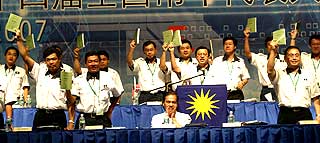 Many in MCA blame Umno for causing it to lose faith and confidence among its own constituencies (the Chinese voters); that MCA is viewed as ineffective; timid; often as an agent of Umno to suppress Chinese interests; that Umno's arrogance is the direct cause of MCA's electorate defeat.
From the viewpoint of some Umno grassroots; they see no value in having MCA; they take up Umno seats and they are voted in by Malay voters; and as many as 10 cabinet positions are given to the MCA members of parliament. "If MCA is not a ‘penumpang’, what are they?" they asked.
So we have this two extremes - MCA felt helpless and beaten down by the Chinese community because of Umno's arrogant outbursts and MCA felt humiliated and insulted for being used as a ‘prop’ in BN to portray its multi-racial face.
Lose-lose for Umno to clip MCA's wings
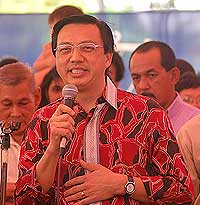 In the recent ISA arrest; a top MCA leader disclaimed the BN government's actions citing that Umno did not consult MCA before such measures were implemented. Minister Liow Tiong Lai, in referring to the ISA, said MCA would lobby the government for changes to the policy. Such statements were ridiculed by critics because MCA, as a member of the government, speaks like a member outside the government.
On the other hand, the Umno ultras could not fathom why these "Chinese" are so ungrateful. They have been allowed to stay, given citizenship, build homes for their families (and of course, given cabinet positions and datukships); yet they are so unhappy with the government. This is the crux of the problem of MCA in Umno-led BN.
In the days when Umno could command an overwhelming majority of Malay votes; everyone else can be a prop. However, at a time where Umno's own political approaches is cracking; to stay in power, the party needs to expand its support base.
MCA has been reduced today to total dependence and subservience to Umno in BN because the Chinese-based party has to abide with the BN code. In part, the MCA leadership has to take responsibility for allowing this situation to arise.
Yes, there ought to be teamwork and cooperation within BN; when you are a cabinet minister, your boss is the prime minister. But when you are MCA president, you are equal to the Umno president. It was difficult to separate the two; and gradually over time, the MCA leadership allowed the premiership and Umno presidency to be seen as a fused entity.
Any political party without its own voters' base is suicidal and ended up having one's own wings clipped. Allowing the dominant and stronger Umno to decide on the allocation of seats; MCA has become totally at the mercy of the Malay-based party.
MCA not at crossroads, but deadend
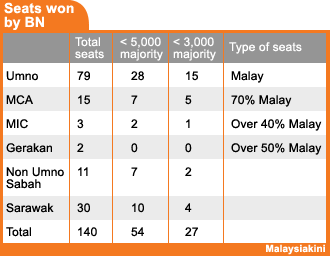 Of the 15 parliamentary seats now held by MCA, only one has voters with less than 30 percent Malay majority and four with over 50 percent of Chinese voters.
Of these 15 seats; seven of them has majority votes less than 5,000 and two seats with less than 3,000. Five cabinet ministers have majority votes of less than 4,000. By any benchmark, it is hard to command respect with this kind of lackluster showing at the polls.
If the current MCA leadership pleaded innocence for this outcome and blamed its poor showing on Umno, one can only conclude that this is also a case of losing touch with the ground, and losing sight of its own political role.
The real issue is MCA has been avoiding political and governance issues so that it doesn't have to confront Umno head on. For over a decade, it hid behind many social-cultural endeavours which duplicated the effort of many social and cultural groups in the Chinese community.
It is also no fair to say that the MCA leadership did not try - they probably did - but how hard, how well they did can be judged by the voters themselves. One fact is clear - MCA has allowed its membership in BN to bring about its own demise.
Some MCA leaders talk about the party being at a crossroads. This description is a wrong - if you are at a crossroads you have many options; but MCA is not at a crossroads, it is caught in an unfortunate and pretty tragic ‘deadend’, the new leadership need to be creative to bring about a major breakthrough.
Tomorrow: MCA 2.0 doesn't need bravery, it needs strategy
FOONG WAI FONG is co-founder of Pahlawan Volunteers , an advocacy and volunteer group who played an important role in the Nipah virus crisis and the Visit Malaysia Cybercampaign of 1997. She is also the director of Megatrends Asia, and best-selling author for 'Megatrends Asia' (with John Naisbitt), 'The New Asian Way', 'We have to talk, Mr Prime Minister', and 'Culture is Good Business'. Join Pahlawan, click here .


Are you sure you want to delete this comment?
This action cannot be undone.