




By-election: Impact on Chinese voters
analysis The Kuala Terengganu by-election was another victory to savour for the opposition Pakatan Rakyat, as a reminder of the ‘political tsunami’ it caused last March and the embedding of another seed toward an alternative government.
On Saturday, Umno’s candidate Wan Ahmad Farid lost to Mohd Abdul Wahid Endut of PAS, who clinched the parliamentary seat with a majority of 2,631 votes.
analysis The Kuala Terengganu by-election was another victory to savour for the opposition Pakatan Rakyat, as a reminder of the ‘political tsunami’ it caused last March and the embedding of another seed toward an alternative government.
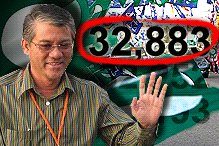 On Saturday, Umno’s candidate Wan Ahmad Farid lost to Mohd Abdul Wahid Endut
(left)
of PAS, who clinched the parliamentary seat with a majority of 2,631 votes.
On Saturday, Umno’s candidate Wan Ahmad Farid lost to Mohd Abdul Wahid Endut
(left)
of PAS, who clinched the parliamentary seat with a majority of 2,631 votes.
Many Malaysian urbanites were in joyous mood the morning after. In coffee shops, hawker stalls, shopping malls and homes, there was lively discussion of the impact and ramifications of the by-election results for the country’s political future.
There was little sympathy for Umno which had obviously received another slap in the face despite being able to call on the superior resources of the Barisan Nasional (BN) - money, machinery, human resources - over the intensive 10-day intensive campaign.
Many urban Malays even see the outcome as reflecting the turning tide in the Malay heartland against the once powerful Umno hegemony.
“Umno can no longer claim to be the champion of the Malays,” said Hussein, 60, a newspaper vendor in Kampung Pandan, Kuala Lumpur.
Echoing the view, chartered accountant KS Goh, 58, of Pandan Desa said: “This is a victory for Anwar (Ibrahim) and Pakatan. It no longer matters whether Umno or MCA are in constant self-denial (in rationalising the loss of electoral support).
 “Only Anwar’s leadership could forge such a victory. Pakatan is on track (to be the alternative government), God willing.”
At the Pudu market, a hawker, who only wanted to be known as Chan, was obviously excited about the prospect of a two-party system.
“There is now a glimmer of hope in fighting corruption, abuse of power and totalitarian methods of political control,” said another hawker, who joined in the conversation.
But the honest outpouring of enthusiasm at the grassroots was in great contrast to those walking the corridors of power. Those in the BN leadership showed no regret over the loss of yet another parliamentary seat.
‘Don’t blame MCA’
Will MCA be content to wait for Umno to make more mistakes and eventually come to grief of its own accord? Until now, MCA has shown more interest in protecting its turf by rejecting any suggestions that it shares the blame for the defeat.
MCA has claimed that Chinese votes have increased in support of the Umno candidate in KT, particularly in the Chinese-majority polling districts.
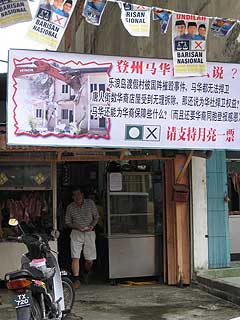 According to party sources, Kampung Cina, Pejabat Bandaran, Paya Bunga, Pulau Kambing and Pantai Terengganu have shown higher Chinese electoral support for BN.
This is despite the fact that the final tally shows Pakatan has walked away with the majority vote in all four state seats within the parliamentary constituency.
Umno, in the old days, was known as the “unstoppable fighting” election machine. But the devastating losses for the BN last March has undermined confidence in that assertion even within the ruling coalition.
MCA, in particular, did not take it for granted that the KT by-election was a ‘sure-win’ situation for Umno and had begun raising its defence against potential apportioning of blame.
Just five days before polling day, MCA Youth chief Wee Ka Siong had said: “Umno should not blame MCA...in order to win, BN must get votes from all races.
“Mathematically, even if the 11 percent Chinese voters give their 100 percent support (to Umno’s candidate) but the rest (89 percent) cannot deliver, it will be the same result (losing the election). Finger-pointing is not the answer.”
 On the same day, MCA secretary-general Wong Foon Meng evaded the issue saying, “as far as MCA is concerned, all the votes from the various communities are important”.
He also downplayed the perception that Chinese voters would play the role of king-maker, adding that “...in the event of BN losing the seat, you cannot say the Chinese factor contributed to that”.
Political observers have said that some 3,000 young Chinese voters did not return to vote in the by-election.
Umno implosion anticipated
Some analysts point out the Chinese factor will not be the only crucial factor in determining the outcome of the next general election.
Umno’s greatest enemy is its own leadership, which looks set to implode. Not only will it destroy itself, but it will bring down other component parties, particularly the MCA.
 With Umno’s obstinacy over internal and electoral reform, there is genuine fear in MCA that the next political tsunami will be even more devastating - even leading to the likelihood of BN being wiped off the electoral map.
As far as the Chinese community is concerned, the writing is on the wall. Negative perceptions toward MCA or Umno will reach saturation point and the electorate will no longer care whether BN parties undertake leadership reform. If the Malay heartland finally abandons Umno, BN is as good as dead.
The influence of the Chinese factor via MCA is diminishing, as the community leans towards a stronger position in Pakatan.
They see MCA as incapable of changing Umno’s destiny, as it merely navigates its journey according to the whims and fancies of its political master.
Jian feng shi duo (sail the boat according to the wind) is a popular saying. If MCA only acts or reacts to Umno’s political wind, this will result in disaster for the party.
Impartial party watchers said the KT by-election has shown up BN’s underhanded tactics, arrogance and hypocrisy, while illustrating MCA’s subservience and silence on alleged widespread money politics during the campaign.
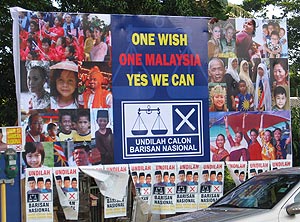 A popular Chinese idiom describes the BN’s campaign speeches as
kong kou shuo bai hua
(making empty promises) and
kou shi xin fei
(being insincere).
A popular Chinese idiom describes the BN’s campaign speeches as
kong kou shuo bai hua
(making empty promises) and
kou shi xin fei
(being insincere).
Other BN-coalition members could not care less whether the campaign was bankrupt of political wisdom and integrity, so long as they stumbled to a win.
“It no longer matters to them whether the campaign runs contrary to MCA’s politics, Chinese ethical-moral philosophy and Confucianism,” said a supporter, referring to allegations of money politics.
A teacher, well versed in the Chinese ‘art of war’, asked with sarcasm: “What is the use of (BN) having qian jun wan ma (1,000 soldiers and 1,000 horses)?
“When Pakatan raised its flag, the battle was won ( qi kai de sheng , or victory was easily achieved). Money politics can no longer buy electoral victory or public trust and respect.”
He added that there is hope for the country now because there are conscientious voters among Malaysians irrespective of race.


Are you sure you want to delete this comment?
This action cannot be undone.