




Another Merdeka? - Return of the repressed
Our co-existence as a people is on precarious ground as we continue to witness all kinds of contestation between the people and the government of this ‘nation’. A nation with people going on protest marches to symbolic signposts of democracy, or the streets, and a government brandishing internal security laws, displaying its power through a show of force and the use of repressive technologies cannot go on indefinitely.
Our co-existence as a people is on precarious ground as we continue to witness all kinds of contestation between the people and the government of this ‘nation’. A nation with people going on protest marches to symbolic signposts of democracy, or the streets, and a government brandishing internal security laws, displaying its power through a show of force and the use of repressive technologies cannot go on indefinitely.
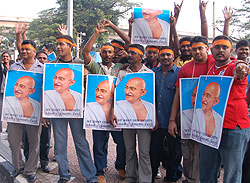 While most of our politicians, young and old, present and retired, keep harping on other ways of communicating the demands for equality and justice and not going to the streets, no one has suggested how. Can anyone really deny that some of the formal and informal, direct and indirect meetings between the people and government now have only come about because there were some street protests?
While there have been definitely some very appreciable responses - even if some people feel that it could be part of a damage control psychological strategy to recover legitimacy and votes - long term solutions for the people’s legitimate expectations have yet to become part of the national policies or political will. We simply cannot have the cake and eat it too or make efforts to change by doing ‘business-as-usual’.
In the final analysis, there is no way any government is going to win the clash it unwittingly engages with history (of justice). Even if it takes two or more generations, even if the path to it (justice) is filled with isolation and even if ‘Bodies of the National Opposition’ are put through biological and psychological pain, history has repeatedly shown that justice will prevail…eventually. It is only up to us to determine, as a society, at what cost we want that and what historical legacy we want to leave behind.
What we see today on the streets of Kuala Lumpur seems to be really the “return of the repressed” – the idea of a dialogue-based multicultural and just Malaysia. Disrupting ‘normal’ flow of life, the repressed will keep coming back until we are mature and become wise enough as a people to address it by getting to the root of the problems we face, instead of indulging in symptomatic treatment (or showing how clever we are in manipulating statistics or how organised we are in the show of force).
The Matrix: Socially toxic institutional reality
A ‘socially toxic’ and unsustainable institutionalised matrix is repressing a hopeful dream and choking this nation, sending it into deep convulsions periodically, intensely affecting each one of us in different ways. Different components of the institutionalised matrix have been carefully nurtured over the last 50 years and have contributed to skewed growth, benefitting a minority on the one hand and hurting many citizens who voice their legitimate demands for equality and justice, on the other.
The unsustainable and chameleon-like institutional matrix has been constituted by a hegemonic agenda shaped by ethnocracy, economism and executive supremacy. This is, in a sense, also the ‘socio-technical womb’ that produces, and continues to produce, a set of social identities that makes Malaysia unsustainable. The socio-technical womb is nurtured by an ethnocracy that victimises through an ethnic hegemonic agenda, an economism that privileges a few and marginalises many and the ‘supremacy of the executive’ that demonises any opposition, even the other arms of democracy.
In such an institutional matrix, multiculturalism and democracy, equality and justice are continuously lost as practice and as values. They have become crippled casualties.
Ethnocracy
We seem to have started our national life on a wrong footing. In the late 1940s, this nation lost the opportunity to choose a path to true dialogical multi-culturalism and a social contract of co-existence based on faith, trust and common destiny. The exclusion of the ‘Malayan Union idea’ (even if we disagree with the way it was to be implemented) and its further development killed, the possibility of growing a genuine multicultural Malaya/Malaysia, where all people brought together by history to build it, were to be treated equally and fairly. As some Malaysians feel today, the communities were forced together only on the basis of a constitutional framework that had a built-in hegemonic agenda and certainly not on the basis of any social contract between equals.
Fifty years have passed, we, as a people, still need to work out that social contract. The rejection of the Malayan Union idea, and the spirit behind it, and years later in 1951 the departure of Onn Jaa’far from Umno that he helped form - when it did not want a Malayan perspective but just a Malay perspective - sowed the seeds of some of the serious discord we see today.
We have been entangled with the notion of ethnocracy from then, moving away slowly from a Malaysia where we will be nation with ‘one heart and one mind’. Race-based politics, race-based affirmative action policy, National Culture policy and Ketuanan Melayu all need to be re-visited/re-addressed by our wise and guided by our individual and collective wisdom.
 Some year ago, a gentle, rustic-looking elderly Malay Malaysian taxi-driver, during a very frank exchange on religion when he took it upon himself to apologise to me for the breaking of Hindu temples, shared his opinion about Ketuanan Melayu. He said something like this: “If
Ketuanan Melayu
is about being aggressive, then it involves breaking us into groups and applying the principle of exclusion…and pulling out the
keris
to threaten or frighten others. If
Ketuanan Melayu
is about peace, then it must be based on the principle of inclusion. Ketuanan Melayu must be protective not aggressive, must be nurturing not destructive, particularly when the others…(many born here)… have come here to help build this country…That is the real Malay Culture.” We need to recover such wisdom among our people and use them to guide our future, together.
Some year ago, a gentle, rustic-looking elderly Malay Malaysian taxi-driver, during a very frank exchange on religion when he took it upon himself to apologise to me for the breaking of Hindu temples, shared his opinion about Ketuanan Melayu. He said something like this: “If
Ketuanan Melayu
is about being aggressive, then it involves breaking us into groups and applying the principle of exclusion…and pulling out the
keris
to threaten or frighten others. If
Ketuanan Melayu
is about peace, then it must be based on the principle of inclusion. Ketuanan Melayu must be protective not aggressive, must be nurturing not destructive, particularly when the others…(many born here)… have come here to help build this country…That is the real Malay Culture.” We need to recover such wisdom among our people and use them to guide our future, together.
The National Culture debate in the 70s and 80s did not leave the people of Malaysia a framework and practice of National Culture that was acceptable to all. It is an emotionally unresolved aspect of our unsettled national life, which continues to affect us. The 1971 National Culture Policy of Malaysia emphasised the following: (1) the National Culture must be based on the indigenous Malay culture (2) suitable elements from the other cultures may be accepted as part of the national culture and (3) Islam is an important component in the moulding of the National Culture. While recognising the presence of other cultures, the National Culture Policy only marginally paid attention to their possible cultural contribution. The submissions of the many memoranda of non-Malay Malaysian ethnic communities in the mid-80s re-capture the tensions of the 1940s and our inability to establish a genuine social contract among the ethno-communities. Another opportunity was missed.
The consequences of this are felt everywhere and in many forms. Putrajaya is a beautiful place though not designed and developed with sustainability in mind. It is not just about ecological sustainability but also cultural sustainability. The architectural aesthetics and social space dynamics found there does not reflect a Malaysia we so fondly portray in our PR films during festivals and national days. It raises the questions of who the owners of Putrajaya are? There seem to be more Arabisation than Malaysianisation. If this is not bad enough, there is a recent report of the Shah Alam map that is completely devoid of Indian/Hindu places. Many years ago, a heritage Chinese cemetery was threatened of destruction because we were caught up with the ‘property development itch’. The list is endless.
As it stands now, discord between the communities unfortunately seems only functional and necessary for maintaining ethnic silos that feeds our brand of ethnocracy. An elite minority, across the communities, benefits immensely from the existence of ethnic silos. And that simply means that the various ethnic communities in Malaysia will continue to be on a collision course, but not really there. The possibility of collision will be played out again and again. It is a function of survival of the present form of politics.
Part II: Economic extremism
Dr M. Nadarajah is a sociologist by training. He is Secretary of the Asian Communication Network (ACN), an inter-faith and inter-disciplinary social communication initiative, based in St John’s University, Bangkok. He belongs to the Asian Public Intellectuals (API) Community, a community of filmmakers, theatre people, song writers, poets, activists and academics working in Thailand, Malaysia, Indonesia, Philippines and Japan for a better Asia. His work focuses on cultural and sustainability issues.


