




The Lady and I (Pt 2)
Former UN Special Envoy Razali Ismail sought to negotiate between the opposition party and the military regime from 2000 until 2005. He recalls his meetings with Burma's most famous prisoner, Aung San Suu Kyi.
When I went back to see Suu Kyi, statistics melted away. There was a clear focus, and of course, hers was political - the prime objective must be to win democracy for Myanmar so that the people could understand and benefit from democracy and development, improve their lives and be protected by the rule of law. She knew how far behind Myanmar was in that sense.
Former UN Special Envoy Razali Ismail sought to negotiate between the opposition party and the military regime from 2000 until 2005. He recalls his meetings with Burma's most famous prisoner, Aung San Suu Kyi.
When I went back to see Suu Kyi, statistics melted away. There was a clear focus, and of course, hers was political - the prime objective must be to win democracy for Myanmar so that the people could understand and benefit from democracy and development, improve their lives and be protected by the rule of law. She knew how far behind Myanmar was in that sense.
I asked her, "You are seen to have banded together with the West, to have adopted what the West wants; your cry for democracy, what motivates it? Is the aim of democracy to help the repressed of Myanmar or is this the exhortation of the West?" I told her that this was one of the reasons why she had alienated some of her Asean neighbours, why they looked upon her with unease. Her struggle, I said, should be manifestly seen to be one from within and not appear to be at the behest of others.
She would bridle at these accusations and would often let loose about Asean - "What has Asean done? I should have gotten help from them, but what have they done? Their ambassadors are afraid to see me." There had been instances when Asean had been shocked out of its complacency to act on her behalf, as when the Depayin incident occurred on 30 May 2003. In that instance, Suu Kyi and a big number of her supporters were ambushed in the northern village of Depayin. But the Asean mantra of non-interference has allowed for a situation where Asean contributes to a status quo situation much to the detriment of the people.
So little being done
When she was to be released from detention in 2002, one of the understandings was that she would not go out and demonstrate or speak badly of Myanmar outside. She was to help the government bring about good things for the people. But you are talking about an icon - you release her, everybody flocks to see her. She was always particular about not creating demonstrations, but after a while she could see that there was so much to be done yet so little was actually being done.
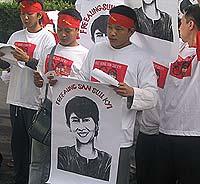 With people pleading to her to help, her visits took on political overtones. She became more of a politician and started traveling farther outside of Yangon [Rangoon]. Everywhere she went, tens of thousands followed. The military leaders were disturbed. I made the point to a minister I knew for some time that it would be a mistake to let Suu Kyi travel around and not begin the critical talks between the government and the NLD.
Then Depayin happened and she was nearly killed. She was unceremoniously clapped into prison. They did allow me to see her after it became untenable for them, though they never told me she was in prison. They called me, so I went. It was like one of those detective stories - they changed cars, changed drivers, I had no idea who the guy behind the wheel was. I got into the car and I thought, "What on earth am I doing?" I was driven farther and farther and I was all by myself. I thought, "Am I going to be safe?" There were cars with tinted windows following. Then all of a sudden, we had arrived. And what a destination it was, Insein Prison, the general prison where all manner of crooks and criminals were gathered. Pronounced like "insane," the irony of the prison's name was certainly not lost on me. Inside the compound, I was driven first to the left, then to the right, then finally, to a concrete hut.
And there she was. In a small concrete hut with a well outside. I went in to see her and was shocked. She was dishevelled, totally unlike the vision who usually greeted me. She said to me, "I want justice, Raz," and then turned to one of the military officials she knew who was standing beside me and commanded, "I want my clothes. From my house. I don't want to wear these clothes that you've given me. And I want all my make-up to be brought to me." I was taken aback by the fact that her humanness was betrayed by this.
Then she said, amazingly, that she was prepared to turn the page for the sake of the people and reconciliation, saying she was still prepared to talk to the government. When I got back to Khin Nyunt, I was angry and sad. I said, "How can you do this? What am I supposed to tell the world?"
So I kept quiet for a while and did not tell the world she was in prison. I did say that she was safe and that her spirit was strong. I told only the UN Secretary-General that she was in prison.
Marionette of the West
The last time I saw Suu Kyi was in March 2004 when she was back at her home under house arrest. She reiterated her readiness to meet the generals, despite Depayin, for the sake of the people. Suu Kyi had come a long way to realize that democracy can only be done through the generals, with the latter still in the driving seat.
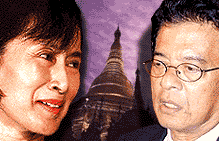 This realization of hers is in stark contrast to the imperious, principled and unbending Suu Kyi I had met over twenty meetings ago. She was hugely concerned as to how far behind Myanmar was compared to its neighbours. She was equally disturbed by the fact that other ethnic groups were not given a level playing field, the Rohingyas, for example. I was unable, to the very end, to make the generals recognise and acknowledge the changes in Suu Kyi. Than Shwe continued to label her as a marionette of the West and quite recently efforts are afoot to make Suu Kyi irrelevant to Myanmar.
I think that Than Shwe sees me as being close to Khin Nyunt, which is true, because since he allowed us to work together, we developed a good relationship. Since I am viewed as being part of him or his period, I know they would not want me. Thus my resignation as the UN special envoy is timely and allows them to consider someone else. It is a pity, though, I have built a broad base of useful contacts with Khin Nyunt and the others, including the ethnic groups, and these same people might come back to power.
Now looking back, I cannot help but feel that we did not do enough to ensure the continuing survival and role of Khin Nyunt. So with Myanmar, I do not see any prospects of change, as there are no internal dynamics operating there.
So the Lady languishes in detention for God knows how much longer, one season after another, from the monsoon, the cool season and the mango showers. I do not know how she does it, but I do know that she will remain unbowed under all circumstances. It is not personal freedom that she is after. She will only accept this if it comes with freedom for her beloved people.
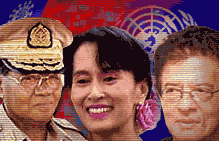 I remember when she was in prison just after the Depayin incident. Her son Alexander contacted me to say that he would like to visit his mother. So I said I would try. When I posed the question to her, she immediately responded with a firm denial, saying that she was no different than any of the others there in prison.
She said, "Why should I be treated differently? Why should my child be allowed to see his mother when there are countless others who never see their unjustly imprisoned mothers again for the rest of their lives?"
Such is Suu Kyi, fortified by her strong principles. Even as I write this, I can see her sitting on that settee, back straight, calm. Awaiting the time when there can be talks or meaningful changes. But does time wait even though she believes she has time on her side? The intransigence of the military and the ineffectiveness of Asean do not provide hopeful signs. But the scent of her bunga melor lingers yet, and she continues to wait, upright, undeterred, in her house. And the people wait with her.
First published in Irrawady magazine. This is an excerpt from Number One Wisma Putra published by the Institute of Diplomacy and Foreign Relations of Malaysia's Ministry of Foreign Affairs in 2006.


Report this comment
Are you sure you want to delete this comment?
This action cannot be undone.