Global Chinese businesses should move beyond discussing artificial intelligence (AI) and translate technological advances, capital and international connections into tangible business opportunities, investment and cross-border cooperation, speakers told the 14th World Chinese Economic Forum (WCEF) in Hong Kong.
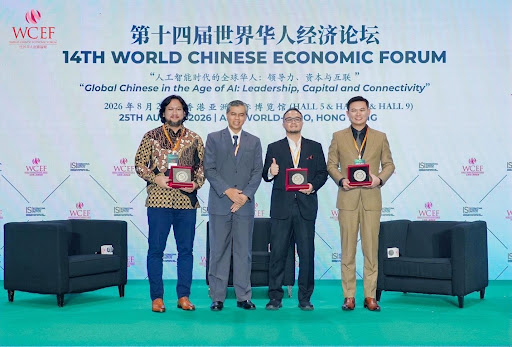
Held at AsiaWorld-Expo under the theme “Global Chinese in the Age of AI: Leadership, Capital & Connectivity”, the Forum brought together business leaders, policymakers, entrepreneurs, academics and technology innovators to examine how AI is reshaping businesses and economies and creating new opportunities for regional and international cooperation.
Key addresses were delivered by Mr. C.Y. Cheah, Founder of the World Chinese Economic Forum and Chairman of the International Strategy Institute (ISI); H.E. Dato’ Norman Muhamad, Ambassador of Malaysia to the People’s Republic of China; and Tan Sri Datuk Seri Panglima Dr T.C. Goh, Permanent Honorary President of the Federation of Chinese Associations Malaysia (Huazong).
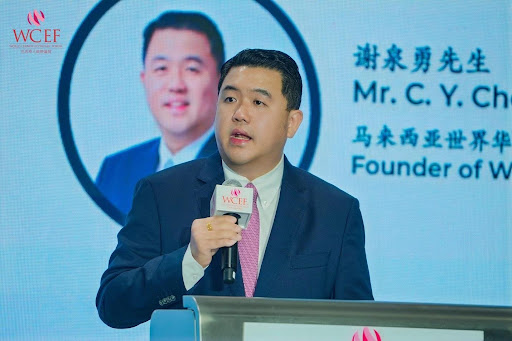
In his opening address, Cheah said AI was no longer merely a technological issue but was increasingly reshaping the global economy, industrial structures, business models and competition between nations. Its impact, he said, could be seen across sectors ranging from finance, healthcare, transportation and education to manufacturing, supply chains and international trade.
Cheah said WCEF, established in 2009, had remained committed to promoting understanding through dialogue and creating value through cooperation by providing an international platform connecting the global Chinese business community with governments, businesses and the wider international community.
Since its beginnings in Kuala Lumpur, the Forum has been held in major cities around the world, bringing together participants from different countries, cultures and industries to exchange knowledge, experience and ideas.
Cheah said the Forum's return to Hong Kong continued that mission by bringing together global Chinese entrepreneurs, policymakers, corporate leaders, academics and technology innovators to consider how technology, capital and cooperation could strengthen international competitiveness in the AI era.
He also highlighted the significance of 2026 as the 35th anniversary of ASEAN-China dialogue relations and the beginning of a new phase under the Plan of Action to Implement the ASEAN-China Comprehensive Strategic Partnership (2026–2030).
Cheah said the continued implementation of the Regional Comprehensive Economic Partnership (RCEP) and advancement of the ASEAN-China Free Trade Area 3.0 were broadening ASEAN-China cooperation into areas including AI, the digital economy, green energy and industrial connectivity, creating new opportunities for Malaysia, ASEAN and the global Chinese business community.
Hong Kong's growing emphasis on AI research and industrial development was also among the reasons for bringing WCEF back to the city, he said.
The Forum was held in conjunction with the opening of the 2026 Global Innovation Show and Global Innovation Summit (GIS), bringing together the commercial experience and networks of the global Chinese business community with AI and innovative technologies.
Cheah said the collaboration provided opportunities for entrepreneurs, investors and technology innovators to establish connections and explore new business opportunities.
He stressed that the Forum should not merely serve as a platform for exchanging ideas, but should also become a starting point for practical cooperation, with innovation, connectivity and collaboration helping businesses navigate the changes brought about by AI.
Malaysia, China and ASEAN well placed for digital transformation
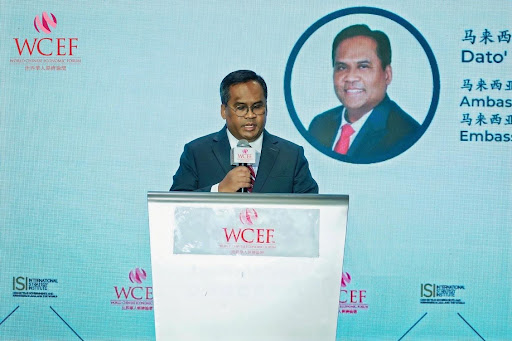
Delivering the keynote address, Dato’ Norman said the Forum's theme was particularly timely as technology continued to redefine how nations trade, businesses operate and societies connect.
He described Hong Kong as a vital gateway linking China with the global economy, bringing together finance and technology while facilitating cooperation across the Greater Bay Area and ASEAN.
Dato’ Norman said Malaysia continued to uphold ASEAN's belief in an open and inclusive region founded on cooperation. “It is not about choosing sides, but building bridges for a peaceful, sustainable, and shared future,” he said.
He said Malaysia remained committed to regional integration, digital innovation and stronger connectivity, priorities that aligned with WCEF's mission of connecting ASEAN, China and the wider global Chinese business community.
Dato’ Norman also highlighted the longstanding Malaysia-China relationship. Referring to Chinese President Xi Jinping's state visit to Malaysia in April 2025, Dato’ Norman said both countries had agreed to build a high-level strategic Malaysia-China community with a shared future to support modernisation and promote regional and global prosperity and stability.
He said AI, digital trade platforms, data-driven logistics and green technologies were fundamentally reshaping economic structures, with trade and investment increasingly driven by digital ecosystems, intelligent networks and seamless data flows.
Malaysia, ASEAN and China, he said, were well positioned in this transformation and together formed one of the world's most dynamic and digitally connected economic regions.
Dato’ Norman also noted that Chinese enterprises were contributing to Malaysia's digital infrastructure, renewable energy and industrial innovation, while Malaysian firms were expanding in China's consumer, logistics and services sectors. However, he cautioned that digitalisation must be accompanied by responsible and inclusive development.
He called for investment in digital skills, ethical governance, strong institutions and cyber-resilience, warning that technology without trust could widen divides while connectivity without governance could weaken cooperation.
Malaysia, he said, emphasised the development of a digital ecosystem grounded in transparency, responsible innovation and equitable access.
Dato’ Norman also identified sustainability and ESG-aligned investment as an important part of the economic transition, with cleaner energy, low-carbon supply chains and responsible production offering opportunities to build industries that are more competitive and future-ready.
He said the future of trade and investment would be shaped by how effectively technology, connectivity and collaboration were combined, while ensuring that innovation created opportunities, empowered businesses and strengthened communities.
Businesses urged to focus on practical AI adoption
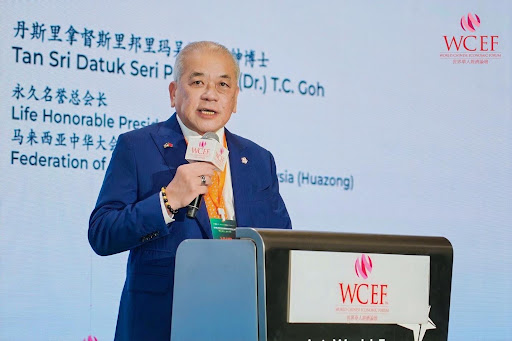
Tan Sri T.C. Goh, meanwhile, called for the connections and discussions generated by international forums to be converted into tangible economic outcomes.
Returning to WCEF for the second consecutive year, he said the impact of a forum should not be judged merely by the scale of the event, but by what happened afterwards - including whether businesses found partners, relationships developed into actual projects and ideas eventually reached the market.
Turning to AI, Tan Sri Goh said the technology was redefining business competitiveness. While businesses had traditionally relied on capital, infrastructure, manpower, market experience and commercial networks, data, algorithms, innovation capabilities and talent had increasingly become important forms of business capital.
He cautioned, however, that business transformation should not begin simply with purchasing technology. Companies should first identify the problems they needed to solve including inefficient processes, costs that could not be reduced, unmet customer needs or business decisions lacking sufficient information before selecting the appropriate technology.
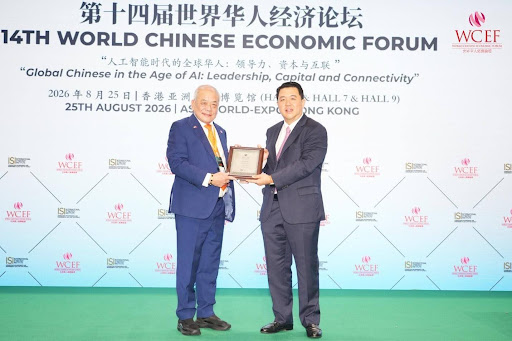
Tan Sri Goh said technology should serve business objectives rather than businesses pursuing technology merely to keep up with trends. The real capability businesses needed to build, he said, was not simply the ability to acquire AI tools, but the capacity to redesign business processes, develop talent and adapt business models.
He placed particular emphasis on ensuring that small and medium-sized enterprises (SMEs) were able to participate in the AI transformation. Many SMEs, family businesses and traditional industries faced practical barriers such as talent shortages, cost pressures, data security concerns and uncertainty over how to begin.
Tan Sri Goh said overcoming these barriers would require support from multiple stakeholders, including clear policy direction, training and appropriate financial support from governments; affordable and practical solutions from technology companies; relevant talent development by universities and professional institutions; and assistance from chambers of commerce and community organisations in connecting businesses with reliable resources.
Malaysia's role should go beyond being a bridge
Tan Sri Goh also said Malaysia's multicultural society, multilingual talent, manufacturing base, semiconductor supply chain and access to regional markets provided the country with opportunities to participate not merely as a user of AI products, but also in related supply chains, manufacturing, research and commercial applications.
He said the Malaysian Chinese community's traditional role as a “bridge” between different markets should also evolve.
The value of such a bridge, he said, should be determined by whether capital, technology, talent and knowledge actually flowed through it; whether businesses found partners; whether SMEs entered new markets; and whether one-off exchanges developed into long-term industrial relationships.
In the new economic environment, he said, Chinese businesses should seek to become participants in technological cooperation, builders of regional brands, integrators of industrial resources and long-term partners in international markets.
Responsible use of AI was another major concern raised during the Forum.
Dato’ Norman emphasised ethical governance, cyber-resilience and responsible innovation, while Tan Sri Goh warned of risks including deepfakes, cyber fraud, misuse of personal data and AI-enabled crime.
Tan Sri Goh said the faster AI developed, the more important it was for laws, governance and public education to keep pace. Businesses adopting AI should consider where their data came from, how personal information was protected, who would bear responsibility when systems made incorrect decisions and whether those decisions could be reasonably explained.
He also stressed the importance of AI literacy among younger generations, saying they should know how to use AI tools while also being able to question their outputs, think independently, use data responsibly and respect personal privacy.
AI could help people work more efficiently, he said, but could not replace human character, judgment or responsibility.
As the Forum concluded, the three addresses converged on the importance of combining technological innovation with leadership, capital, talent, trust and international cooperation.
Tan Sri Goh called for stronger connections between traditional and technology companies, greater transformation support for SMEs, deeper cross-border business and talent cooperation, and continued follow-up after the Forum so that contacts and discussions could be translated into actual projects, investments and market opportunities.
Cheah similarly stressed the importance of moving from dialogue to practical cooperation, while Dato’ Norman called for technology, connectivity and collaboration to contribute towards a more integrated, competitive and equitable economic region.
For more information, visit https://wcef-forum.org & https://istrategyglobal.org
This content is provided by IAF Strategy Sdn Bhd.
The views expressed here are those of the author/contributor and do not necessarily represent the views of Malaysiakini.