




Anwar - Asean and beyond
 Though hardly mentioned in Asean, Anwar Ibrahim was the first among the new generation of Asian leaders who spoke of the importance of 'constructive intervention', a principle which he first laid down in a
Newsweek
op-ed in 1997.
Though hardly mentioned in Asean, Anwar Ibrahim was the first among the new generation of Asian leaders who spoke of the importance of 'constructive intervention', a principle which he first laid down in a
Newsweek
op-ed in 1997.
This was several months prior to the eruption of the Asian financial crisis that brought along his downfall a year later.
To be sure, 'constructive intervention,' which went against Asean's cherished principle of non intervention, first struck a chord in Bangkok, that was then struggling with the refugee inflow from Burma.
As such, the idea was duly taken up by Dr Surin Pitsuwan, a Harvard trained political scientist who was then the Foreign Minister of Thailand.
Due in part to the rapport between Anwar and Surin, both of whom have been friends for years prior to their role in the government, the idea of 'constructive intervention' generated further support in both countries and abroad, leading the Philippines and later on Indonesia, to take the idea more seriously.
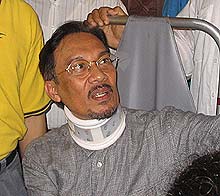 Though hardly mentioned in Asean, Anwar Ibrahim was the first among the new generation of Asian leaders who spoke of the importance of 'constructive intervention', a principle which he first laid down in a
Newsweek
op-ed in 1997.
Though hardly mentioned in Asean, Anwar Ibrahim was the first among the new generation of Asian leaders who spoke of the importance of 'constructive intervention', a principle which he first laid down in a
Newsweek
op-ed in 1997.
This was several months prior to the eruption of the Asian financial crisis that brought along his downfall a year later.
To be sure, 'constructive intervention,' which went against Asean's cherished principle of non intervention, first struck a chord in Bangkok, that was then struggling with the refugee inflow from Burma.
As such, the idea was duly taken up by Dr Surin Pitsuwan, a Harvard trained political scientist who was then the Foreign Minister of Thailand.
Due in part to the rapport between Anwar and Surin, both of whom have been friends for years prior to their role in the government, the idea of 'constructive intervention' generated further support in both countries and abroad, leading the Philippines and later on Indonesia, to take the idea more seriously.
Invariably, it was morphed into a unique concept called 'enhanced interaction' by Indonesian Foreign Minister Ali Alatas. The goal was to give member states of Asean the latitude, indeed the proverbial fig-leaf, that it at least had the right to 'comment' on the policies of others, politely.
Naturally, with the removal of Anwar in 1998, followed by the loss of Surin's Democrat Party in Thailand, coupled with the retirement of Ali Alatas, meant neither 'constructive intervention' nor 'enhanced interaction' would have any advocates. Both doctrines were silently buried in Asean, leaving only a few fringe academics to defend the merits.
Nevertheless, in light of Anwar's release, some of the ideas that he once espoused, whether on Asean or beyond, will now enjoy a revival.
His emphasis on civil society, Islamic authenticity, human rights, the importance of freedom and democracy, all of which formed his concept of Asian Renaissance - as opposed to the rigid Asian Values peddled by the old guards of Asean - will now be dusted off and restored in the lecture circuits in Malaysia and abroad.
Across the Straits of Malacca, there is no dearth of Islamic scholars or foreign policy specialists in Indonesia, such as Dewi Fortuna Anwar, the former advisor to President Habibie, again a friend of Anwar, who will move mountains to get Anwar to speak in Jakarta or elsewhere.
Progressive think tanks in Indonesia, such as the Center for Strategic and International Studies (CSIS), led by Jusuf Wanandi and Hadi Soesastro, will be keen to hear what Anwar has to say too.
Allies in the US
Further afield in the United States, Anwar will not run out of friends or scholars to promote his views. At the Center for Muslim and Christian Understanding in Georgetown University, for instance, it is almost inevitable that Anwar will call on the support of Professor John Esposito and Professor John Voll, both of whom have supported, and carefully chronicled, Anwar's brand of moderate Islam in numerous academic works.
Although 9-11 has eclipsed the standing of these academics, battered as they are by the neo- conservative scholars like Daniel Pipes and Patrick Clawson who don't believe in the 'existence' of a moderate Islam, Esposito and Voll remain influential in North American academic institutions.
Their invitations to Anwar to speak at various universities will come in handy for Anwar to promote his brand of moderate Islam that includes giving Islamic groups greater say in government affairs.
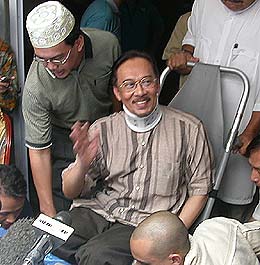 At Harvard University, where Anwar has an admirer in Professor Ezra Vogel, it would not be difficult for Anwar to gain an audience at the Asia Center too. Lawrence Summer, currently the president of Harvard, once worked closely with Al Gore during their days in the Clinton Administration. He may well provide Anwar with an even bigger platform. An invitation to speak in Harvard would of course lead to speaking engagements in Yale, Princeton and elsewhere, all of which have scholars who are well acquainted with Anwar.
Anwar will also seek to connect with the Muslim scholars based in US, especially those based at the International Institute of Islamic Thought (IIIT) in Herndon, Virginia. For years, IIIT have forged a link with the International Islamic University of Malaysia (IIUM), where Anwar once served as its president.
Although IIIT has lost much of its influence in US after 9-11, as some of the scholars there were too closely connected to the Wahabbism in Saudi Arabia, it will be a useful vehicle for Anwar to bring his message to the North American Muslim audience and further afield.
Should Anwar wish to go further than to reach out to elite Muslim institutions in Europe, he only need to engage Professor Talal Ramadhan, a progressive Islamic thinker formerly based in Geneva, but now at the University of Notre Dame. Professor Pervez Manzoor at Stockholm University, whose writings on Islamic issues Anwar enjoys reading will come in as a key backer in Scandinavia too.
If Anwar's plan is to reach out to Turkey, a country on an Islamic ascendance, he can do it via Dr Ahmet Davutoglu, formerly a political scientist at IIUM with whom he is well acquainted. Ahmet Davutoglu, a devout Muslim, who is easily Turkey's leading intellectual today is now the key advisor to the Turkish government on matters verging on Europe and Turkish security in the Middle East.
In the Middle East, Anwar will most likely call on AbuHamid Abusulayman former rector of IIUM, to pave his way further into the region, if anything to gain various forms of moral and financial support. Yusuf Qadhawi, the dean of Islamic studies in Qatar, who is well known in the Gulf region, who is also a good friend of Anwar, will provide his support too. By leaning on Qadhawi's Islamic leanings and scholarships, Anwar will polish himself as a Muslim modernist in grip with classical Islamic scholarship.
Weak in China
What Anwar may be lacking is official and non-official assistance in China, Japan and Korea. These are the countries without an "Islamic dimension" to their society and politics. Indeed, Anwar's views on Asian renaissance have had a limited impact in Northeast Asia, both when he was in the Malaysian government, or out of it.
On the issue of Burma, for instance, the present Japanese government has taken a conservative approach to induce changes in Rangoon. Anwar, being a former political prisoner, would surely call for the release of Aung San Suu Kyi, another prisoner of conscience adopted by Amnesty International.
This message would not be consistent with the priorities of the Ministry of Foreign Affairs in Tokyo. China, meanwhile, seeks to strengthen its relations with Asean. And, Beijing does not want Asean to change in any way, except to liberalise its trade regime. Anwar's message to reform Asean would, therefore, not go down well with leaders there. Besides, Beijing enjoys a close relationship with Prime Minister Abdullah Ahmad Badawi who made his first official trip abroad by going to China on a trade mission with more than 800 officials and top businessmen in tow.
In all, some old networks of Anwar would be revived to create the picture of a new Anwar. In Malaysia, Anwar will have a twin track strategy of reaching out to the local NGOs first - the mainstay of his support before he entered the government in 1982 - to buttress his standing as a 'people's leader'. Given the charisma and standing of Anwar, chances are a majority of the NGOs in Malaysia will indeed tip their hats to him.
At the same time to ensure his relevance in the party realm, Anwar will also use Parti Keadilan Rakyat to move into the territory controlled by Umno to strike some fear into the party incumbents. This is to declare that he is not a spent-force.
In Asean, Anwar may well have a role to play if there are further violent eruptions in southern Thailand, whom authorities in Bangkok believe are led by a former Thai Muslim lecturer who once worked in IIUM.
Although Anwar is not a dominant force on IIUM campus anymore, having left it six years ago when he was imprisoned, he could use his previous good office to bring some pressure to bear on the Thai separatist movement, a move that nevertheless would be categorically opposed by the Malaysian government as it complicates Prime Minister Abdullah and his deputy Najib Abdul Razak's efforts to bring stability to the region by first helping Thailand to reform the Islamic school system in the five southern provinces of Thailand.
If there are further conflicts in southern Philippines, Anwar could also be called upon by Manila to quietly ease the friction, due to Anwar's ties with the Islamic movement in Mindanao. Having said that, Anwar's old compatiot, Nur Misuari, does not have any standing in Mindanao anymore. So, Anwar's impact on this region has reduced significantly.
Internationally, Anwar's networks are most dominant in the universities and think-tanks in the US, especially in the New England areas. In the West coast, Anwar would have to rely on John Mallot, former US ambassador of Malaysia, who is arguably the most ardent US supporter of Anwar's freedom, to speak in Stanford University, University of California and elsewhere.
All these speaking engagements will help Anwar restore his standing as a democrat. Though in the Middle East, Anwar would have to project himself as an Islamist who also believes firmly in democracy.
Since some of the sheikhdoms that support Anwar abjure any talks of democracy, Anwar would have to curtail his democratic exuberance in this region.
Global events
What Malaysian audience will see, however, is an Anwar neither old nor new in the interim. Rather one who will take on the profile of an activist and advocate - if not of Islam, then certainly that of an Asian renaissance that embraces democracy and good governance - in an engaging and charismatic manner. This is how he will pull in the crowd, to once again project himself as a leader with values and vision, not just for Malaysia, but Southeast Asia writ large.
The issue foremost in the mind of many is: How much can Anwar change in Malaysia first? The answer to this question, incidentally, revolves on globalisation.
If Malaysia can globalise based on its old way of doing things, which tolerates patronage and in built inefficiency that favors long-term stability, then Malaysians need not buy into the vision or value of Anwar.
On the other hand, if Malaysia is continuously undercut by the hyper competitive China, then obviously needs to be reformed soon - from the mindset of the policy makers right down to the work habits of the common Malaysian.
Anwar's chances of being re-embraced as a key leader, therefore, relies on how much Anwar understands global events, rather than to purely focus on democracy, freedom and progressive Islam only.
It also depends very largely on how secure Malaysians feel about their future given the advent of globalisation - led by US - and the increased competition coming from China.
Since Anwar is weak on China, both in networking into it, as well as to understand it, this is one area that will see Anwar doing a lot of work to catch up.
PHAR KIM BENG is author of Eye Eye You column in malaysiakini . He graduates from the International Islamic University in 1994 as a Muslim revert, having previously been a Buddhist. He has travelled around the world studying at the University of Notre Dame, where he understood the beauty of Catholic scholarship, the University of Cambridge, where he learned the importance of British education, and later the University of Tokyo, where he learned his survival Japanese.


