




A blow to Pak Lahs men
When the results of the triennial party elections at the 55th Umno general assembly were announced last week, many were stunned. It was obvious that Abdullah Ahmad Badawi's men, including several members of his cabinet, had lost in the polls.
 Those who won were staunch supporters of former Umno president Dr Mahathir Mohamad (read: deputy president Najib Abdul Razak's men). This includes Federal Territory Minister Mohd Isa Samad, who had prior to this been considered by many to have no hope of winning a vice-president post, garnered the highest number of votes among the seven vice-presidential candidates.
On the other hand, incumbent vice-president Muhyiddin Yassin, who had been predicted in the early stages to have no problems retaining his post, almost lost - he came third. Muhyiddin held on to the last of three vice-president posts by defeating another incumbent, Muhammad Muhd Taib by a slim margin of about 60 votes.
When the results of the triennial party elections at the 55th Umno general assembly were announced last week, many were stunned. It was obvious that Abdullah Ahmad Badawi's men, including several members of his cabinet, had lost in the polls.
 Those who won were staunch supporters of former Umno president Dr Mahathir Mohamad (read: deputy president Najib Abdul Razak's men). This includes Federal Territory Minister Mohd Isa Samad, who had prior to this been considered by many to have no hope of winning a vice-president post, garnered the highest number of votes among the seven vice-presidential candidates.
On the other hand, incumbent vice-president Muhyiddin Yassin, who had been predicted in the early stages to have no problems retaining his post, almost lost - he came third. Muhyiddin held on to the last of three vice-president posts by defeating another incumbent, Muhammad Muhd Taib by a slim margin of about 60 votes.
Minister in the Prime Minister's Department, Mustapa Mohamed, who has been described as one of Pak Lah's men, failed to win a vice-presidential seat. Meanwhile, Malacca Chief Minister Mohd Ali Rustam won second placing in the three vice-presidential seats at stake.
At the supreme council (SC) level, some of Pak Lah's candidates were also bundled out. None of the candidates with religious backgrounds won, even though Pak Lah's administration is heavily dependent on the success of his Islam Hadhari concept. This includes Pak Lah's religious advisor, Hamid Othman.
Is this because the delegates were exercising their 'democratic right' to pick their own line-up for the party, so much so that Pak Lah's men were sidelined?
Pak Lah spooked?
 Indeed, the implications of the 'freak' poll results go deeper than the mere exercise of 'democracy' by delegates. This is all the more so because Najib spent half of the time allocated for his concluding speech to reiterate his pledge of loyalty to Pak Lah.
Why did Najib need to do so if he has all along been loyal to Pak Lah. It is clear that he felt he had to do so because many of his supporters won while Pak Lah's men lost. He would not want to overtly spook Pak Lah's camp.
Muhyiddin, who is considered a Pak Lah strongman, in his concluding speech called for the SC to be expanded with the appointment of 'his friends' who had lost key posts in the party to sit in the council. That will ensure that Pak Lah will still be surrounded by some his men in the party's top decision-making body.
Pak Lah himself, in his concluding speech, welcomed the suggestion, and openly named several defeated candidates, including Tok Pa (Mustafa), Adnan Yaakob and Kadir Sheikh Fadzir, to be given responsibilities in the party.
Strangely, he also said that 'the deputy president had agreed' with the suggestion. The question is: Why he, as president, needed to obtain the agreement of the deputy president to make the appointments - something which is the prerogative of the party leader?
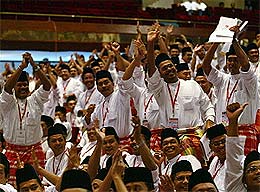 In any case, what is the message the 2,500-odd delegates sought to send to Pak Lah?
For example, did they disagree with the line-up of pro-tem officers appointed by Pak Lah when Umno divisions were dissolved after the constituency boundaries were redrawn? Did they also disagree with the list of Umno candidates selected to stand for state and parliamentary seats during the last general elections?
Or were they not in agreement with the appointments of ministers, deputy ministers and parliamentary secretaries from Umno in Pak Lah's cabinet?
Opportune time
Based on the party polls last Thursday, this appears to be so.
Earlier, the delegates did not want to 'muddy the situation' within the party, and so opted to wait for the opportune time - the polls last Thursday - to say what they had kept in their hearts all along.
 If that is really the case, then what veteran leader Tengku Razaleigh Hamzah (Ku Li) had argued - that some grassroot members did not agree with several decisions made by Umno under Pak Lah, is true. The difference is, Ku Li had stepped forward to voice his dissatisfaction and offer himself to contest the party presidency.
But he failed to secure enough nominations to challenge Pak Lah. Perhaps the members did not agree with Ku Li's methods after Umno was once declared illegal when he challenged Mahathir for the presidency in 1987. Clearly, they did not want a repeat of that in the recent party polls.
However, there is still something not quite right with the results of the Umno party polls this time. As has been mentioned above, Najib tried to 'calm' Pak Lah's feelings by pledging to be a loyal deputy, and never to stab him in the back.
In order not to be too obvious about why he needed to do so, Najib stated that he had known Pak Lah for the last 30 years, while Pah Lah was loyally serving under his late father, Abdul Razak Hussein.
As such, he said, the time had come for him to serve Pak Lah, something which, according to him, was fated to happen.
Najib strengthens his hand
Even this pledge was not enough to end niggling questions on the shift in power. Whether they liked it or not, Pak Lah and his men had to accept the reality that Najib's strength has grown after the polls last Thursday.
Were the victories linked to money politics? This appears to be something blown up by the mainstream media to divert attention from the matter of Pak Lah's men losing to Najib's men.
Because of that, it was portrayed as if there were parties toting bags full of money to be distributed on the eve of the party polls.
Perhaps that could cloud the public's eyes, especially the eyes of Umno members who were not present in the Putra World Trade Centre, and only followed Umno general assembly developments through the media.
Aside from that, there were also some parties who considered that Pak Lah was not firm in enforcing the rules and guidelines which had been fixed early on before the selection of divisional and branch level delegates.
Originally, the Umno management committee had banned all forms of campaigning which involved the media. Candidates were also not allowed to have meetings with, or hold functions for, delegates with the intention of campaigning.
Loosening the rules
But after the divisional polls had ended, the management committee suddenly announced that candidates could campaign via the media with the proviso that they do not criticise their opponents.
During the weeks leading up to the party polls last Thursday, the Umno management again loosened the rules to allow candidates to organise meetings and functions to lobby the delegates.
 There were some who considered that as depicting how Pak Lah is easily influenced, and how the decisions and rulings which have been made by the Umno management committee can be quickly changed.
But there are some parties who saw the party polls results from a different perspective. They see it as evidence of efforts to sideline Muhyiddin, who is at this point Najib's closest challenger.
As such, did the delegates who supported Najib vote against Muhyiddin? Did the delegates from Umno Youth, which is led by Najib's cousin Hishammuddin Hussein, also vote against Muhyiddin?
Though it cannot be confirmed, this possibility clearly exists. Hishammuddin, who had initially been attracted by the suggestion that he contest the vice-presidency, suddenly changed his mind and instead opted to remain as Youth head.
And what is more interesting, he teamed up with Pak Lah's son-in-law, Khairy Jamaluddin, to lead Umno Youth. Hishammuddin also said that he only wants to lead the Youth for one more term. After that he will step down in favour of Khairy, who is now his deputy.
Was Hishammuddin's decision a part of the political framework to ensure that Najib's position as deputy president is not threatened by the presence of Muhyiddin?
NASH RAHMAN is malaysiakini's news editor.


