




Pacific War in Msia, Spore remembered (Part 1)
Next year will be the 60th anniversary of the end of the Pacific War (1941-1945), a traumatic series of armed conflicts and conventional warfare between Japan on one hand and the United States, Britain, France, Holland, Australia and New Zealand on the other.
Beginning with the Japanese strikes at Kota Baru in Kelantan and Pearl Harbour in Hawaii, the hundreds of battles and other engagements were fought between the two sides from Imphal and Kohima on the India-Burma border to Peninsular Malaysia, Singapore, Sabah, Sarawak, Sumatra, Java, Timor, the costal areas of Kalimantan, the Philippines, New Guinea as well as the
Pacific islands of Hawaii, Midway, Wake, Guam, Guadalcanal, Savo, Makin, Lae, Salamaua and Solomons.
They were fought not only on land and in jungles, but also on and below the seas and in the air. There were also irregular warfare and special operations, both professional as well as voluntary, in occupied areas such as the Kinta Valley in Perak where the legendary towns of underground resistance like Ipoh, Chemor, Kampar, Papan, Pusing, Batu Gajah, Tanjung Tualang, Gopeng, Tapah, Bidor and Malim Nawar have become parts and parcels of the collective memory of those of survivors and their offspring.
Next year will be the 60th anniversary of the end of the Pacific War (1941-1945), a traumatic series of armed conflicts and conventional warfare between Japan on one hand and the United States, Britain, France, Holland, Australia and New Zealand on the other.
Beginning with the Japanese strikes at Kota Baru in Kelantan and Pearl Harbour in Hawaii, the hundreds of battles and other engagements were fought between the two sides from Imphal and Kohima on the India-Burma border to Peninsular Malaysia, Singapore, Sabah, Sarawak, Sumatra, Java, Timor, the costal areas of Kalimantan, the Philippines, New Guinea as well as the
Pacific islands of Hawaii, Midway, Wake, Guam, Guadalcanal, Savo, Makin, Lae, Salamaua and Solomons.
They were fought not only on land and in jungles, but also on and below the seas and in the air. There were also irregular warfare and special operations, both professional as well as voluntary, in occupied areas such as the Kinta Valley in Perak where the legendary towns of underground resistance like Ipoh, Chemor, Kampar, Papan, Pusing, Batu Gajah, Tanjung Tualang, Gopeng, Tapah, Bidor and Malim Nawar have become parts and parcels of the collective memory of those of survivors and their offspring.
For the elderly generation of Malayans and Singaporeans, they remember not only the 44-month occupation but also the 70 days of collapsing defence and continuous southward retreat of the British, Australian and Indian troops, whose survivors finally had to surrender in Singapore on Feb 15, 1942. The 70-day failed defence is now known as the Malayan Campaign.
Greatest defeat
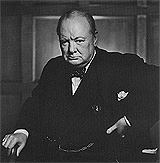 In the words of the then Prime Minister of Britain, Sir Winston Churchill, the fall of Peninsular Malaysia and Singapore in only 70 days was the greatest defeat in the military history of the British Empire.
According to British war historian Sir Martin Gilbert, at the surrender, 32,000 Indians, 16,000 British and 14,000 Australian soldiers were taken prisoner (see The Second World War C A Complete History, New York, Owl Book, 1991; p. 300). More prisoners were added later, and many of them were to die while being detained as prisoners-of-war.
In a memorial service held by the Chinese community to honour the memory of 18 resistance partisans in Kuala Lumpur last year, it was recalled that during the 44 months of occupation, about 70,000 people of all ethnic communities were killed.
Another 80,000 perished as the result of torture and imprisonment and also an additional 300,000 died because of malnutrition and physical exhaustion in performing forced hard labour.
The failure and ignominy also had other serious and far-reaching political and strategic repercussions. These include, among other things, the upsurge of postwar anti-colonial nationalisms in Malaya and Singapore - where local people felt betrayed by their self-styled protector, and the postwar decisions of Australia and New Zealand - to seek a new military alliance with the United States, which were seen to be more effective and trustworthy as the security umbrella in the Pacific and the world.
But why were the some 100,000 British, Australian and Indian troops defeated in such a short period of time by their Japanese counterparts with only half of the number? This has been a passionate controversy and emotional question for the past 63 years, especially among the survivors of the Malayan Campaign now scattered in Malaysia, Singapore, Britain, Australia, Thailand, India and Pakistan, China, Hong Kong and Macau.
Many memoirs and academic studies have also been written about the Malayan Campaign and the latest book is Did Singapore Have to Fall? Churchill and the Impregnable Fortress, authored by Karl Hack and Kevin Blackburn and published earlier this year by Routledge Curzon in London.
E-mail interview
Recently, malaysiakini interviewed, via email, Karl Hack in Singapore and attempted to extract some latest insights and perspectives of the traumatic series of events, its consequences and repercussions as well as the collective memory of it in Malaysia and Singapore.
Karl Hack is Associate Professor in the Humanities Academic Group at the National Education, Nanyang Technological University, Singapore. Born in Changi, Singapore in 1966, he was raised in England and educated at Oxford. He returned to Singapore to teach history in1995.
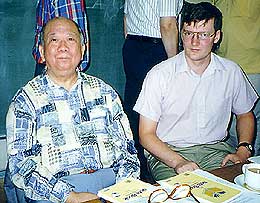 Besides meeting and interviewing Chin Peng in the Canberra Dialogue in 1999, Karl Hack also co-edited the dialogue sessions with another historian Chen Jian. The resulting book is titled Dialogue with Chin Peng, New light on the Malayan Communist Party. He is also the author of another major book titled Defence and decolonisation in Southeast Asia, Britain, Malaya and Singapore, 1941-68.
Reproduced below is a four part series of the in-depth and comprehensive interview between Karl Hack and malaysiakini on the many themes and sub-themes related to the Malayan Campaign:
Q: Many books, monographs and memoirs on the Pacific War in Peninsular Malaysia and Singapore have been written and published since early 1950s. Why did you and Kevin Blackburn still find it necessary to write another one, Did Singapore Have To Fall? Churchill And The Impregnable Fortress and publish it some 63 years after the beginning of Japanese attacks on Kota Baru in Kelantan, Pattani and Songkhla in Southern Thailand, Singapore and Pearl Harbour?
A: The huge number of books is precisely what made us think that another was desperately needed. When I first asked myself why Singapore fell, a decade and a half ago, I found books beyond number.
I remember sitting in Oxford's Rhodes House, nearly submerged under towering piles of tomes old and not so old, and feeling a mixture of awe and rising despair.
For most of these books, except those that told rather unanalytical stories, concentrated on just one central cause. According to which work you chose, Singapore fell for the lack of enough ships, or for failure to launch Operation Matador with its emphasis on seizing Thai ports so as to prevent Japanese landings, or because of tactical failings in Malaya and Singapore, or because Churchill deliberately neglected Singapore and sent the tanks and aircraft it needed to Russia and Egypt. But each work was isolated in its own silo.
Visualise events
There was no single monograph which gave a good overview. So we said: let's write a book which guides people through the tangle of debates, with enough maps and photographs to allow them to visualise events.
 In short, we wrote the one-stop, scholarly but reader-friendly work we thought people needed, covering everything from the 1921 decision to build a base, to twenty-first century commemoration. We are now looking forward to its publication as a paperback as well, sometime next year.
But what goaded us into making this idea into reality was a request that came out of the blue, in the latter part of 2001. Dr Blackburn, myself and a team at Singapore's National Institute of Education, were asked, by the Singapore Tourism Board, to research Singapore's five 15-inch coastal guns, for a project that resulted in a replica gun opening near Changi's airport and
prison, on 15 Feb 2002.
Anyone who visits Changi Chapel and Museum can now pop round the corner and see the replica as well.
I can still remember the sense of the bizarre when we first went to visit the site the tourism board wanted developed. Nothing was left above-ground. Almost nothing, that is, except some rusty old hatches hidden in the grass, next to some scruffy banana trees, near to Changi prison.
From one of these hatches, clad in gangly rubber boots, we plunged vertically, 60 feet down creaky ladders, into the watery bunker below. All that was left was nuts and bolts, a sign, and a small frog which swam towards us out of the gloom.
This was one of the tunnels which once housed the guns' shells, generators and winching gear. It is now the only remaining bunker of Singapore's biggest coastal guns. Alas, the tunnels themselves are not open yet, but at least they are marked out above ground, with a replica gun and shell.
Anyway, we researched the guns, dispatching assistants to artillery museums and ordinance records and scouring fortress society magazines: all very arcane stuff to us, let alone the layman. But what gradually emerged from this laborious detective work was anything but arcane.
We soon realised that our research could help to explain why there had been a persistent myth about these weapons - which were literally great battleship guns emplaced on land, and capable of firing a shell the weight of a family car twenty miles to sea - had been so persistent.
Churchill's delaying tactic
The reason was that, though many guns could and did turn from the sea to join the battle for Singapore, the myth of 'the guns that faced the wrong way' symbolised inadequate preparation for a rear defence line around Singapore. But this in turn linked to something much bigger, and more important. It led us to see just how far Churchill based his decisions on a view of Singapore plus southern Johore as the ultimate 'fortress-like' or 'hedgehog-like' defence line for the area, which he assumed had been properly fortified. For him fighting in Malaya was alright as a delaying tactic, but nothing should compromise a final stand here. For him, Singapore was or should be 'a fortified place'. For him Malaya was less important: ultimately expendable.
But for Churchill's commanders a forward defence in Kedah and the Kra, followed by a determined fighting retreat, was more vital, to keep Japanese aircraft away from Singapore's naval base and to buy time. For them Malaya was vital. The critical point is that the two approaches, the 'pan-Malayan' and 'hedgehog', were not reconciled. The planners stuck to forward defence and did too little to 'fortify' the final lines, but Churchill would only send equipment sufficient for a more limited defence. No one ever cracked heads together and said, "hang on, we have to reconcile these contrasting strategic approaches, or more lives are going to be lost than need be."
The result was a demoralising, 400-mile series of defeats and disasters, as the troops made a fighting retreat from north Malaya to Singapore. Given orders not to fight to the end, and so risk being surrounded and destroyed, they were virtually doomed to defeat at each new line: Jitra, Kampar, Slim River and Muar.
So we now also had a story on the guns, and on Churchill and strategy, that demanded telling.
(Part 2 will be published on Oct 12)


Are you sure you want to delete this comment?
This action cannot be undone.