



Civil disobedience is our patriotic duty
You are an enemy of the state when the state chooses to paint you as such. But civil disobedience is patriotism of the highest order and the distinction clear. It is a conscious rejection of unjust laws and deeply immoral events perpetrated under the guise of law.
The state is never perfect and civil disobedience is a tool to point that out. Civil disobedience is reinforced by its rich history of change and has attracted some of the greatest moral agents through ages. Often, violence is not a solution. More often, the path to a better society is paved by peaceful civil disobedience of the rakyat in a sheer display of unity and desire for a better future.
Civil disobedience is a moral act of highest order for many reasons. First because it stems from awareness of injustice. Often these are systematic in nature and violates principles we care most deeply about. Civil disobedience is also a very public phenomenon.
You are an enemy of the state when the state chooses to paint you as such. But civil disobedience is patriotism of the highest order and the distinction clear. It is a conscious rejection of unjust laws and deeply immoral events perpetrated under the guise of law.
The state is never perfect and civil disobedience is a tool to point that out. Civil disobedience is reinforced by its rich history of change and has attracted some of the greatest moral agents through ages. Often, violence is not a solution. More often, the path to a better society is paved by peaceful civil disobedience of the rakyat in a sheer display of unity and desire for a better future.
Civil disobedience is a moral act of highest order for many reasons. First because it stems from awareness of injustice. Often these are systematic in nature and violates principles we care most deeply about. Civil disobedience is also a very public phenomenon.
It seeks to unite people and rally them to protest against repressive authorities. It also seeks to directly communicate its grievances and projects calls for change straight to the authority. It recognises that certain institutions have continued unjust practices and even if prosecution under law or persecution is a likely consequence of protest, the machine must be made aware.
Mahatma Gandhi became the saviour of a whole subcontinent equipped with nothing but sheer grit and determination. He marched his followers through streets and fields and lived the life of disobedience as he made the fabric he wore and all along, kept his head low. Gandhi’s resistance against the British Rule is now patriotism of the highest order but he suffered and got brandished as a criminal at every juncture.
The Boston Tea Party served as a keystone towards the American Revolution and was also civil disobedience of the highest order. The movement for universal suffrage, which meant voting rights for women was also rooted in civil disobedience.
The deeply misogynistic society of the 1900s could not even imagine allowing women to vote. British Women’s Social and Political Union resorted to hunger strikes, public protests and even militant tactics to bring attention to the issue. Only in 1918, women of age 30 in UK were given rights to vote on a limited basis and it would be a journey of a decade to get to universal standards.
I can write all day about how the Daughter of Democracy, Aung San Suu Kyi, refused to bow down to the junta and displayed her convictions through civil disobedience for decades. US civil rights movement was led by activist of the highest order like Martin Luther King, Jr, who displayed their conviction for peaceful and discursive civil disobedience.
Nelson Mandela brought down the apartheid with his acts of civil disobedience and united a country in the process.
Civil disobedience is particularly important when democratic channels are clogged up by those in power. When free media is suppressed. When institutions of integrity like the Malaysian Anti-Corruption Commission, the Attorney-General’s Chambers, the police, etc are under the firm grip of our elected representatives, that’s when civil disobedience not only becomes warranted, but also becomes our patriotic duty.
A manifesto of dissent
How do you battle scandalous moral transgressions in a country that can be perhaps the greatest, but is routinely brought down by the people entrusted to better things? Civil disobedience has much to offer. In a peaceful disruption of the state of affairs, it is a manifesto of dissent. It has the power to unite the conscientious rakyat and spark discussions often pushed under the rug. It is about tackling difficult questions and coming up with resolutions.
These are not meant to be obedient patchworks meant to hide the veins that bleed from injustice. More often, civil disobedience demands brave proclamations of what is deeply wrong with the society and calling out fear-mongers who would rather have us all shackled in fear.
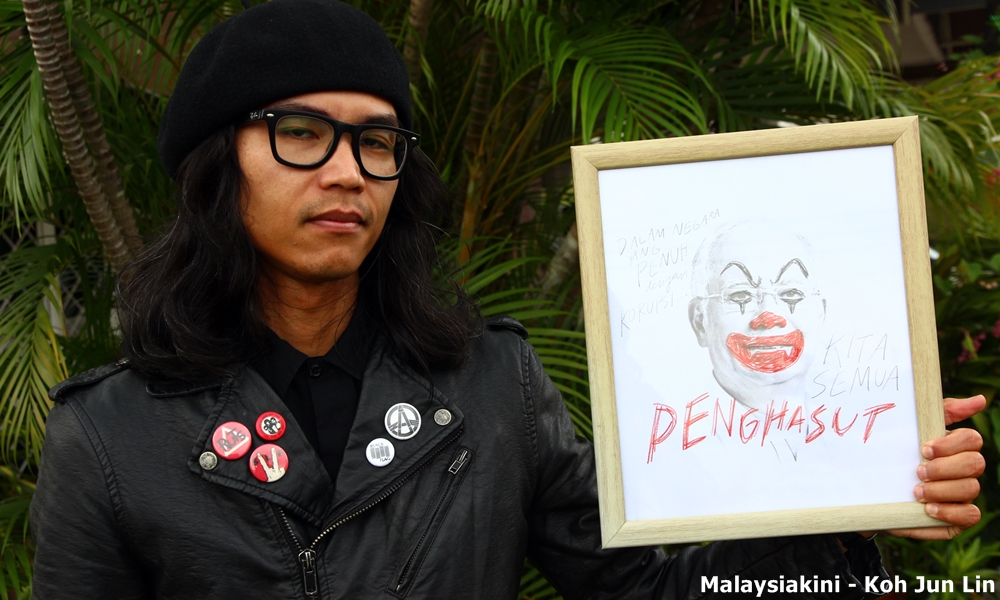
For Malaysia, civil disobedience has never been more urgent. Young artist Fahmi Reza has shown the power to unite it possesses. An artist displaying disobedience through arts. Even when the government stands tall in its towers of repression, civil disobedience unites people. Civil disobedience sparks critical questions in curious minds especially of the youngest Malaysians.
We saw how BersihI united hundreds of thousands of Malaysians to protest for a clean and fair election. It shows them that they ought not just obey and fall in line but they can and should demonstrate their desires for a better Malaysia through activism of the highest order.
Civil disobedience reaches out to the very top and does at least two things. It strikes fear at the very heart of repressive structures. And it prompts many conscientious politicians to reconsider their stance and stand up. We have seen a rising stream of politicians standing up against and speaking up about the failures of the government.
Civil disobedience however creates a precarious situation, whereby all agents for change must unite and cannot afford to remain atomised in cradles of safety or privilege. All the sacrifices certainly aim to transform the most fundamental processes and hold the worst offenders accountable. However, even upon a failure to reach such goals, civil disobedience succeeds in revealing the truth and uniting people behind it.
Civil disobedience is not undemocratic, it’s indeed part and parcel of a functioning democracy. A democracy which isn’t only dependent on a once every five-year election, but a vibrant democracy which breathes through every patriotic Malaysian, every day, every second.
SYED SADDIQ SYED ABDUL RAHMAN is a part-time lecturer at Universiti Islam Antarabangsa (UIA) Malaysia and is Asia’s best debater, winning the United Asia Debate Championship in May 2015.


Are you sure you want to delete this comment?
This action cannot be undone.