
Fear is a deadly tool in quashing dissent. It if is not addressed well, it will spiral into the creation of institutionalised fear which quashes dissent for generations to come. The failure to act at the beginning will be costly for the future.

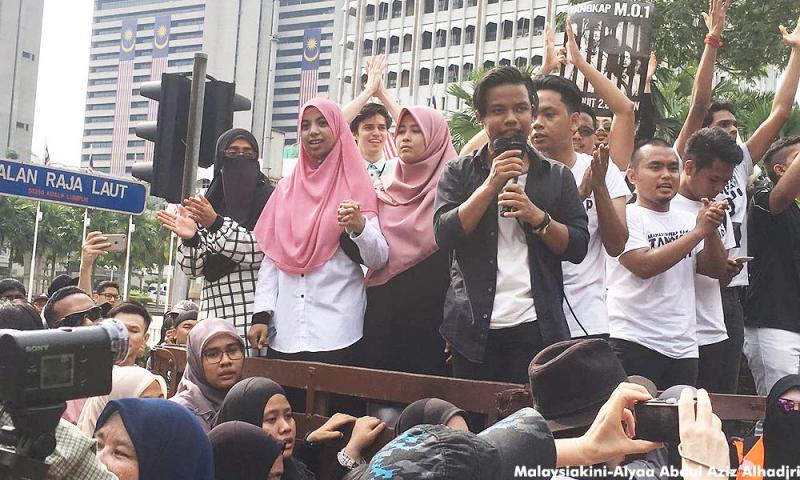
It’s unsurprising that the government took up the very same tactic to quell the Tangkap MO1 protest. Prior to the protest, public university students were threatened with disciplinary action if they were to partake in the protest. Flyers were distributed in UKM and the notice went viral on Social Media. Three of the activists were detained for three days for merely trying to create awareness in universities via peaceful means.

Post- rally, the organisers were hauled in by the police for questioning. The minister in charge of Mara threatened scholars who joined the peaceful protest. This tactic has been used times after times again to quell dissent. We saw it during BERSIH and during the uncalled for dismissal of the two Universiti Islam Antarabangsa (UIA) Malaysia student leaders for hosting a debate on the Goods and Services Tax (GST).

The fear generated from the threats alone is destructive for Malaysian democracy. It nurtures a society which acts and omits based on fear, not principled values which are the bedrock of a democracy. Albert Einstein once said, “Peace cannot be kept by force; it can only be achieved by understanding.” The way forward for Malaysia is not through force, but by having intellectual debates and discourse on important issues. Democracy cannot be contained by fear forever.

How do we then challenge the ‘culture of Fear’?

Firstly, NEVER stand alone.

It’s much easier for the authorities to take action upon one or a few individuals, but once you amass the number, it becomes unfeasible for action to be taken against the many. During all the Bersih rallies, there were thousands of participating students. I was one of them. If action was taken against me, universities must also take action against the thousands who attended the rally. This becomes impractical, ergo the absence of disciplinary actions.

When the United States was still segregated by the colour of a person’s skin, riding in buses not meant for ‘the whites’ was a criminal offence. ‘Freedom riders’ (those who actively challenged the law) were successful in combatting this law when they amassed support till a point that almost all the exclusively white busses had a protester in it. This made the law redundant which eventually led President John F Keneddy to issue a desegregation order.

Secondly, NEVER let your allies stand alone.

When action is taken against those who champion for your rights and liberties, never let them stand alone. If action is taken and no subsequent retaliation is carried out, this creates a bad precedent for the future. A precedent which tells the authorities that their oppressive action will not be met with an equally strong resistant. A precedent which tells other activists that I will be left alone if I am caught, thus disincentivising others from speaking up.

Piercing the wall of fear as a collective

Our failure to stand with those who fight for us today means that our future will be imprisoned by fear. Little by little fear will make its way into our democratic system. This incubates a collective action problem where ‘Activist A’ will not speak up under the presumption that others won’t do the same as well, thus leaving him alone. We must pierce through the wall of fear together as a collective.

In 1955, Rosa Parks was arrested for refusing to give up her seat which contravened with American Segregationist laws. Her arrest led to the Montgomery bus boycott which lasted for 385 days and was so effective that it permanently changed the segregationsist laws in the country.

Her courage wasn’t put to waste. Instead, it morphed into a nationwide movement which brought concrete outcomes. We should be seeing more of these in Malaysia when our freedom fighters are taken down by the authorities.

If Anis Syafiqah Mohd Yusof and her team are punished, we should not remain silent. We should not let them stand alone. If we do, we are effectively murdering our future by letting fear win. Today it’s them, tomorrow, it will be us.

Stand with them, or run the risk of standing alone in the future.


SYED SADDIQ SYED ABDUL RAHMAN is a part-time lecturer at Universiti Islam Antarabangsa (UIA) Malaysia and is Asia’s best debater, winning the United Asia Debate Championship in May 2015.