


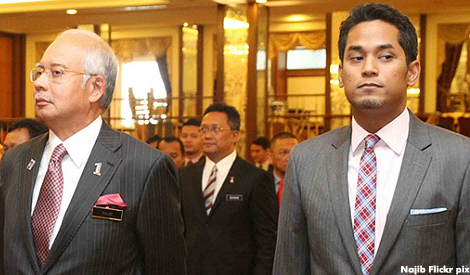

For the talented young of Umno to rise...
It’s uncontroversial to inject the notion that Umno today is not the same as the Umno we once knew in the past. Prior to Malaysia’s independence, it was the brave and courageous leaders of Umno who stood up against the British despite the rulers’ initial consent to support the establishment of the Malayan Union.
It was Onn Jaafar and his delegation who dissuaded the rulers and went on the streets with thousands of supporters to protest against the assault upon Malaysia’s sovereignty done by the British Empire.
Today, Umno has lost the moral courage to act for the interest of the people. They’re more comfortable to insulate themselves from criticisms by erecting undemocratic walls at the expense of democracy. They’ve either shut their mouth or actively support the alleged blatant corruption perpetuated by 1MDB under the control of their party’s president, Najib Abdul Razak.
It’s uncontroversial to inject the notion that Umno today is not the same as the Umno we once knew in the past. Prior to Malaysia’s independence, it was the brave and courageous leaders of Umno who stood up against the British despite the rulers’ initial consent to support the establishment of the Malayan Union.
It was Onn Jaafar and his delegation who dissuaded the rulers and went on the streets with thousands of supporters to protest against the assault upon Malaysia’s sovereignty done by the British Empire.
Today, Umno has lost the moral courage to act for the interest of the people. They’re more comfortable to insulate themselves from criticisms by erecting undemocratic walls at the expense of democracy. They’ve either shut their mouth or actively support the alleged blatant corruption perpetuated by 1MDB under the control of their party’s president, Najib Abdul Razak.
Channels of democracy like Sarawak Report and The Edge have taken a beating. The Malaysian Anti-Corruption Commission (MACC) and the Special Branch have been shaken up by arbitrary transfers and ‘retirements’ allegedly in the name of protecting Najib. The former attorney-general was miraculously and forcefully retired in the midst of an ongoing investigation. Vocal leaders of the party were sacked and loyalists promoted.
This is just the tip of the iceberg, but it signals the regressive path on which Umno is taking Malaysia. In the past, Umno challenged the British. They played a pivotal role in securing independence. They navigated Malaysia out of the 1969 riots. They buttressed Malaysia’s economic position despite the crushing 97-98’ economic crisis. Today, they shy away from even speaking up against what is purportedly the largest money-laundering case in the world.
This begs the question, where are the young and talented members of Umno?
In the past, Najib was selected to be an MP at the age of 23. He became a minister at the age of 25 and a chief minister at 29 years old. Rais Yatim, a senior member of Umno, first became a minister at the age of 34 and a chief minister at 36 years old. Anwar Ibrahim was a minister by the age of 36 and entrusted to become the education minister by the age of 39.
These youth-friendly appointments were not an anomaly in the past. On average, an Umno MP would be around the age of 35-45. There will be a handful of ministers who will be below 40 years old. Today, the situation is wildly different. On average, Umno MPs would be around the age of 50-60 years old. The fact that the youngest minister under Umno is YB Khairy Jamaluddin who turned 40 recently is indicative of the youth-attrition which plagues Umno today.
In Umno’s supreme council, there are no members who can be considered a youth under the new youth age guideline set by Malaysia’s Youth Ministry. This is vastly different than the past (1980s) where on average there will be at least three young members on board. I wouldn’t even want to start with how freakishly old the Umno warlords (the divisional chiefs) are.
This trend is caused by the complacency shown by the Umno elites. People like Najib, Rais and Tengku Razaleigh Hamzah are all beneficiaries of a youth-friendly Umno in the past. Unfortunately, when they’re in power, they forget about the youth-friendly structure which got them into power. The least they can do is to abdicate their divisional party post or their posts on the board of respective companies and universities.
There is no rejuvenation plan as the vast majority of these members are hungry for power and cash. In 2006, The Umno president announced a RM600 million bonanza to Umno divisions at the general assembly pre-council meeting. Last August, Najib proudly said, “Before it was RM1 million, now it is RM5 million but next year there will be more. I will make an announcement about what we can do.”
BN now has 134 MPs, which means that their current annual allocation costs taxpayers RM670 million.
When each MP receives an allocation of more than RM5 million annually, it’s telling why they’re hesitant to let go of power. This is excluding the money which each divisional head will get. Imagine an MP who’s also a divisional head. That lucky man/lady will be instantly rich. This drives the Umno members to cling on to power, thus blocking the path for the young to come in.
We’ve heard numerous reports where the party registration forms for young applicants had been lost after they were handed in. It is simple, when you’re young, energetic, popular and well-educated, you automatically become a threat to the party leaders. The Umno divisional leader will fear that this ‘random chap’ will replace him/her as the candidate in that area. This fear ferments the destructive youth-attrition which is murdering the party.
Losing will be the solution
What’s the solution to revive the youth in Umno?
Losing! Falling once will compel Umno to recalibrate its archaic power structures. Today they’re complacent, thus empowered to be selfish. A party which never falls is a party which is bound to drag the country down due the complacency. “The old power structures have kept us in power this long, so why recalibrate in favour of the young?” some oldies will argue.
When Umno falls, leaders who are magnetised by wealth and power will be forced to leave. Their infinite resource-bank would be depleted thus money becomes an even more scarce resource. The ones who lose will also be shown the exit door while a new rejuvenated leadership takes over.
We saw this happening in Japan under the Liberal Democratic Party’s (LDP) administration. After governing the country for more than 50 years, LDP lost the 2009 election to the Democrats (DPJ). Prior to LDP’s exit, the party was embroiled in a myriad of scandals. When LDP fell, they recalibrated and became more contemporary-friendly. Despite the fact that their main leader was retained, the party tactics and structures were overhauled.
Umno must go through this process to steer back on the right path.
YB Khairy’s dream of becoming the prime minister will be slim if this power structure is intact. Leaders like Shahril Hamdan who has a good academic and corporate background (exco pemuda) will forever be relegated due to his age and immaturity in politics. In the end, the young and talented are forced to conform or sit silently, either way, they’re zombified. When the youth are zombified, the future looks bleak.
SYED SADDIQ SYED ABDUL RAHMAN is a part-time lecturer at Universiti Islam Antarabangsa (UIA) Malaysia and is Asia’s best debater, winning the United Asia Debate Championship in May 2015.


