


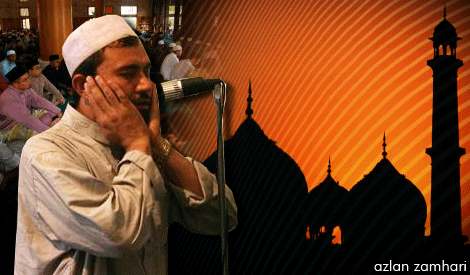

The way forward for political Islam
There has never been any doubt about political aspirations of Islam. As a worldview that seeks to codify a complete way of life, politics become an imminent consideration. However, moderate Muslims and strict interpretations have always differed as to the scope and preferred tools to that end.
Democracy has been embraced by the world and its rise remains a fact. Islam has joined the cause and there has been a rise of democratic parties propagating Islamic values. These parties continue to face criticism from the Shariah establishment. On the other hand, they have often been put under the radar for their violations of democracy and human rights.
Malaysia remains a God-fearing country with strong party establishments propagating Islamic values while maintaining its status as a constitutional democracy. It is also a very interesting case study of how political Islam can look like.
Islam and democracy - discussion on compatibility
Scholars are divided into two wide views on the issue of democracy and Islam. One group of scholars believe that democracy is akin to a religion and therefore not compatible with Islam. While another group of scholars believe that Islam has no opposition to democracy as long as the spirit of Islam is not violated.
Common attributes
Islam offers concepts such as shura (consultation), ba’ya ( allegiance), ijma (consensus), ijtihad (the exercise of discretion), maslaha (public interest), al-ta’addudiyyah (diversity), al-mas’uliyyah (public accountability and shafafiyah (transparency) (Hadad, 1995) and all these principles prove that Islam is equipped with norms and fundamentals which are compatible with the objective of democracy and good governance.
Popular frameworks
Three popular concepts outline the dominant philosophies behind political Islam. The concept of theo-democracy and popular vice regency was introduced by Maulana Al-Maududi. The concept of Faraghaat was coined by Rashid Ghannounchi, while the concept of ‘Islam as a semi-democratic religion’ was poised by Niaz Faizi Kabuli.
Theo-democracy and popular vice-regency
Abul A’la Al-Maududi (1903-1979) founded Jamaat-e-Islami, one of the most popular Islamist movements spanning across the Indian sub continent. He believed that democracy must be in compliance with Islamic norms as sanctioned by Allah in the Quran and in accordance to the teaching of the Prophet.
The concept of theo-democracy is his brainchild whereby he defined democracy as an institution that can be founded within shariah. (Israr,1998). Al-Maududi therefore believed that the concept of democracy should only be accepted on condition that it is in harmony with the syariah and in compliance with Islamic norms.
He was a proponent of the concept of sovereignty of Allah, the Almighty God whereby Allah must be the prime source of jurisprudence. He also propagated the concept of collective leadership. This was revolutionary because it argued that the responsibility for leadership does not belong to a special group or class of people.
Rather, leadership must be exercised collectively and it must accommodate the participation from the various stakeholders of the state affairs. He uses a piece of evidence used by many scholars to justify democracy.
Before the death of Prophet Muhammad saw, no particular person among his companions were named by him to be the successor to his leadership position in the event of his demise. After his death the Muslim community had to elect among themselves a leader, giving a space for everyone in the community to nominate the most able and credible.
Such a practice has given legitimacy to the concept of collective leadership responsibility where the role of providing leadership is not any longer the exclusive rights of certain individual or inherited by a particular class or group of people (Israr, 1998).
There has never been any doubt about political aspirations of Islam. As a worldview that seeks to codify a complete way of life, politics become an imminent consideration. However, moderate Muslims and strict interpretations have always differed as to the scope and preferred tools to that end.
Democracy has been embraced by the world and its rise remains a fact. Islam has joined the cause and there has been a rise of democratic parties propagating Islamic values. These parties continue to face criticism from the Shariah establishment. On the other hand, they have often been put under the radar for their violations of democracy and human rights.
Malaysia remains a God-fearing country with strong party establishments propagating Islamic values while maintaining its status as a constitutional democracy. It is also a very interesting case study of how political Islam can look like.
Islam and democracy - discussion on compatibility
Scholars are divided into two wide views on the issue of democracy and Islam. One group of scholars believe that democracy is akin to a religion and therefore not compatible with Islam. While another group of scholars believe that Islam has no opposition to democracy as long as the spirit of Islam is not violated.
Common attributes
Islam offers concepts such as shura (consultation), ba’ya ( allegiance), ijma (consensus), ijtihad (the exercise of discretion), maslaha (public interest), al-ta’addudiyyah (diversity), al-mas’uliyyah (public accountability and shafafiyah (transparency) (Hadad, 1995) and all these principles prove that Islam is equipped with norms and fundamentals which are compatible with the objective of democracy and good governance.
Popular frameworks
Three popular concepts outline the dominant philosophies behind political Islam. The concept of theo-democracy and popular vice regency was introduced by Maulana Al-Maududi. The concept of Faraghaat was coined by Rashid Ghannounchi, while the concept of ‘Islam as a semi-democratic religion’ was poised by Niaz Faizi Kabuli.
Theo-democracy and popular vice-regency
Abul A’la Al-Maududi (1903-1979) founded Jamaat-e-Islami, one of the most popular Islamist movements spanning across the Indian sub continent. He believed that democracy must be in compliance with Islamic norms as sanctioned by Allah in the Quran and in accordance to the teaching of the Prophet.
The concept of theo-democracy is his brainchild whereby he defined democracy as an institution that can be founded within shariah. (Israr,1998). Al-Maududi therefore believed that the concept of democracy should only be accepted on condition that it is in harmony with the syariah and in compliance with Islamic norms.
He was a proponent of the concept of sovereignty of Allah, the Almighty God whereby Allah must be the prime source of jurisprudence. He also propagated the concept of collective leadership. This was revolutionary because it argued that the responsibility for leadership does not belong to a special group or class of people.
Rather, leadership must be exercised collectively and it must accommodate the participation from the various stakeholders of the state affairs. He uses a piece of evidence used by many scholars to justify democracy.
Before the death of Prophet Muhammad saw, no particular person among his companions were named by him to be the successor to his leadership position in the event of his demise. After his death the Muslim community had to elect among themselves a leader, giving a space for everyone in the community to nominate the most able and credible.
Such a practice has given legitimacy to the concept of collective leadership responsibility where the role of providing leadership is not any longer the exclusive rights of certain individual or inherited by a particular class or group of people (Israr, 1998).
Faraghaat or self-government
Another Muslim scholar known for his significant contribution to the understanding of Islam and democracy is Rashid Ghannounchi. Ghannounchi’s works on Islam and democracy differs from Al-Maududi because Ghannounchi has taken a more positive position in reconciling Islam and democracy.
He propagated the idea of freedom and space. Also known as Faraghaat; his idea is a reflection on the Prophets Muhammad's decision to not name a successor among companions. That meant the position of leadership was to be decided by the Muslim community at that time (Azzam, 2001).
Ghannounchi argued that such an example is sufficient to justify that Islam provides the freedom to the Muslim community to determine their own affairs, especially when matters of leadership and the state administration is considered. He concludes that the Prophet had given Muslims an opportunity, space and freedom to decide matters of leadership on their own.
The concept of Faraghaat is similar to the concept of Ijtihad in Islamic jurisprudence. Ijtihad is the process of making a legal decision through independent interpretation of the legal sources which are Quran and Sunnah. It is done when a clear ruling is unavailable within primary legal sources.
That means two things. First, Faraghaat’s application is limited to issues related to the state and conflict resolutions; also known as siyasi. The applications must also not oppose the Islamic principles found in the Quran and the Sunnah.
Second, in matters of adini, muslims are required to follow the principles stipulated in the Quran. These are things such as aqidah, the fundamental belief system of Islam, ibadah, the rituals and akhlak, which is morality. Ijtihad does not apply to those aspects.
What matters however is that in questions of state and administration muslims are indeed supposed to interpret and innovate. Faraghaat, as laid out by Ghannounchi, is a mandate for change.
Islam as a semi-democratic religion
The freedom provided by Islam in matters of siyasi and its compatibility with Ijtihad have found the support in Niaz Faizi Kabuli, another progressive Muslim thinker, through his thesis that Islam could be regarded as a ‘semi-democratic religion’ (Niaz, 1994). Niaz put forward the contention that Islam should regarded as ‘semi-democratic’ because there are a mixture of autocratic and democratic elements in its practices.
Autocratic elements refer to things such as mandatory obligation by the Muslims to obey all the sanctions provided by al-Quran and As Sunnah especially in matters of ‘adini’. This strict observance of religious rituals and sanctions are viewed as autocratic because Muslims are not allowed to question the rationale of such obligations.
And on the other hand, there are elements of democratic practices in Islam where law making power of people is recognized when Quran does not have a ruling. Even principles of Islamic jurisprudence such as Ijtihad, Ijma (consensus of the community) and Qias (analogical reasoning) equips muslims with the responsibility to search for viable solutions to contemporary problems.
Reconciling theo-democracy, popular vice regency and Faraghaat
These concepts help shape ways to reconcile Islam and democracy. However, these concepts do suffer from incongruence in so far as complete democratic principles are considered. Theo Democracy succeeds in democratising power. However, it fails in a pluralistic community where power is categorically impeached from non-Muslims.
On the other hand, the idea of Faraghaat differs significantly from theo-democracy since it promotes self-determination. But the concept of Faraghaat or space and freedom introduced by Ghannounchi is only considered legitimate and valid in matters of siyasi and on condition that there is an absent of sanctions found in the Quran and the Sunnah. It is therefore not a doctrine of complete freedom. It restricts matter fundamental to Islamic faith to Shariah.
However, the notion of Faraghaat provides a framework and mechanism for the Muslim to determine the affairs of the state and its administration and this renders legitimacy to the claim that Islam cherish democratic values such as freedom of thought and expression. (Esposito,2001).
Political Islam in Malaysia
What differentiates radical Islamic movement and moderate Islamic movement is the interpretation they subscribe to and therefore the means they use. So radicals end up using force to achieve political goals while moderates seek public approval and use means such as democracy.
An Islamic movement which works along with democratic system should therefore be viewed and treated differently. By allowing them to participate in the democratic process, we encourage engagement and understanding. It also legitimises outright disapproval and prosecution of violent movement that claim to forward religious goals.
Malaysia has always taken the differentiated approach. Which is why its treatment towards democratic Islamic movements like Parti Islam Se-Malaysia (PAS) and radical Islamic movements like Kumpulan Militan Malaysia (KMM) and Al-Maunah has been vastly different. Radical movements have been consistently banned in Malaysia because these movements provoke terrorism and eventually threaten national and global security.
Meanwhile, PAS has been given its political freedom and has since participated in general elections.
PAS remains a strong political force with positions in state governments in Kelantan and Terengganu. PAS has faced challenges such as its leaders being held under Internal Security Act. Which essentially permits indefinite detention without trial.
Popular support towards PAS however keeps increasing. Popular support towards PAS in the general election has increased from 0.7 percent with 994,279 votes in 1999 to 15.07 percent with 1,046,968 votes in 2004 (Mohd Izani, 2005). Political freedom that PAS enjoying is far much better when compared to other Islamic political parties such as FIS in Algeria, Refah in Turkey and Hamas in Palestine or Jamaat E Islami in Bangladesh.
But it is perhaps a befitting fact considering that PAS has succeeded in fostering democratic values and upholding peace.
PAS is characterised by strong belief in democracy. Which is why since 1955 it has continuously participated in general elections. They claim that fostering democracy is consistent with their core objective of establishing a nation of Islam with Islamic laws.
Abdul Hadi Awang, the president of PAS, reasserts that PAS will always use the democratic channel to gain the people’s mandate. This includes participating in election, enforcing its members to go out and vote for PAS, and disallowing its members to turn to non-democratic or violent means.
PAS showed increasingly progressive trends since 2005 elections. In 2011, Mohamad Sabu was elected as deputy president and he was the first non-ulama to be elected such since 1983. Since then, two more non-ulama vice-presidents were elected. And approximately three-fifth of PAS’s current central committee members hold progressive views.
Unfortunately, there was a purge of moderate intellectuals in PAS due to their reluctance to support the implementation of the hudud law now. The moderates like YB Khalid Samad and Salahuddin Ayub ended up forming a new Islamic party called, Amanah (Trust).
The policy agenda of PAS’s/Amanah’s new generation of post-Islamist politicians is predominantly determined by governance issues such as corruption and public spending, electoral and law and order reform, education and health and poverty eradication.
PAS and Amanah have also made ever greater efforts to be inclusive by fielding a non-Muslim woman candidate in the 2008 election and the formation of a PAS Supporters Club that consists of more than 20,000 non-Muslim members. In 2010, the PAS Supporters Club was formally granted party wing status and upgraded in status to the PAS Supporters Congress 65.
A 2001 amendment to the party constitution has also ensured that at least one vice-president is a woman. The shift in PAS’s policy agenda away the Islamic state goal is evident by its recent promotion of the slogan ‘negara kebajikan’ (welfare/ benevolent state).
A senior PAS official, Mujahid Yusof Rawa, frankly acknowledges that the negara kebajikan slogan “reflects the political maturity of PAS in trying to adjust itself to the reality of Malaysian society. (Rahim, 2006)
Malaysia remains a good approximation of the ecosystem that assists moderate Islamic political parties and keeps radicals at bay. It suffers from institutional discrepancies like most nations do. However, the broader commitment towards supporting democracy and harmonising Islam and democracy remains strong.
This tackles the view that political Islam is a negative force in the democratic ecosystem. And it keeps radical extremists away from positions of influence by allowing Muslims to engage with democracy is a way that fits their religious mandate.
Issues surrounding political Islam
Takfirism is the act of declaring another Muslim as non-believer. It is an act extreme fringes of political Islamists have often resorted to. Muslim Brotherhood Review ( main findings) pointed out how Sayyid Qutub, the spiritual leader of the Ikhwan movement, propogated takfirism which then took root in many organisations. Terrorist outlets are characterised by widespread practice of takfirism.
It is critical that Islamic political outlets decline such practices. Firstly because it promotes a singular interpretation of Islam. Secondly because it is intolerant of divergent viewpoints. Thirdly because it acts as a precursor to circular justification of violence.
While parties like PAS have actively denounced violent methods; the Muslim Brotherhood in Egypt as pointed out by Muslim Brotherhood Review, Jamaat E Islami in Bangladesh have often been associated with violent methods. There is a possibility that parts of the leadership structure of these organisations condone such means. So Islamist parties must make an active effort to divorce themselves from violence.
The next step in integrating Islam and democracy will however be a two-way street. In that direction; democratic institutions, western institutions and progressive structures must all acknowledge their role.
The first problem that arises is the widespread misconception that regards Islamic politics as inherently violent. That disregards complex geo-political factors that plague politics in many parts of the world. It means that a lot of these parties that claim to be Islamists are only seeking the norm as they act violently.
We can look at the political culture in Bangladesh or Pakistan as examples. Despite encouraging maturity, all parties seem to often fall back on violent means to get their demands across, and Islamist parties have been implicit to the same degree. Islam has no causal relation with violent actions.
A second misconception stems from the lack of recognition regarding the diverse scope of Shariah Law. Many democratic entities are painfully ignorant of progressive strides made in Islamic ideology. They fail to recognise mass efforts at interpreting the religion in light of modern issues and categorically reject Shariah Law based on a monolithic understanding of it.
Most Muslims do not subscribe to absolutist and blind versions of Shariah. Also, shariah law spans across a wide spectrum of issues. Such as economy, education, social interaction and so on. Most of these issues are constantly debated and there is a spectrum of options available for Muslims. Shariah Law is still however painted as the thing that cuts people’s hands off. That is an unrealistic portrayal of Shariah law and misses the variations by miles.
A number of steps can be taken to improve the aforementioned problems. There is an imminent need to publicise the diversity of political Islam. It means looking at the various practitioners and allowing people greater access to true representation of their differentiated values.
A second solution is committing to long-term dialogue projects. This is important because as we see from the history of PAS in Malaysia, once Islamist political entities become interested and stakeholders in matters of state, they empathise with the principles of the state more.
A third solution is protection of divergent views regarding identity of political Islam. It may entail promoting minority views in forums, campuses and so on. It’s important because a lot of these views are progressive and hold the potential to foster understanding.
A fourth prescription would be fostering leadership among young Muslims. Young Muslims are often first to recognise a need for change. They are also more attuned to rising needs and more likely to empathise with previously ignored causes. Substantial steps to recognise and train such leaders would mean they can go back to their communities and preach transformation.
Democracy remains the cornerstone of the 21st century because it promises that everyone has a chance to be heard within its boundaries. While religion will forever remain a defining aspect of people’s lives. So one should not be told that a choice must be made between the two.
The rise of moderate Islam and political Islam that embraces democracy will mean that we change the way we look at things. We must recognise that democracy and Islam may often prescribe differentiated approaches but they seek the same end goals.
References
Azzam Tamimi, 2001: Rashid Ghannouchi. A Democrat Within Islamism. Cary, NC, USA. Oxford University Press.
Espositi L John, Voll O John, 2001: Makers of Contemporary Islam. New York. Oxford University Press.
Haddad, YY, 1995. Islamists and the Challenge of Pluralism. Washington. Georgetown University.
Lily Zubaidah Rahim, 20011. Towards a Post-Islamist Secular Democracy in the Muslim World. NSW, Australia. University of Sydney.
Mohd Izani Mohd Zain, 2007. Konsep Theo-Democracy, Popular Vice-Regency dan Faraghat dalam Wacana Islam dan Demokrasi (The Concept of Theo-Democracy, Popular Vice-Regency and Faraghaat in Islamic Discourse on Democracy). Kuala Lumpur. Penerbit Universiti Malaya.
Mohd Izani Mohd Zain, 2005. Islam dan Demokrasi: Cabaran Politik Muslim Kontemporari di Malaysia. Kuala Lumpur. Penerbit Universiti Malaya.
Niaz Faizi Kabuli, 1994. Democracy According to Islam. New York. Dorrance Publishing Co Inc.
Israr Ahmad. 1998.Constitutional and Legislative Framework of Khilafah. www.islamabad.net/framework.htm dated Jan 14, 2007.
SYED SADDIQ SYED ABDUL RAHMAN is a part-time lecturer at Universiti Islam Antarabangsa (UIA) Malaysia and is Asia’s best debater, winning the United Asia Debate Championship in May 2015.


