




Labour movement trapped in a time-warp
It should be a period of rejuvenation, for a fresh approach towards resolving old issues and improved medicine to treat recurring symptoms. It should be a time for the labour movement to re-invent itself.
But does it know how?
Veterans feel that true unionism has become the sacrificial lamb at the altar of foreign direct investment, and is at the risk of obliteration by globalisation.
They cite the fallout from ex-premier Dr Mahathir Mohamad's grip over trade unions since the 1980s, as he cleverly and gradually coerced leaders into submission; the occasional perks granted were not unlike crumbs dropped from a sumptuous banquet.
 More need to be done - and quickly - by private sector trade unions led by the Malaysian Trades Union Congress (MTUC), but talk is rife that much-anticipated changes will not see the light of day.
The criticism bears some truth. The new team has hardly made any visible changes almost six months after getting the popular vote - at this stage, there is no escaping the feeling that the movement is trapped in a time warp.
It should be a period of rejuvenation, for a fresh approach towards resolving old issues and improved medicine to treat recurring symptoms. It should be a time for the labour movement to re-invent itself.
But does it know how?
Veterans feel that true unionism has become the sacrificial lamb at the altar of foreign direct investment, and is at the risk of obliteration by globalisation.
They cite the fallout from ex-premier Dr Mahathir Mohamad's grip over trade unions since the 1980s, as he cleverly and gradually coerced leaders into submission; the occasional perks granted were not unlike crumbs dropped from a sumptuous banquet.
 More need to be done - and quickly - by private sector trade unions led by the Malaysian Trades Union Congress (MTUC), but talk is rife that much-anticipated changes will not see the light of day.
The criticism bears some truth. The new team has hardly made any visible changes almost six months after getting the popular vote - at this stage, there is no escaping the feeling that the movement is trapped in a time warp.
This is illustrated by poor IT literacy among trade unions. While the Internet is a powerful communication and networking tool, unions appear to be ignorant of its potential - only a few maintain websites and make use of e-mail.
The MTUC website could do with regular updates that includes current news, especially if the leadership is serious in developing the clout to pressure the government for reform.
Top-down approach
A lot rides on the election promises made by MTUC president Syed Shahir Syed Mohamud and his long-standing secretary-general G Rajasekaran in reviving the labour movement.
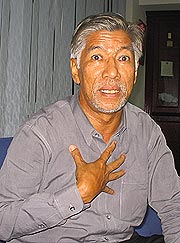 After the Labour Day gathering in Dataran Merdeka, a few disgruntled voices said the speeches by the MTUC leaders had not been "fiery" at all.
Veteran unionist K Duraiappah, however, says there is no need for fiery speeches.
"There is no need for a revolution. It's a question of approach. Fiery speeches are the trademark of political parties, and the MTUC is not a political party with no political affiliation," he said.
A lamentable situation is the top-down approach within the movement, especially given the blind and unwavering support of national policies from public sector unions under Cuepacs.
The tightening of labour laws in the early 1980s gutted the movement, leaving leaders struggling to keep pace with global changes.
The clampdown began the 1970s after a massive MAS union strike prompted Mahathir to tighten the screws. This was followed by a nationwide plantation strike in the mid-80s.
Divided leadership
Veterans can only reminisce over the movement's pre-1960s glory days when mutual respect matched industrial action such strikes, rallies and marches.
One-time Cuepacs strongman A H Ponniah said the era of "true unionism" could return if the "handful of experienced and committed leaders" carry on with the battle-cry for reform without sugar-coating protests and objections.
He said the MTUC should drop age-old demands and actively pressure the government to adopt the International Labour Organisation's (ILO) recommendations and ratify the remaining convention that would ensure the freedom of association.
The government has responded by declaring that it will not be intimidated by external pressure.
Due to the tightening of labour laws, leaders have also become less adept at dealing with the government's might and are easily divided, especially along racial lines.
This resonates deeply with the reality where leaders are bogged down with the daily chores of trade disputes to the extent that they are stuck in a slavish cycle.
One suggestion to counter this is to run a worker-specific public education campaign to reinforce the generally weak trade leadership and enable them to handle tough situations.
"The media is of no help in promoting an active trade union movement by helping to educate workers," said Ponniah, who has kept track of developments.
In 1999, the Human Resources Ministry reportedly considered engaging the ILO for an actuarial study on the New Remuneration Scheme that was supposed to have been launched soon after. The scheme never saw the light of day.
 A similar fate befell the idea for a Workers Shop - a fair-price shop for the working class - although then MTUC president Zainal Rampak had pledged to launch it later that year.
Even the ongoing leadership battle within the National Union of Bank Employees has been described as a mere diversion, which Ponniah said would have resolved itself "if not for the mess created by the registrar's meddling".
Mergers needed
In such a situation, trade-union reform will only be possible if there is a clear and open national labour policy and if the absolute legal powers of the registrar are removed.
Ponniah said trade union leaders, particularly those helming the MTUC, must be hell-bent in pressing for reform with no compromise.
"To me, a trade union is the core of any meaningful struggle. It is pointless to have weak trade unions and to still stay on as a leader," he said.
The way forward is to consolidate smaller trade unions, similar to the merging of banks, into giant entities capable of meeting global challenges.
To Ponniah, an ideal situation is where 90 percent of workers in sectors like the electrical, banking and finance, transport, hotel and teaching get into big unions, leaving the MTUC to deal with larger policy issues.
"Leaders should just follow their own vision instead of going along with the government agenda. They must break the egg first before making an omelette... that there's no story in a shell and caged unions will only be left to rot."
Former Cuepacs deputy president A Ragunathan said a reservoir of skilled and knowledgeable workforce could overcome the serious labour shortage among nurses, doctors, teachers and government departments.
The challenge lies in identifying root causes of poverty at the grassroots and attending to workers' working and living conditions, lack of basic amenities and absence of supplementary income.
"But today's trade unions lack interest in matters other than bread-and-butter issues. At the end of the day, only money matters to most workers, which is a very short-sighted approach," Ragunathan added.
Until and unless the MTUC leadership takes a more consistent and aggressive stance in pushing the government for labour reform, nothing can be achieved in the three years that the new team has to prove its mettle.
CLAUDIA THEOPHILUS is a team-member of malaysiakini.


