




Ayah Pins manual for survival
Over the last 30 years, Kampung Batu 13 has been slowly transformed from an ordinary village of rubber tappers and farmers into a close-knit community that practises its own brand of belief.
Along the way, the village has discreetly risen in prominence for two reasons.
 One is the religious philosophy espoused and taught by village head Ayah Pin, 65, who has amalgamated common features of the world's major religions into a philosophy of his own. This has attracted a following from as far as Johor, Kuala Lumpur and Singapore.
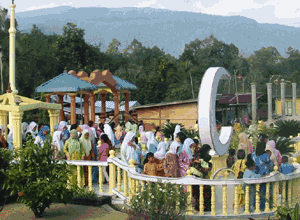
The other attraction is the larger-than-life concrete structures built in stages since 1998 featuring, among others, a teapot, vase, crescent moon and umbrella-like tower symbolising the universality of the world's religions. However, these are now slated for demolition.
Over the last 30 years, Kampung Batu 13 has been slowly transformed from an ordinary village of rubber tappers and farmers into a close-knit community that practises its own brand of belief.
Along the way, the village has discreetly risen in prominence for two reasons.
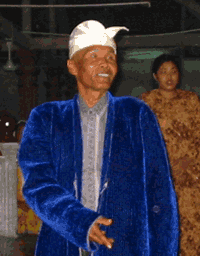 One is the religious philosophy espoused and taught by village head Ayah Pin, 65, who has amalgamated common features of the world's major religions into a philosophy of his own. This has attracted a following from as far as Johor, Kuala Lumpur and Singapore.
The other attraction is the larger-than-life concrete structures built in stages since 1998 featuring, among others, a teapot, vase, crescent moon and umbrella-like tower symbolising the universality of the world's religions. However, these are now slated for demolition.
News of the commune spread to the outside world only by word of mouth until four Kelantanese from the village, who were prosecuted for apostasy, took their appeal to court.
On July 21 last year, the Federal Court dismissed their appeal for a declaration that the four (one of whom has since died) have the absolute right and freedom to practice the religion of their choice.
Subsequent news reports have revealed more details about the commune and its way of life. From then on, it seemed like only a matter of time before the authorities would step in.
But surprisingly to Malaysians accustomed to immediate heavy-handed or knee-jerk reactions from religious enforcement authorities, nothing happened - until last month.
Shifting stance
The government has adopted a shifting stance that has made its real views difficult to fathom.
Late last year, for example, the government declared in Parliament that Ayah Pin's followers were deviationists and a threat to Muslims because their practices encouraged apostasy - they were even compared to alleged militant groups like al-Maunah and al-Arqam.
 Abdullah Md Zin, the minister in charge of Islamic affairs in the Prime Minister's Department, told parliamentarians that the internal security ministry was
finalising action
against the group.
Abdullah Md Zin, the minister in charge of Islamic affairs in the Prime Minister's Department, told parliamentarians that the internal security ministry was
finalising action
against the group.
There is no doubt that police knew about the activities at the village, since there was a regular Special Branch presence at most of Ayah Pin's routine weekend gatherings. This was confirmed last year when malaysiakini covered an inter-faith and cultural event - a police officer seen there said he had been on the case for 10 years.
Equally obvious is that local political personalities and administrative officials had knowledge of the commune. During the inter-faith event, Hulu Besut state assemblyperson Nawi Mohamad, his aides and plainclothes policemen dropped by to "look around and see for myself what I've heard so much about".
What is not as clear is why the authorities did not act earlier and have only now issued an order to Ayah Pin's first wife Che Minah Remeli, the land owner, to have the concrete-and-marble structures demolished within 30 days.
The order, issued under the National Land Code, was issued for violation of land use conditions and expired last Saturday.
Che Minah has ignored the order and is expected to be summoned within two weeks to the Besut district land office for a hearing.
The only legal consequence of this is that the land authorities will move in to demolish the structures and fine Che Minah for non-compliance.
Followers unperturbed
 Interestingly, Ayah Pin's followers appear to be unperturbed by this development. In fact, as the issue gained prominence in the press, villagers were busy preparing for yet another of their regular weekend retreats for followers. It was business as usual on the ground.
This has raised questions as to why they remain so confident that they will not get into trouble with the authorities, especially the internal security ministry. Certain official statements could shed some light.
Last week, Malay-language daily Berita Harian quoted Abdullah, who is also Besut MP, as saying that Ayah Pin's group, together with smaller groups classified as deviationist, were harmless but were being constantly monitored.
On the same day, English-language daily The Star quoted him as saying that big groups such as Ayah Pin's "have been broken up" but no details were provided.
This approach is in stark contrast with the more dramatic treatment of other deviant groups. Perhaps this is because Ayah Pin's activities have less to do with alleged militancy, while his followers are confined to a remote area and have maintained a low public profile.
Another possibility is that the group is actually closer to Umno, the dominant party in the ruling Barisan Nasional coalition, than most people realise.
Whenever Ayah Pin and his aides are in Kuala Lumpur, a visit to the Umno headquarters in Menara Dato Onn is inevitably on the itinerary.
"It is just to discuss some business," quipped an aide when asked last year about these regular visits.
"We prefer to update them on our activities personally so that they're aware of the situation on the ground."
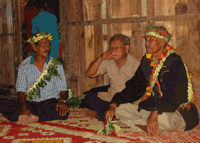 Another described the visits as an opportunity to obtain Umno's assurance that villagers will not be unduly harassed or barred from carrying on with their activities, so long as they do not go overboard.
"We maintain a good relationship with Umno and we're all supporters of the BN. As long as they know what we do and where we go, there is no problem with the authorities. We are not a threat to anyone," he repeatedly explained.
Last year, a group of Umno leaders even joined the group on a visit to an Orang Asli village in Endau-Rompin along the Pahang-Johor border. They stayed a few days to enjoy a cultural performance and to go deer-hunting, which is Ayah Pin's hobby.
Ayah Pin claims to have between 5,000 and 30,000 followers including Malay Muslims and ethnic minorities such as Indians, Chinese and Orang Asli communities in Kelantan and Johor.
When translated into number of votes, a likely reason for the government's patient and quiet treatment emerges.
In the 2004 general election, Abdullah won the Besut parliamentary constituency with a comfortable majority of 8,500 votes despite being a new candidate against PAS strongman Nasharudin Mat Isa.
 The Hulu Besut state seat was secured by Nawi by a 2,633-vote majority against Abdullah Mat Dan of PAS.
In the Endau state constituency, where there are several Orang Asli settlements, Umno incumbent Zainal Abidin Osman retained his seat with a majority of 5,290. During the campaign, he reportedly pledged to fulfil previous election promises.
The total number of votes may seem insignificant to those used to larger constituencies, but liaisons like these inevitably lead many to believe that Umno may have bartered protection to Ayah Pin and his group, in return for political loyalty.


