




Hard lessons on Malaysia's campuses
 Just when student activists felt that procedures for campus elections in Malaysia could not get more restrictive, tighter regulations were introduced during polls last week, setting off
boycotts.
As a result, 'pro-establishment' candidates swept the board, wresting control of the student representative councils in all 17 state-run universities for the first time ever.
 Just when student activists felt that procedures for campus elections in Malaysia could not get more restrictive, tighter regulations were introduced during polls last week, setting off
boycotts.
As a result, 'pro-establishment' candidates swept the board, wresting control of the student representative councils in all 17 state-run universities for the first time ever.
The rival 'pro-students' groups in five universities boycotted the elections, while many pro-establishment candidates won uncontested in 10 others. In the remaining universities, pro-students groups, fighting against the odds, were trounced.
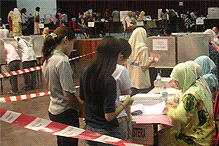 The flurry of boycotts came in the face of stifling new restrictions and alleged cases of intimidation and harassment, which student activists claimed had turned the polls into a farce.
"It has become worse compared to previous years," said Soh Sook Hwa, the administrative secretary of the liberal Malaysian Youths and Students Democratic Movement (Dema), who pointed to the "the influence of the state in trying to oppress the activism of the students".
Soh herself is no stranger to these restrictions, especially the overbearing Universities and University Colleges Act 1971, which bars political activism on campus.
Last year, Universiti Sains Malaysia (USM) hauled up Sph, then a third-year journalism student, and slapped her with a RM200 fine and a warning.
Soh's offence: showing support or sympathy for a political party at a general election campaign rally. The evidence? A newspaper photograph, during the campaign, in which she was spotted wearing an opposition party T-shirt.
Additional restrictions
The restrictions for campus elections would be almost comical if they were not oppressive.
To become a candidate, a student has to obtain the clearance of three parties: the deputy vice- chancellor for student affairs and development, the dean of the relevant faculty and the warden of the hostel where the student resides.
Candidates, usually in the second year or, in some cases third year, are also required to have a minimum grade point average (GPA) score varying from 2.5 to 3, depending on each university.
In the past, candidates for seats on the students' representative councils were allowed to address small rallies on campus under close supervision. Even so, those representing specific constituencies were only allowed to state their names, the course they were enrolled in, which year they were in and their constituencies.
This year, it is learnt that at one campus even these supervised public rallies were discontinued.
Instead, students were allowed to have their campaign speeches recorded on video, the duration allowed being three to five minutes depending on the type of seat contested. Many candidates didn't bother taking up the offer because of the boycott.
Previously, candidates could introduce themselves to students in classrooms with the permission of lecturers. But student activists at one campus said that candidates were now only allowed to meet students in the classroom either 10 minutes before class or 10 minutes after.
"It is simply not practical as there is usually no one in class (at that time)," grumbled a pro-students candidate who eventually boycotted the election.
The campaign period for elections, which are almost devoid of any serious larger issues, is way too short, "just one-and-a-half days", said one student activist.
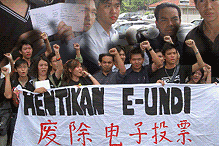 New e-voting procedures in a couple of campuses as well as some decentralisation of the voting/counting process have added to the difficulty in monitoring the polls. Others complained that serial numbers of ballot papers issued were recorded, undermining confidence in the secrecy of the ballot.
Activists also pointed to the alleged harassment of a few candidates via SMS and anonymous phone calls to a few of their families warning that candidates could face suspension from university. They also spoke of cases of alleged intimidation by campus officials.
"We heard from the candidates' seniors that the SMS messages were along the lines of 'I know what you did last summer'," said one activist.
Uptight authorities
So it was little wonder that student groups and many candidates decided to throw in the towel.
"I decided to boycott the polls because I felt the system was not fair. I had prepared my own manifesto, but I was not allowed to announce it in class. The students only get to know my name and face. So what's the point?" asked one.
Some wonder why there are all these restrictions on campus elections. It is not as if the students' representative councils themselves exercise much influence.
"They have no power to be involved in any decision-making process (on campus)," Soh said.
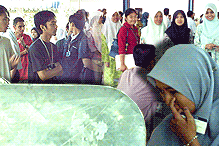 They exist as a body to be consulted by the university administration, say, when hostel fees are to be hiked.
So why are campus authorities so uptight? The answer lies probably in the fear among the establishment that opposition Malay-Muslim political parties such as PAS are making inroads into campus life.
And now, with former deputy premier Anwar Ibrahim, himself a former student activist, trying to revive an opposition political coalition, the authorities seem to be taking no chances.
Politicians from opposition party Parti Keadilan Rakyat, of which Anwas is advisor, have alleged that Umno's junior wings had held briefings with friendly students' groups to discuss strategy during the campus elections.
The tough new restrictions have disturbed many Malaysians.
"It sounds like it is getting outrageous, especially as it is happening under the watch of (Prime Minister) Abdullah Badawi, whom many had expected to be more liberal than (his predecessor) (Dr) Mahathir (Mohamad)," said a university lecturer, who declined to be identified.
"They just want to make sure they conquer all the universities." - IPS


Are you sure you want to delete this comment?
This action cannot be undone.