




Police atrocities bring out Msian dilemma
Malaysians, who are generally immune to shocking scandals, must have been flabbergasted by the latest dare-devil defiance of the police against the legitimate orders of the nation's highest authority.
On Nov 24, a video clip of female police officer ordering a naked woman - believed to be of Chinese nationality - to do 10 ear squats was shown to MPs in Parliament House. They and many ministers expressed disgust over the humiliation of the detainee.
The next day, Prime Minister Abdullah Ahmad Badawi, obviously infuriated at such abusive conduct, called such incidents "shameful" and damaging to the country's image. He ordered Deputy Inspector-General of Police Musa Hassan to carry out an immediate and thorough investigation and to take stern action against the culprits.
But on Nov 26, Musa made an earth-shattering announcement: "It is the perpetrator behind the video footage whom we are after and not the policewoman who was carrying out a routine check."
Malaysians, who are generally immune to shocking scandals, must have been flabbergasted by the latest dare-devil defiance of the police against the legitimate orders of the nation's highest authority.
On Nov 24, a video clip of female police officer ordering a naked woman - believed to be of Chinese nationality - to do 10 ear squats was shown to MPs in Parliament House. They and many ministers expressed disgust over the humiliation of the detainee.
The next day, Prime Minister Abdullah Ahmad Badawi, obviously infuriated at such abusive conduct, called such incidents "shameful" and damaging to the country's image. He ordered Deputy Inspector-General of Police Musa Hassan to carry out an immediate and thorough investigation and to take stern action against the culprits.
But on Nov 26, Musa made an earth-shattering announcement: "It is the perpetrator behind the video footage whom we are after and not the policewoman who was carrying out a routine check."
In other words, while the cabinet wants to nab the police culprits, Musa is chasing the whistle blower, having rejected the notion of police wrong-doing. And so, in one humiliating blow, Musa swept aside with contempt, not only the PM's order, but also the indignation of Deputy PM Najib Abdul Razak, ministers, parliamentarians, NGOs and the public.
Specifically, Musa said that "all detainees were required to strip and be searched before being sent to the lock- up", contradicting Najib's statement that " forcing a person to strip was not part of the procedures in police investigations, and there was no reason for a person to be embarrassed in that manner".
 With Musa's latest defence that the policewoman was carrying out a "routine check", he is in effect saying that stripping a woman naked and getting her to perform squats while holding her ears is standard police procedure. Is Musa not bestowing on Malaysia the dubious honour of being the only country in the world to adopt that practice?
Adding to the seriousness of this dramatic defiance is that this is Musa's second public disobedience of cabinet authority within two days.
On Nov 25, Musa publicly rejected unanimous cabinet advice on Nov 23 to a policeman to withdraw his defamation suit against a teenager who had reported him to the Anti-Corruption Agency (ACA). It resulted in the policeman being charged in court for corruption, but being cleared on a technicality.
The cabinet was of the opinion that the legal suit was against public interest as it would deter the public from making reports to the ACA in the future, thus frustrating the prime minister's on-going anti-corruption campaign.
However, Musa retorted that the policeman was entitled to his human right to sue and the police department would not interfere with that right.
Business as usual
This daring insubordination against civilian authority came on the heels of a series of police scandals that have enraged the nation, involving alleged extortion, corruption and abusive treatment of women from China.
 Just two weeks ago, four Chinese nationals complained of wrongful detention by police for several days during which time they claimed to be subjected to sexual harassment and theft of their money - all because they allegedly refused to pay corruption money at police road block.
They have since identified two policemen and two policewomen in an identification parade as the culprits. In spite of this, the alleged culprits are continuing their work as usual, while the police authorities are supposedly continuing with their investigations.
These incidents have made sensational headlines around the world. The Malaysian police are now perceived as habitual violators of human rights and a brute force beyond the control of the civilian authority.
While foreign countries may be surprised that a country hyped by the Western powers as a model Islamic democracy should have fallen to such a dire state of the rule of law, should Malaysians be similarly surprised?
They should not, for this is but the tip of an iceberg, and the recent allegations are relatively mild when compared to past atrocious violation of human rights, whether in the criminal or political fields.
After all, gory details of physical and mental torture of innocent people detained for political purposes have appeared in books and in the famous trials of former deputy premier Anwar Ibrahim. Police detainees have also died under unexplained circumstances.
Search for solution
Then, what is the solution? Will it help to punish all the police personnel said to be involved in the recent cases, or even to punish Musa? It could help to check the decline of discipline to some extent, but it would be only a treatment of symptoms, not the root causes.
 The real solution lies in the political leadership. Two decades of former premier Dr Mahathir Mohamad's corrupt and decadent autocracy - during which he relied increasingly on the police as henchmen to sustain his political power - has turned a disciplined and conscientious force that protects the people into a brute force that serves not the people but its political master as well as itself.
The police have also become armed with awesome arbitrary legal powers that can be used to clamp down on any political opposition at will, in addition to allowing personnel to lord it over the people.
However, making a monster out of the police force is akin to creating a double-edged sword. It can cut in both directions. While it is an effective instrument to hit the opposition, it can deliver fatal blows to the political master as well.
We now have the classic autocrat-police relationship that prevails in many tyrannical states in Africa, where each holds the other in mutual respect and mutual fear.
The autocrat depends on the police to protect his corrupt rule, while the police rely on the autocrat to provide shelter for their corrupt life. It would not be wise to rupture that happy balance, as it may lead to unpredictable consequences.
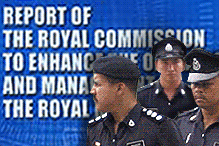 In the case of Malaysia, the autocrat may have stepped down, but the corrupt leadership remains intact. As long as the political leadership remains corrupt, it is futile to talk about cleansing the police force.
It is precisely due to this reason, that the cabinet has continued to drag its feet on implementing the recommendations of the Royal Commission on the Police. Its reforms proposed removal of the repressive powers of the police and to check abuse through an independent watchdog.
What can Malaysians do to change that status quo? That, in a nutshell, is the dilemma that faces them today.


Are you sure you want to delete this comment?
This action cannot be undone.