




For whom the axe falls
"Gripping... A veritable 'whodunit', leaving us breathless 'til the end!"
This would be an apt description for a hypothetical book written about the chain of events here in Malaysia, since the publication of racist caricatures in Denmark.
"Gripping... A veritable 'whodunit', leaving us breathless 'til the end!"
This would be an apt description for a hypothetical book written about the chain of events here in Malaysia, since the publication of racist caricatures in Denmark.
Now that the heat is off the New Straits Times , the natural question on everyone's minds is, who's next? Flailing fingers all over the place do have serious consequences for ordinary people, such as, will I get to keep my date with the honey and Casablanca on TV2 tonight, or are the mating habits of praying mantises all that's left to watch? All that finger-pointing is tiresome and at times, dangerous. We do get poked in the eyes.
In examining the cases available here, one could argue that some Kantian ethics may be applicable; that is, one should analyse their intentions. Consequences, intended or otherwise, is a different scenario altogether.
 Sarawak Tribune
and
Guangming
published them as part of its reportage. Ditto for some television stations.
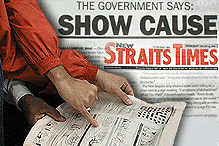
New Straits Times
published a commentary in the form of a caricature. Unlike the right-wing Danish newspaper
Jyllands-Posten
and other European print media who knew exactly why they published those caricatures, whereas one could argue it wasn't the case here.
Sarawak Tribune
and
Guangming
published them as part of its reportage. Ditto for some television stations.
New Straits Times
published a commentary in the form of a caricature. Unlike the right-wing Danish newspaper
Jyllands-Posten
and other European print media who knew exactly why they published those caricatures, whereas one could argue it wasn't the case here.
Editorial oversight is hardly justification for allowing the government and our newly promoted Tuan 'Goebbels' to peer over journalists' shoulders and wield the axe of the Printing Presses and Publications Act.
Grave injustice
Inevitably we return to the original question, what is press freedom? It's certainly not for permitting the publication of racist materials. While it has been repeated ad nauseam , let it be stated here once more for the record - rights and freedom are indivisible and interconnected - meaning, we aim for an equilibrium of free expression and respect for humankind, never at the expense of each other.
Jyllands-Posten and the other European papers, in their pursuit to vilify minority Muslims in Europe, have done a grave injustice to the cause of press freedom, and should be held accountable. But we have diverted attention away from their actions with our own little shadow boxing and sleight-of-hand ('Oooo...Look at their placards!') tricks to consolidate a decisive response to the twin trends of Eurocentrism and Islamophobia.
Press freedom is a case for zero state intervention in what appears in the media, even though there are many a times when we can only shake our heads emphatically and concur with the logic of Sturgeon's Law.
It means not threatening newspapers with revocation of their licences just because the government didn't quite like their tone. It means allowing alternative and often opposing viewpoints.
It means having the autonomy to decide on editorial policies and be solely responsible for their outcomes, including the right to print government opinions as well as to rubbish them, without our home-grown phenomenon of strange phone calls and equally queer dictates from 'up there'.
If we don't like what we see on television, or read in the newspapers, by all means, do the necessary. One can picket or protest outside their offices, burn an effigy or two, write nasty letters to the editor or organise a boycott. But don't be a cry-baby and go running to the government asking them to do something about it. In this day and age, it is unforgivable and downright humiliating to allow the state determine what we can or cannot read.
Open war
When I was in Kathmandu earlier this month, the journalists recounted their initial brush with absolute monarchic rule. One of the first few priorities of the Nepali King, apart from putting political party and NGO leaders in jail, was to control the media. Thankfully, it didn't last very long but for a few months, military personnel were stationed in newsrooms to vet through certain stories and demand the rewriting of others.
The writing on our wall can't be any clearer. The tit-for-tat soap opera, played out in this country for our eyes only and involving our newspapers and television stations (yes, who's next?), masks an increasingly open war between competing political interests and rival factions within the ruling party, while at the same time, serving as a warning to those who may fall out of line. It is not accidental that this year, the axe first fell on China Press , with another vernacular paper, which has nothing to the 'cartoon drama', still waiting for its licence to be renewed.
Let us not indulge in this any further, and be roped in to fight as proxies. We have little to boast about the state of our press freedom in the first place, so the last thing we want is to invite Internal Security Ministry officials to sit comfortably in media offices and broadcast stations, trying to be like editors.


Are you sure you want to delete this comment?
This action cannot be undone.