




Reality check on reforming the police
I read a commentary piece, where our boys in blue reportedly turned on the taps, during a closed-door meeting between the ruling coalition parliamentarians and the police over the proposed bill on the Independent Police Complaints and Misconduct Commission (IPCMC).
I almost cried too from laughter.
Perhaps many would fail to appreciate the fine show put up by the police. But for many of us who have been working on police reform for more than a decade, we have documented and seen too many cases to start dishing out tissues, group hugs and Washington apples.
It wasn't too long ago when the former (now disgraced) Inspector-General of Police, Rahim Noor, threatened human rights organizations with arrest and indefinite detention without trial when we tried to organise a gathering of victims of police brutality.
 Rahim Noor had a problem with the image of dozens of people on stage, recounting how the police sided with developers who were conducting illegal evictions, or women repeating what police officers said to them when they tried to lodge domestic violence reports, or of family members describing the bruises and welts on the cold bodies of their loved ones, who were well and alive before they were placed in police lockups.
Apparently, what we had planned 'berbau Marxis' (smells of Marxism). I didn't know many Marxists who wore Chanel no. 19. My partner was so tickled that he rang from London and asked if he could trademark the tagline and begin mass- producing t-shirts. He was convinced that fans of Nirvana would buy them in bulk, thinking there was an unreleased hit song.
However, we decided then to postpone the gathering as we were unable to guarantee those giving testimonies would not be arrested. As replacement, we held a dialogue with the police at their headquarters.
Regime change a must
What came out of it was the distinct impression that, for all the abuses of power and misdeeds committed by the police, they were well protected by the power-that-be. Ismail Che Ros, then Head of Criminal Investigation Department, gave us a long lecture peppered with sneers, and ended with this note:-
 "You don't like it, you can sue us."
Less than a year after the dialogue, they arrested the then Deputy Prime Minister, Anwar Ibrahim, and Rahim Noor used the occasion to hone in his boxing skills.
Reforming the police, without regime change, is an almost impossible task. We have had two Royal Commissions of Inquiry and an existing National Human Rights Commission (Suhakam), but how little things have changed.
In the event the IPCMC bill is passed in Parliament, if its powers are whittle to that of Suhakam, it will serve as yet another depository of complaints and grievances.
While we can throw brickbats at the police, we have in fact forgotten who is really in charge of the police.
It is not the Inspector-General of Police, but the Minister for Internal Security, who happens to be the prime minister, with two other deputy ministers to assist him.
Thus, the question of political will comes into play. Does the minister want to reform the police, or perhaps it is in the interest of the ruling coalition to tinker with nominal issues and leave the fundamentals intact?
Not a pretty picture
Hishamuddin Rais, an activist detained in the 2001 Internal Security Act (ISA) sweep, wrote the following in his affidavit:-
"During an interrogation, the Interrogating Officer stood up and pointed his hand at me (in the style as if he was holding a gun his hand) and said "Kamu hanya berdemo nanti jika PAS atau Barisan Alternatif menang, kami semua akan turun dengan senjata mengganas di jalan raya. Kami ada pengalaman dan dilatih. Tak sampai seminggu Barisan Alternatif akan bungkus". (You guys are only demonstrating if PAS or the Alternative Front wins, we'll all take to the streets with weapons. We are trained and we have experience. The Alternative Front won't last a week)"
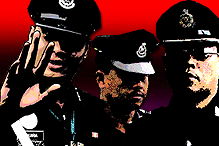 It isn't a pretty picture but it does illustrate that the relationship between the police and the ruling isn't as fractious as we imagine.
So here I am in Banda Aceh, catching up with an old friend. Rachland, a former political fugitive, now spearheads a human rights group in Jakarta. He has recently completed his task of leading the Presidential fact-finding team to investigate the murder of Munir, an extraordinary human rights advocate in Indonesia.
He is in Aceh this week to run a compulsory training session on 'cara mereformasikan polisi' (way to reform the police) at the district police headquarters.
It is hard for any Malaysian NGOs to even fathom the thought of doing something similar here, much less utter the word 'reformasi'.
So the question begs to be asked. How does one get from point A to B?
With a smile, he puts down his cup of dark coffee and quips, "Reformasi, dong!"


Report this comment
Are you sure you want to delete this comment?
This action cannot be undone.