




Whom do the police serve?
The Malaysian police force seems to be more concerned with the loss of political power by the ruling party (read Umno) than the people not getting efficient police service, in its deliberation on the proposed Independent Police Complaints and Misconduct Commission (IPCMC).
In a special bulletin posted on its official website, the police launched an all out attack against the IPCMC. Among the reasons of objection given, most of which are wild assertions unfounded on facts and logic, the police hammer on the point that perhaps strikes closest to the heart of Umno - the police claim that Umno will lose political power if IPMC is implemented.
Under the subheading 'Rationale for rejecting IPCMC', the police give nine reasons for its objection, and the third one is stated as erosion of political power by the ruling party.
The Malaysian police force seems to be more concerned with the loss of political power by the ruling party (read Umno) than the people not getting efficient police service, in its deliberation on the proposed Independent Police Complaints and Misconduct Commission (IPCMC).
In a special bulletin posted on its official website, the police launched an all out attack against the IPCMC. Among the reasons of objection given, most of which are wild assertions unfounded on facts and logic, the police hammer on the point that perhaps strikes closest to the heart of Umno - the police claim that Umno will lose political power if IPMC is implemented.
Under the subheading 'Rationale for rejecting IPCMC', the police give nine reasons for its objection, and the third one is stated as erosion of political power by the ruling party.
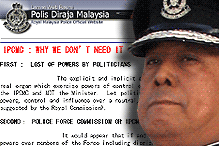 And under another subheading: 'IPCMC: why we don't need it', the police give ten reasons, and the first one warned of the minister losing power of control of the police to the IPCMC and said: Let politicians beware that they will eventually lose power, control and influence over a neutral, professional and people-centered police (as suggested by the Royal Commission).
The special bulletin also quoted the Association of Gazetted Senior Police head ACP Jamaludin Khalid as warning that the police will vote for the opposition in the next election if IPCMC is formed.
Political partisanship
Reading between the lines, what the police have said could be interpreted to
mean that if the police are truly reformed with the help of IPCMC into a neutral, professional and people-oriented force as suggested by the Royal Commission, then the ruling party will lose political power.
(In fact the police admit as much to its lack of neutrality in reason No 9 under subheading 'IPCMC: why we don t need it' when it claims that the time is not ripe for implementing the IPCMC, saying: 'If facilities are in place and the government is ready (when the police is required to be neutral and people-centric) only then IPCMC could be considered with suitable amendments to the Bill in fairness to the police.)
The crucial question we must ask is: why should the ruling party lose political power if it is clean and honourable? Shouldn't a better police force be welcome by the electorate and thus enhance instead or eroding the ruling party's popularity?
On the other hand if the ruling party is corrupt and depends on illegitimate
repression enforced through the police to stay in power, then a neutral and
corrupt-free police force would not be helpful in protecting the ruling party from the wrath of the people.
Our police is obviously hinting at the latter case.
Thus, through its desperation to ward off the IPCMC, the police have inadvertently and implicitly confirmed its well-known unconstitutional role as henchmen to protect Umno's illegitimate hold to political hegemony and have also given credence to the wide-spread skepticism over the legitimacy of postal votes cast by the police and military personnel.
And so we have a police force telling the ruling party in its face: don't crack down on us and on corruption, or we will not insulate you from losing your corrupt rule; or putting it bluntly: 'you scratch my back, I will scratch yours'.
Electoral threat
As for the police threat to vote for the opposition in the next election, it clearly implies that hitherto the police have been voting for the ruling party. But, isn't voting secret? How do the senior police officers know who the rank and file and their families have voted for?
There have been persistent complaints that our armed personnel and their familes cast their votes under the gaze of their superior officers, and these postal votes have reversed the electoral outcome at the last moment in favour of the ruling party in many a tightly fought electoral contests. In spite of repeated protests, postal voting by these armed personnel remain closed to any independent observer including those from the opposition parties. The latest electoral threat by the police only reinforces the illegitimacy of such postal voting.
 On an even more serious note, such police electoral threat is tantamount to blackmail. It is already a breach of law to coerce voting en bloc for any political party, and it is doubly serious when the police use this block voting to blackmail the political leadership into reversing a major policy decision. Such blatant defiance of civilian authority is unheard of in any democracy and would have undoubtedly resulted in severe disciplinary action being taken against the top police officer(s) involved including dismissal.
Reading over the myriad of reasons given for opposing the IPCMC, one gets the impression that the police are merely scraping bits and pieces of possible justification in the hope of hitting the jackpot of a heavyweight objection that could knock the IPCMC off its intended course. Alas, apart from the possible legitimacy of the police concern over the alleged lack of space for self-defence by the officer under investigation - a defect could be readily rectified if found to be true - none of the reasons stated could stand up to reason.
Main objection invalid
The police objection is evolved around the contention that the IPCMC has
supplanted the authority of the minister and the police chief and usurped the constitutional function of the Police Force Commission (PFC). This is fragrantly untrue. IPCMC comes into play only when there is a breach of discipline or a complaint of such breach. It does not take over any of the existing authority to appoint, promote, transfer, and discipline members of the police force as provided for under article 140 of the Constitution.
IPCMC's function to investigate and discipline errant police officers is deemed an additional measure to supplement the existing bodies carrying out such functions, which have been found badly wanting. Contrary to the police claim that IPCMC's disciplinary power is unconstitutional, the second part of Article 140 (1) of the Constitution specifically provides for such disciplinary power to be exercised by an authority other than the PFC. There is no doubt that this part of the Constitution was deliberately crafted in anticipation of the coming into being of a body like the IPCMC.
As for the police claim that there is no pressing need to introduce the IPCMC, this is contradicted by the report of the Royal Commission. The latter, which is the result of more than one year of painstaking investigations and hearings conducted all over the country, is recognized as the most authoritative finding ever on the state of the police force.
The report speaks of rampant and pervasive corruption with many examples of vast wealth amassed by police officers unhindered by any of the law enforcement agencies. And the Commission's comprehensive recommendations to thoroughly reform the police into a dedicated and service-orientated force, of which the IPCMC forms the core, have been hailed unanimously by the people of this country as effective and timely in pulling the police force from its present cesspool.
 It is noteworthy that while the police have been scouring for excuses to fend off the IPCMC, it has not denied the factual findings of the Commission on corruption and low efficiency. This is an indirect admission that the present checks and balances, both internal and external, are grossly inadequate. Surely that calls for serious reforms and the creation of a truly effective discipline master to restore some shine to our police force.
Without denying such poor state of health, the police claim of IPCMC's demoralizing impact will only invite interpretation that they feel nervous of an impending shake-up of their corrupt life style. It is an implicit admission that they are corrupt and are not prepared to change, as a morally upright police officer has no reason to fear but every reason to welcome the IPCMC as a positive influence to improve the police image.
The larger context
While focusing on police corruption, we must not loose sight of the larger
context within which this has taken place, for which the Royal Commission
has rightly said: 'Corruption in the police force is part of a larger problem of corruption in Malaysia that is recognized by both people and government alike'.
Corruption is a social disease that cannot be effectively eradicated without addressing the root causes. Corruption in the police also cannot be eliminated in isolation from the social and political environment.
Looking back over the 59 years of our existence as an independent state, one
cannot recall a lower moment than this, when the police could openly admit to mutual complicity with the ruling party to unconstitutionally perpetuate the latter's rule, while hurling threats at the political leadership to defy its major policy decision.
The older generation who has lived through the fifties and sixties under the first three prime ministers must have looked on aghast at such a fragrant display of indiscipline and low integrity. How did we come to this?
While it is outside the scope of this article to go into details, suffice to say that this is only one of the many manifestations of two decades of Mahathirism, during which racism, cronyism, corruption and abuse of the Constitution ran rampant. It is also a stark reminder to current prime minister Abdullah Badawi that his so-called reforms have not made any impact. Worse, there is every indication that corruption and indiscipline in the government have deteriorated.
Finally, a word of advice to the police. It is not the business of police to dabble in politics. The police have sworn allegiance to the country and the Constitution, not to the ruling party. It is an act of betrayal to the country to clamp down on legitimate political opposition using means that violate the letter and spirit of the Constitution.
It is also a breach of their oath of allegiance if the police should deliberately fail to act on criminal offences in particular, corruption involving leaders in the ruling party.
As for the implementation of IPCMC, while we share the police view that the
practice of corruption is not peculiar to the police force but generally
prevalent in government service, we do not agree that the police should reject such a watchdog body.
The police must realize that it is the unanimous view of the people that corruption and dereliction in the police department is most serious, as a result of which public security has plunged to a level that is testing the tolerance limit of the people.
The police should abandon the notion of victimization. Instead it should look upon such an opportunity as a challenge and an honour, to spearhead the country's much-needed reforms that will not only bring pride to the police force, but will also spread to other parts of the government.
KIM QUEK is a retired accountant.


